
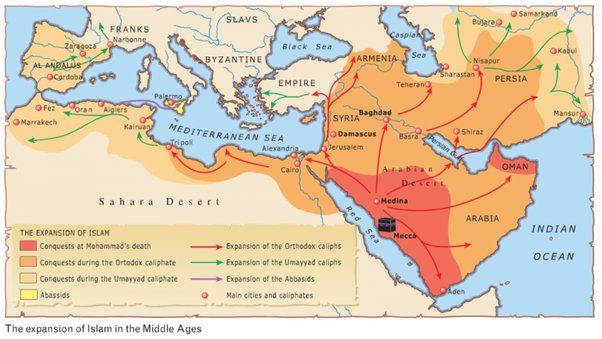
The Islam spread East
Learning goals: OG.CS.3. Understand the individual-society dynamic, through the analysis of the relationships between people, events, historical and geographical processes in space-time, in order to understand the patterns of change, permanence and continuity of different social phenomena and their consequences.
Resources:
https://docs.google.com/document/d/1WbibeAqbQ_S-1hAWSsDOH9rL1LyBh0whx-aVpj5wiJs/edit https://course.apexlearning.com/public/activity/7001001/page/2
https://www.canva.com/design/DAF4URl0glU/401mcBtY4LUri4eJBgK5Fg/edit?utm_content=DAF4URl0glU&utm_campaign=designshare&utm_medium=link2&utm_source=sharebutton https://docs.google.com/document/d/15D-DW0Vd3BQ-_9s5QNE0TYH5Tju-crkt9Yprxm5sXIY/edit?usp=sharing
Learning activities: Students will organize the events of the spreading of Islam as previews knowledge. Students will create a timeline in their notebook or cardboard, showcasing the spread of Islam to the East. Learning by doing: Students will choose of writing a short story or having a role play. Students will learn the effects of Islam in India. Art and Architecture Analysis: Students will explore the Islamic art and architecture of Eastern regions. Students will examine and compare the styles, motifs, and influences seen in mosques, palaces, and other structures in different areas where Islam spread. This activity will include creating presentations or posters showcasing the architectural diversity.
Mapping Exercise: Students will receive maps showing the expansion of Islam. Students can mark and label regions where Islam spread, identifying routes, important cities, and key trade connections. This exercise helps visualize the geographical spread and its impact on various regions.
Adaptaciones curriculares:
– VC DT
– DB DT
–
–