
Unit Progress
0% Complete
Prepositions of Time
HeyGen Introduction Video
Content
Prepositions of time help us talk about when things happen. They tell us if something happens in the morning, at a specific time, or on a specific day.
The next video will explain the basics of the prepositions of time.
As explained in the video, these are the most important prepositions of time:
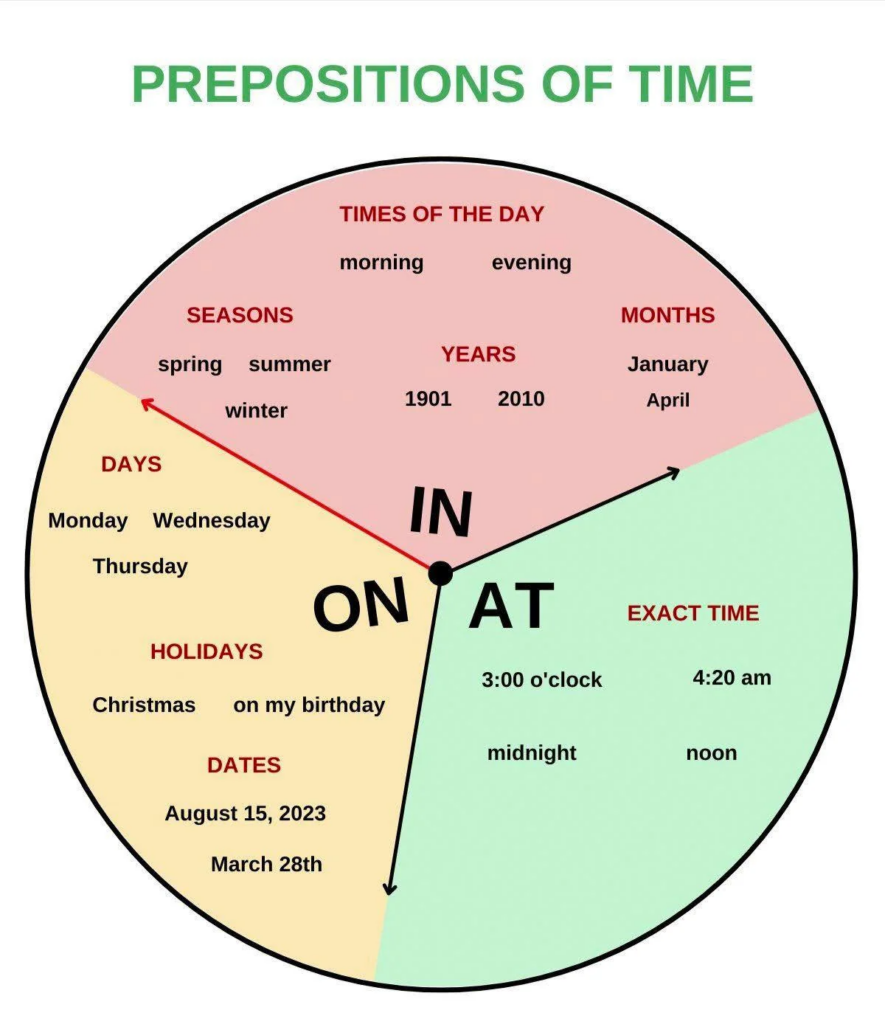
1. “In” – Used for longer periods of time, like months, seasons, years, and centuries.
- Months: “I will visit my grandmother in June.”
- Seasons: “We go on holiday in summer.”
- Years: “I was born in 2007.”
- Centuries: “Dinosaurs lived in the past century.”
2. “On” – Used for specific days and dates.
- Days: “We have English class on Monday.”
- Dates: “My birthday is on November 5th.”
- Weekdays: “I wake up early on weekdays.”
3. “At” – Used for specific times or moments.
- Time: “I wake up at 7 o’clock.”
- Specific moments: “We meet at lunch.”
- Holidays: “I visit my family at Christmas.”
This image summarizes and explains when to use each preposition of time:
Practice Zone
1. In this first activity, look at the time period being used in the sentence and choose the correct time preposition.
Click here to access the multiple-choice activity
2. For this activity, select the correct preposition of time for the sentences.