
Advanced Phrasal Verbs

Learning goals
Understand Advanced Phrasal Verbs: Learn the meanings and contexts of advanced phrasal verbs.
Differentiate Between Separable and Inseparable Phrasal Verbs: Identify and use separable and inseparable phrasal verbs correctly.
Apply Phrasal Verbs in Real Life: Use phrasal verbs accurately in speaking and writing.
Enhance Communication Skills: Improve your fluency and naturalness in English through the use of phrasal verbs.
Phrasal verbs are phrases that consist of a verb combined with one or more particles (prepositions or adverbs) that together create a meaning different from the original verb alone. These particles often change the meaning of the verb in significant ways.
Key Points
Structure
A phrasal verb is made up of a verb and a particle. The particle can be a preposition, an adverb, or both.
- Example: “Look” (verb) + “after” (particle) = “Look after” (phrasal verb meaning to take care of).
Meaning
The meaning of a phrasal verb is usually not obvious from the meanings of the individual words. It often needs to be learned as a whole.
- Example: “Give up” means to stop trying, not simply “give” + “up”.
Types
Separable: The particle can be separated from the verb, especially when using a pronoun.
- Example: “Turn off the lights” / “Turn the lights off” / “Turn them off”.
Inseparable: The particle cannot be separated from the verb.
- Example: “Look after the baby” (cannot be “Look the baby after”).
Meanings and Contexts of Advanced Phrasal Verbs
Break Down
Meaning: To stop functioning (for machines) or to become very upset.
Context: “The car broke down on the way to the airport.” / “She broke down in tears after hearing the news.”
Bring Up
Meaning: To raise a topic or to raise a child.
Context: “She brought up an interesting point during the meeting.” / “They brought up their children in the countryside.”
Carry Out
Meaning: To perform or complete a task.
Context: “The scientists carried out an experiment to test the theory.”
Come Across
Meaning: To find something by chance or to appear a certain way.
Context: “I came across an old photo album while cleaning.” / “He comes across as a very confident person.”
Figure Out
Meaning: To understand or solve something.
Context: “Can you help me figure out this math problem?”
Separable and Inseparable Advanced Phrasal Verbs
Separable Phrasal Verbs
Definition: The object can be placed between the verb and the particle.Examples:
- Bring up: “She brought up an interesting point.” / “She brought it up.”
- Figure out: “I need to figure out the answer.” / “I need to figure it out.”
Inseparable Phrasal Verbs
Definition: The object cannot be placed between the verb and the particle.Examples:
- Break down: “The car broke down.” / “She broke down in tears.”
- Come across: “I came across an old friend.” / “She comes across as kind.”
Real-World Examples and Applications
Professional Context: Using phrasal verbs in business meetings and presentations.
- Example: “Let’s carry out the plan as discussed.”
Academic Context: Incorporating phrasal verbs in academic writing and discussions.
- Example: “The researchers brought up a significant issue in their study.”
Social Context: Using phrasal verbs in everyday conversations.
- Example: “I came across a great book at the library.”
Technical Context: Describing technical issues and solutions.
- Example: “The computer broke down during the presentation.”
Emotional Context: Expressing emotions and reactions.
- Example: “He broke down after hearing the news.”
Today, we’ll explore the structure, meanings, and usage of advanced phrasal verbs. By understanding and mastering these, you’ll be able to speak and write more naturally and fluently. Here you have an exciting presentation on phrasal verbs:
Learning activities
EGB
Phrasal Verb Matching Game
Objective: Reinforce understanding of phrasal verbs and their meanings.
Instructions:
- Preparation: Create cards with phrasal verbs on one set and their meanings on another set.
- Task: In pairs, match the phrasal verbs with their correct meanings.
- Class Activity: Review the matches as a class and discuss any mistakes.
- Example: Match “bring up” with “to raise a topic.”

Phrasal Verb Story Creation
Objective: Use phrasal verbs in a creative context.
Instructions:
- Task: Write a short story that includes at least five different phrasal verbs.
- Sharing: Share your story with a partner and discuss the use of phrasal verbs.
- Class Activity: Read some stories aloud and discuss the phrasal verbs used.
- Example: “I came across an old map and decided to figure out where it led.”
BGU
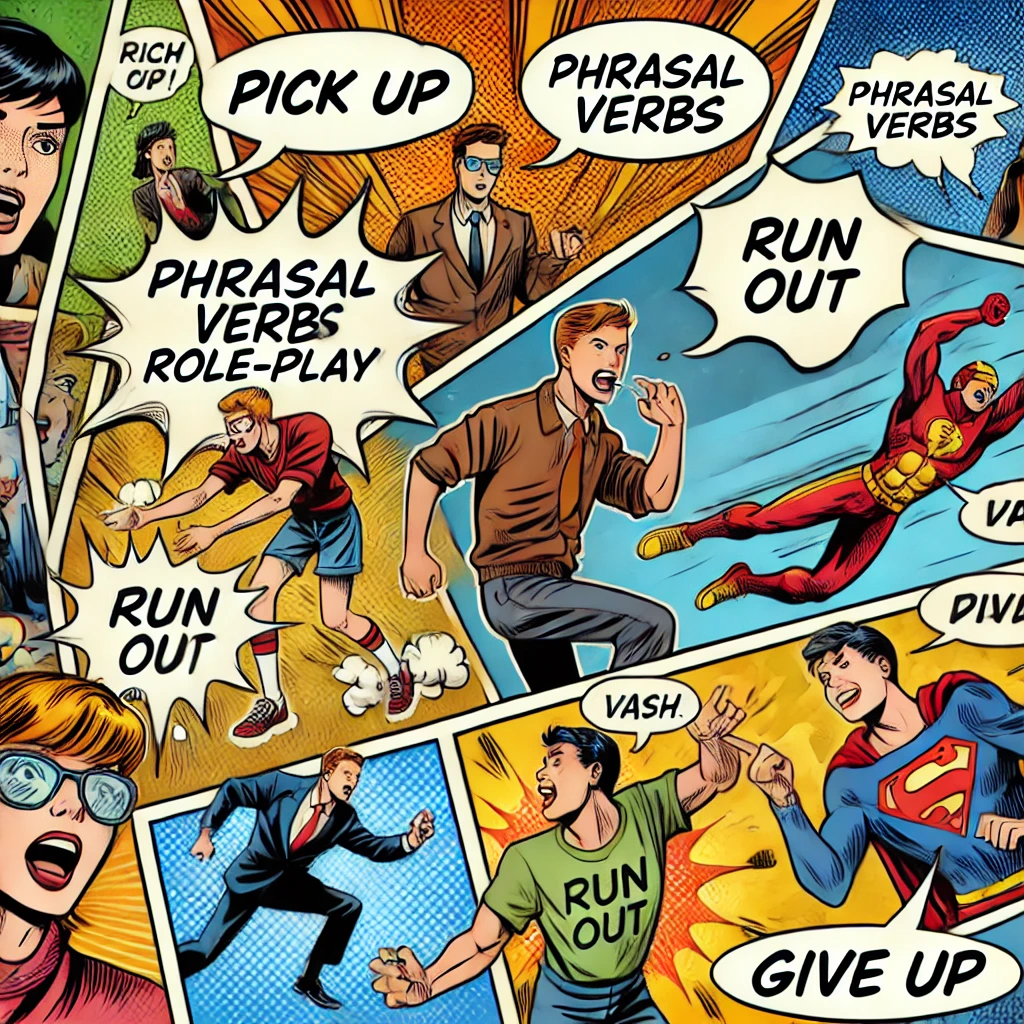
Phrasal Verb Role-Play
Objective: Practice using phrasal verbs in spoken English.
Instructions:
- Pairs: Pair up and choose a scenario (e.g., at a meeting, solving a problem, a social event).
- Task: Role-play the scenario, using at least five phrasal verbs in your dialogue.
- Class Activity: Perform the role-plays for the class and discuss the phrasal verbs used.
- Example: Role-play a business meeting where you “bring up” issues and “figure out” solutions.

Phrasal Verb Quiz Game
Objective: Test knowledge of phrasal verbs through a gamified quiz.
Instructions:
- Preparation: Create a quiz with sentences missing phrasal verbs and multiple-choice answers.
- Task: Complete the quiz individually or in small groups, selecting the correct phrasal verbs for each sentence.
- Class Activity: Review the answers together and discuss any mistakes.
- Example: “He __________ an interesting idea during the meeting.” (a) brought up (b) came across (c) broke down.