
K-LEARNING PROJECT
SKILLS
EFL 3.1.1
Interact in short conversations and exchanges using familiar vocabulary and expressions.
EFL 3.2.2
Ask and answer simple questions about familiar topics and everyday situations.
EFL 3.3.1
Identify and understand information in short texts supported by visuals and familiar language.
EFL 3.4.2
Write short, simple sentences and descriptions using basic grammatical structures.
REAL-LIFE APPLICATION
In everyday life, people need to describe places, ask for and give directions, and talk about locations in their community. This project helps students use English to navigate a city, explain where places are located, and communicate directions clearly. These are practical skills for traveling, meeting friends, helping tourists, and understanding maps.
LEARNING ACTIVITIES
SESSION 1 (80 min)
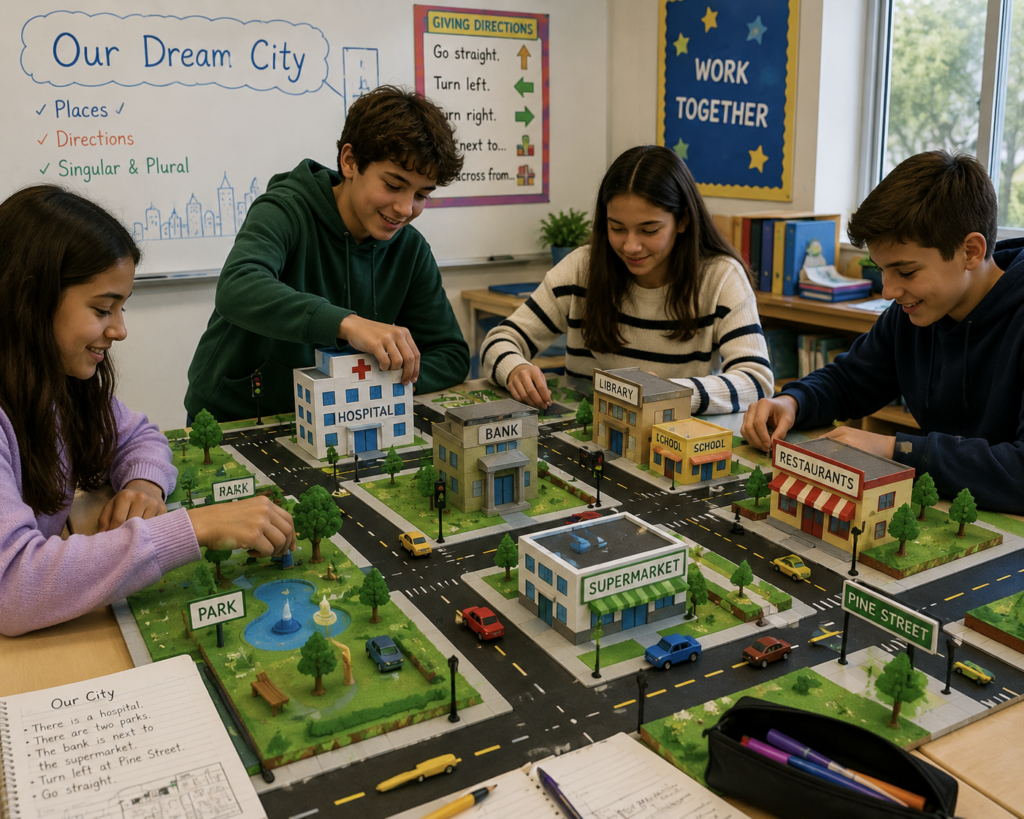
“My Dream City”
Period 1 (40 minutes)
Part 1: Planning (10 min)
Show a simple city map.
Review:
- hospital
- park
- bank
- supermarket
- school
- library
- restaurant
Review direction expressions:
- Turn left
- Turn right
- Go straight
- Next to
- Across from
- Between
Part 2: Create the City Map (25 min)
Instructions
Students work individually or in pairs.
Create a city that includes:
✓ At least 8 places in town
✓ At least 3 plural nouns
Examples:
- two parks
- three restaurants
- four stores
✓ Street names
✓ A title for the city
Example:
“Sunshine City”
Students draw and label all places in English.
Part 3: Writing Task (5 min)
Students write 5 sentences about their city.
Examples:
- There is a hospital in my city.
- There are two parks near the school.
- The bank is next to the supermarket.
- There are three restaurants on Main Street.
- The library is across from the park.
Period 2 (40 minutes)
Part 1: Direction Challenge (15 min)
Students exchange maps with another pair.
Student A asks:
“How can I get to the library?”
Student B answers:
“Go straight. Turn left at Pine Street. The library is next to the school.”
Complete 3 different routes.
Part 2: Oral Presentation (20 min)
Presentation Requirements
Students present their city for 1–2 minutes.
Must include:
✓ Name of city
✓ 5 places in town
✓ 2 plural nouns
✓ 2 direction expressions
Sample:
“Welcome to Green City. There is a hospital and a library. There are two parks and three restaurants. The library is next to the school. To get to the hospital, go straight and turn right.”
Part 3: Gallery Walk (5 min)
Students display maps around the room.
Classmates walk around and leave positive comments.
Examples:
- Nice city!
- Great directions!
- Good use of plural nouns!
Assessment Rubric (10 Points)
| Criteria | Points |
|---|---|
| Places in town vocabulary used correctly | 2 |
| Directions used correctly | 2 |
| Singular and plural nouns used correctly | 2 |
| Creativity and organization of map | 2 |
| Oral presentation and pronunciation | 2 |
Total: 10 points
NEE – Agregar el tipo de adaptaciones curriculares
Principio II: Pautas 6.1 – 6.3 – 6.4
Principio III: Pautas 7.1 – 8.1 – 9.1
ALUMNO 1: Constante monitoreo. Dar tiempo adicional para el desarrollo de la actividad y se reduce el número de ejercicios o se modifican los ejercicios con un nivel de dificultad reducido, de acuerdo con sus necesidades académicas.
ALUMNO 2: Constante monitoreo, Dar tiempo adicional para el desarrollo de la actividad y se reduce el número de ejercicios o se modifican los ejercicios con un nivel de dificultad reducido, de acuerdo con sus necesidades académicas.
ALUMNO 3: Constante monitoreo. Corroborar que el contenido entregado en clase haya sido comprendido por la estudiante mediante retroalimentación.