
K-LEARNING PROJECT
SKILLS
(EFL 3.1.1 / 3.1.6): Combine routine times with food preferences to discuss daily life.
(EFL 3.2.11 / 3.2.14): Express likes/dislikes and talk about daily habits using proper timing.
(EFL 3.4.1 / 3.4.7): Write a short daily log using sequence adverbs, time prepositions, and countable/uncountable nouns.
REAL-LIFE APPLICATION
Knowing how to describe your routine and diet is a fundamental conversational building block. In the real world, this mirrors the work of lifestyle bloggers, fitness coaches, or simply sharing your culture and lifestyle with an international pen pal or friend online.
LEARNING ACTIVITIES
SESSION 1 (80 min)
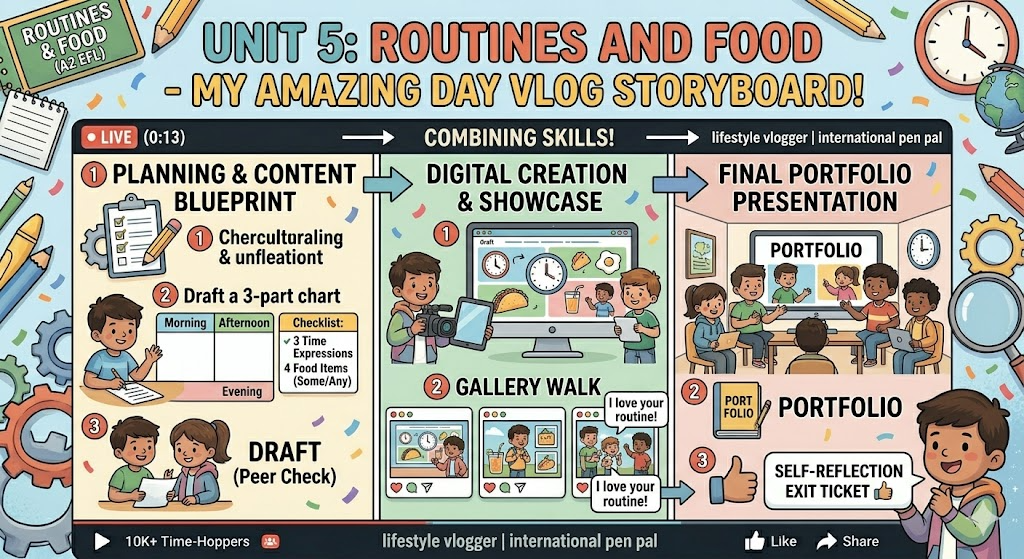
Planning & Content Blueprint (40 Mins)
1. Project Launch & Brainstorming (10 mins)
- Task: Introduce the project: “My Ideal Food & Routine Day.”
- Instructions: Students draw a simple 3-part chart on a piece of paper or a digital document labeled: Morning, Afternoon, and Evening/Night.
2. Drafting the Content (20 mins)
- Task: Students write a 6-sentence draft (2 sentences per time of day).
- Strict Requirements:
- Must use at least 3 Time Expressions (at 7:00 AM, in the afternoon, on weekends, before, after).
- Must use at least 4 Food/Drink items correctly using some or any (some eggs, some juice, any coffee).
- Example Draft:“In the morning, I wake up at 6:30 AM. For breakfast, I eat some fruit and bread. After school, I play soccer. In the evening, I have dinner with my family; we usually eat some chicken, but we don’t drink any soda.”
3. Peer Check (10 mins)
- Task: Students pair up in digital breakout rooms to check each other’s work against a checklist: Did they use time expressions? Did they use some/any correctly?
Session 2: Digital Creation & Showcase (40 Mins)
1. Digital Production (20 mins)
- Task: Students bring their draft to life using Canva, Google Slides, or Adobe Express.
- Instructions:
- Create a 3-slide visual presentation or a 1-page digital infographic.
- Add their checked text from Session 1.
- Include colorful, fun images of the food and activities (e.g., a clock, a plate of tacos, someone playing video games). Remind them to use a bright color palette like light blue, green, and pink!
2. The Interactive Gallery Walk (15 mins)
- Task: Sharing and speaking.
- Instructions:
- Students upload their final links to a shared Padlet wall or Google Classroom drive.
- Students spend 10 minutes looking at 3 classmates’ projects and must leave a digital comment in English using the target vocabulary.
- Comment Formula: “I love your routine! I also eat [Food Item] [Time Expression]!” (e.g., “I love your routine! I also eat some fruit in the morning!”).
3. Wrap-up & Self-Reflection (5 mins)
- Task: Students complete a quick 3-question exit ticket reflecting on what they learned across both units (e.g., “Name one countable food item” and “What preposition do we use with times like 7:00 AM?”).
NEE – Agregar el tipo de adaptaciones curriculares
Principio II: Pautas 6.1 – 6.3 – 6.4
Principio III: Pautas 7.1 – 8.1 – 9.1
ALUMNO 1: Constante monitoreo. Dar tiempo adicional para el desarrollo de la actividad y se reduce el número de ejercicios o se modifican los ejercicios con un nivel de dificultad reducido, de acuerdo con sus necesidades académicas.
ALUMNO 2: Constante monitoreo, Dar tiempo adicional para el desarrollo de la actividad y se reduce el número de ejercicios o se modifican los ejercicios con un nivel de dificultad reducido, de acuerdo con sus necesidades académicas.
ALUMNO 3: Constante monitoreo. Corroborar que el contenido entregado en clase haya sido comprendido por la estudiante mediante retroalimentación.