
Food and drinks
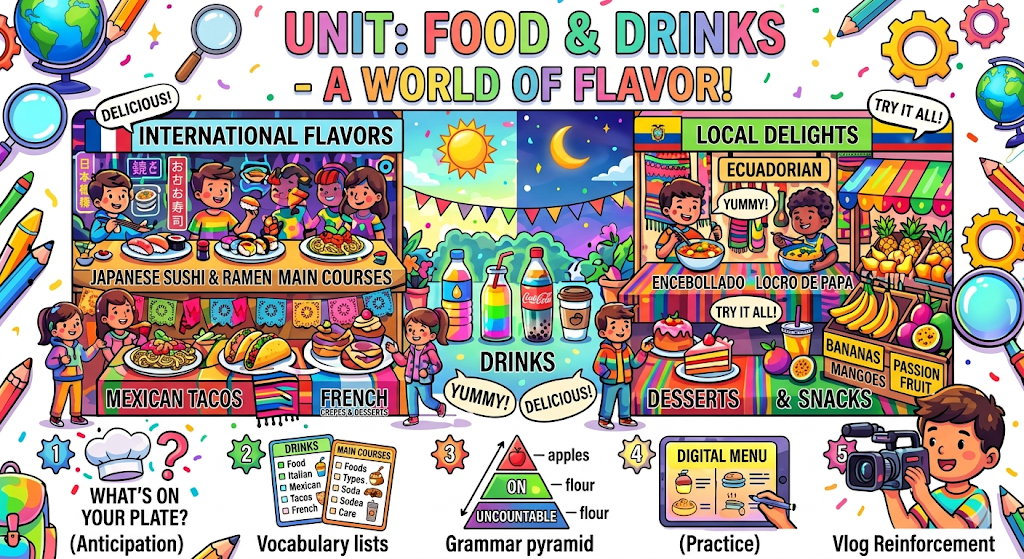
SKILLS
EFL 3.1.6 Demonstrate a basic understanding of cultural diversity by comparing local food traditions (Ecuadorian) with international ones.
EFL 3.2.11 Ask and answer questions about likes and dislikes regarding food and drinks using simple phrases.
EFL 3.3.7 Follow short, illustrated instructions or menus to understand a food ordering process.
EFL 3.4.7 Write a simple, short description of a recipe or a digital menu using count and uncount nouns.
REAL-LIFE APPLICATION
Food is the ultimate social connector. Whether they are ordering a burger on a delivery app, explaining what encebollado is to a foreigner online, or understanding a recipe on YouTube, knowing how to talk about food, quantities, and preferences gives students practical tools to navigate restaurants and kitchens globally and locally.
LEARNING ACTIVITIES
SESSION 1 (80 min) ANTICIPATION
Part 1 – ( 10-15 minutes)
Anticipation Activity:
“What’s on Your Plate?”
- Objective: Distinguish between local and international foods and spark vocabulary recall.
- Instructions:
- Display an interactive digital whiteboard collage (like Jamboard or Padlet) divided into two zones: “Local Delights 🇪🇨” and “International Flavors “.
- Give students 5 minutes to drag and drop images or write text of their favorite foods into the categories (e.g., locro de papa, tacos, sushi, pizza).
- Ask a few students: “Is it yummy or yucky?” to introduce basic preference expressions.
CONSTRUCTION
Part 2: Vocabulary Development (15 min)
The teacher explicitly introduces key vocabulary needed for the lesson, ensuring students clearly understand meaning and use. The words include:
Local Delights (encebollado, locro de papa)
International Flavors (Japanese sushi, Mexican tacos)
Healthy Snacks (bananas, passion fruit)
Refreshing Drinks (water, fruit juice, soda)
Sweet Desserts (cake, chocolate crepes)
“I would like to order…” (The golden phrase for ordering)
Part 3: Grammar Introduction using Presentation (20 min)
Grammar Introduction:
The Food Pyramid”
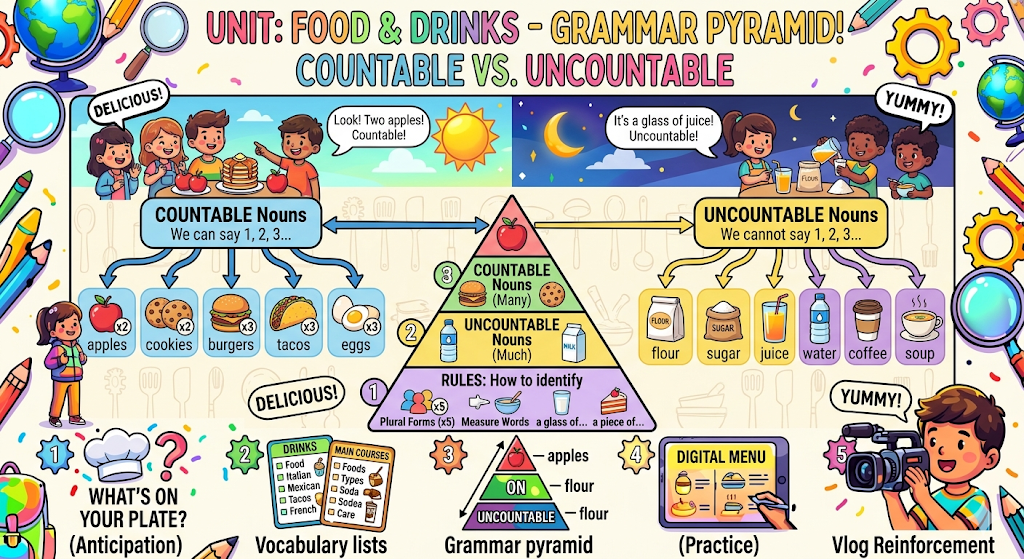
- Focus: Countable vs. Uncountable Nouns with Some and Any.
- Instructions:
- Direct Instruction (10 mins): Present a food pyramid. The bottom layer is Uncountable (things you can’t easily count individually like flour, rice, juice, soup). The top layer is Countable (things you can put an ‘s’ on like apples, bananas, tacos). Introduce rules: Use some for affirmative (“I want some apples”) and any for negatives/questions (“Is there any juice?”).
- Concept Check (10 mins): A rapid-fire game of “Count or Drop!” using a digital tool like Gimkit or Baamboozle. If a food appears (e.g., Milk), students shout or chat: “Uncountable!”
Grammar Practice Activity (25 mins)
“Design a Digital Menu”
- Activity: Designing an interactive, color-coded menu.
- Instructions:
- In pairs, students open a shared Canva template to design a one-page menu for a fictional food truck using a color palette of light blue, green, and pink.
- The menu must feature: 2 Countable items and 2 Uncountable items.
- They must write short descriptions using some or any (e.g., “Our Special Combo comes with some delicious tacos and some fresh fruit juice. We don’t have any soda!”).
SESSION 2: CONSTRUCTION – REINFORCEMENT (40 min)
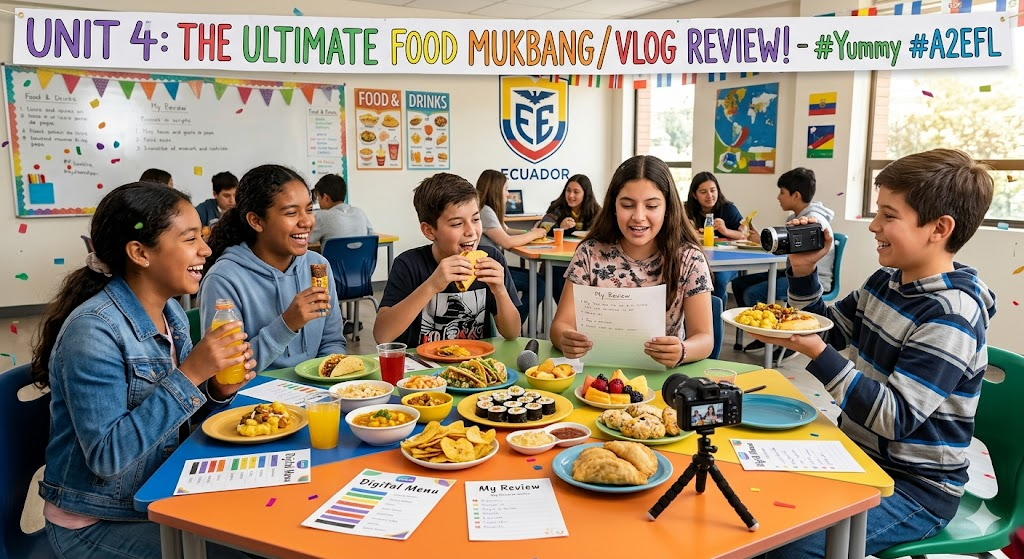
The Ultimate Food Mukbang / Vlog Review (40 mins)
- Activity: Creating a short food critic review video.
- Instructions:
- Setup (10 mins): Students act as famous food vloggers reviewing a meal they “just ate.”
- Drafting (15 mins): They write a 5-sentence script. They must use words from the vocabulary list and express a strong opinion. (“Today I am reviewing Mexican tacos. They are delicious! I also drank some passion fruit juice. I don’t like sushi, it’s yucky!”)
- Production (15 mins): Students use their devices to record a 45-second video on Flip (Flipgrid) using fun face filters, acting like enthusiastic food critics.
SESSION 3: CONSOLIDATION (80 min)
Part 1 – ( 2 x 40min)
Assessment Activity
Period 1: The Restaurant Simulator (40 mins)
- Part A (20 mins): Digital Reading Quiz (Google Forms). Students read a short comic strip of a customer ordering food in a restaurant. They answer 5 multiple-choice questions checking their understanding of the order and 5 grammar questions fixing mistakes with count/uncount nouns.
- Part B (20 mins): Writing Task. Students write an email to a foreign friend (40-50 words) inviting them to an Ecuadorian restaurant. They must describe at least two Local Delights and two Drinks they want to buy them using some and any.
Period 2: Roleplay Café (40 mins)
- Task (25 mins): Breakout room speaking challenge. In pairs, one student plays the “Waiter” and the other plays the “Hungry Customer.” Using the digital menus they created on Day 1, they must roleplay a complete conversation: greeting, ordering food/drinks, asking about ingredients (“Are there any onions in the encebollado?”), and saying goodbye.
- Wrap-up & Peer Feedback (15 mins): Pairs fill out a digital evaluation form for each other, focusing on whether they used the vocabulary phrases and correct grammar, followed by a quick teacher-led reflection.
NEE – Agregar el tipo de adaptaciones curriculares
Principio II: Pautas 6.1 – 6.3 – 6.4
Principio III: Pautas 7.1 – 8.1 – 9.1
ALUMNO 1: Constante monitoreo. Dar tiempo adicional para el desarrollo de la actividad y se reduce el número de ejercicios o se modifican los ejercicios con un nivel de dificultad reducido, de acuerdo con sus necesidades académicas.
ALUMNO 2: Constante monitoreo, Dar tiempo adicional para el desarrollo de la actividad y se reduce el número de ejercicios o se modifican los ejercicios con un nivel de dificultad reducido, de acuerdo con sus necesidades académicas.
ALUMNO 3: Constante monitoreo. Corroborar que el contenido entregado en clase haya sido comprendido por la estudiante mediante retroalimentación.