
Transport

SKILLS
EFL 3.3.1 Understand most details of the content of a short simple text when something is familiar and supported by visuals.
EFL 3.4.1 Complete simple forms and write basic information using familiar vocabulary and grammatical structures.
EFL 3.4.2 Write short simple sentences and phrases about everyday topics using basic grammar accurately.
EFL 3.1.1: Use singular and plural nouns in short oral interactions.
REAL-LIFE APPLICATION
Understanding transport systems is a life skill that fosters independence and safety. Students learn to navigate their environment, interpret transit schedules, and communicate effectively with service providers. This unit moves English from a classroom subject to a functional tool, enabling students to plan journeys, troubleshoot travel delays, and navigate both local and international transit systems with confidence.
LEARNING ACTIVITIES
SESSION 1 (80 min) ANTICIPATION
Part 1 – ( 10-15 minutes)
Anticipation Activity (10–15 minutes)
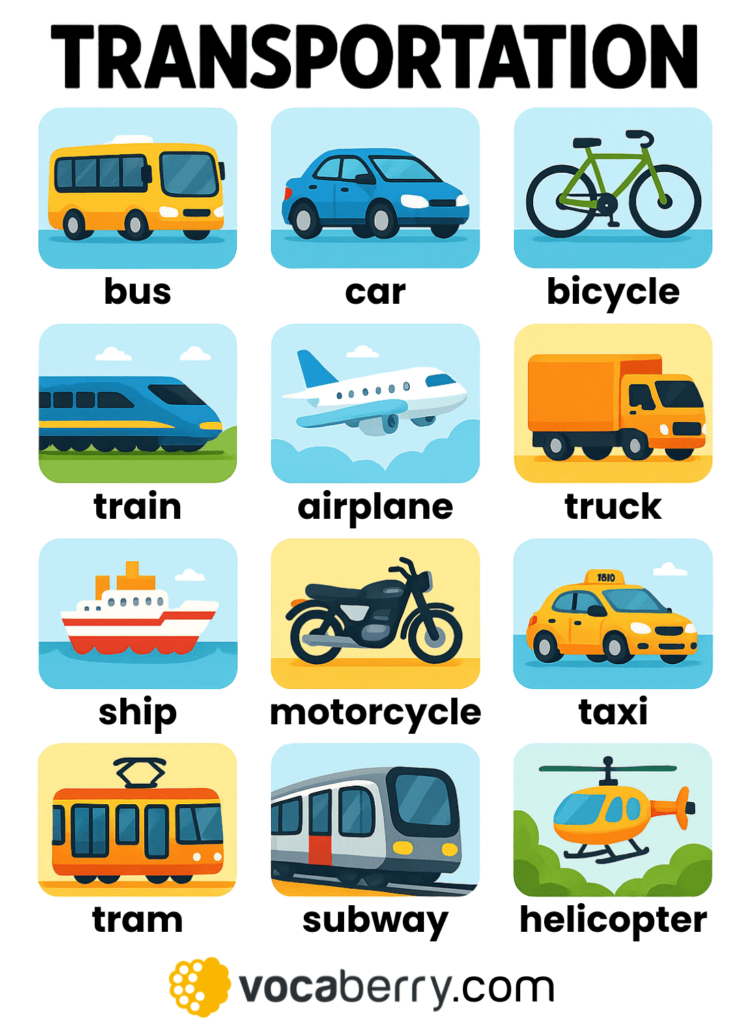
“The Travel Challenge”: Display a digital collage of different transport hubs (a bus station, a train platform, an airport, and a bicycle lane). Ask students: “How do you get to school?” and “If you could travel anywhere, what vehicle would you choose?” Use a Mentimeter poll to visualize the class results, then briefly discuss why different transport modes are used for different distances.
https://www.menti.com/alsvaz4ohceg

CONSTRUCTION
Part 2: Vocabulary Development (15 min)
The teacher explicitly introduces key vocabulary needed for the lesson, ensuring students clearly understand meaning and use. The words include:
| Vocabulary Word | Definition | Example Sentence |
| Public Transport | Vehicles like buses or trains for everyone. | We take public transport to get to the city center. |
| Fare | The price you pay for a ticket. | The bus fare is only 30 cents. |
| Schedule | A list of arrival and departure times. | You should check the schedule before leaving home. |
| Route | The way or path a vehicle follows. | This bus route takes us directly to the park. |
| Get on / off | To enter or leave a vehicle. | Get on the bus at the next stop, please. |
| Destination | The place where you are going. | The final destination of this train is Quito. |
Part 3: Grammar Introduction: Singular and Plural Nouns (20 mins)
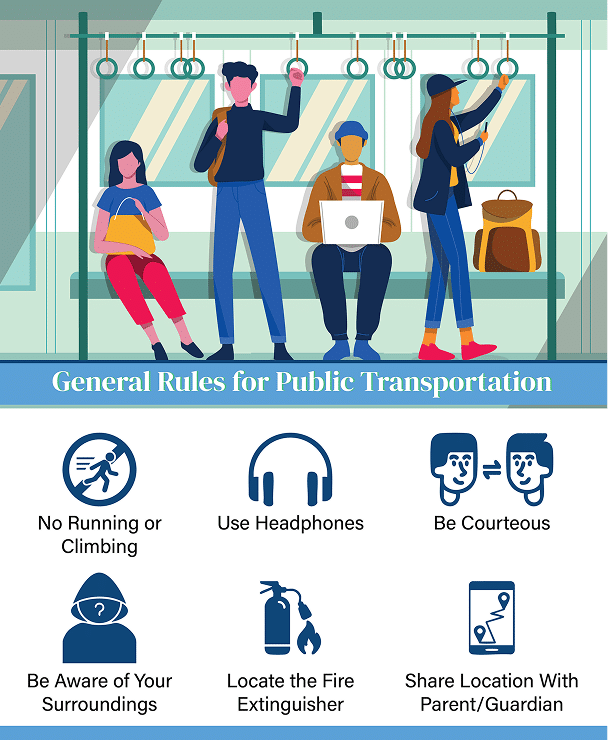
Focus: Modals of Obligation & Advice (Can/Can’t and Should/Shouldn’t). Explain that we use these for travel rules and tips.
- Rules: “You can buy a ticket here.” / “You can’t eat on the bus.”
- Advice: “You should check the schedule.” / “You shouldn’t sit in the priority seat.”
Presentation:
https://share.gemini.google/k1tR4dTG2RTB
4. Grammar Practice Activity (25 Minutes)
Activity:
“Transport Advice Forum”: Create a collaborative digital board (Padlet). Assign students to pairs. One student asks, “I am at the airport/bus station, what should I do?” The other replies using should/shouldn’t or can/can’t. (e.g., “You should arrive early. You can’t park here.”)
Padlet: https://padlet.com/fiorellanp55/my-harmonious-padlet-l01ylmovrrh39oqn
SESSION 2: CONSTRUCTION – REINFORCEMENT (40 min)

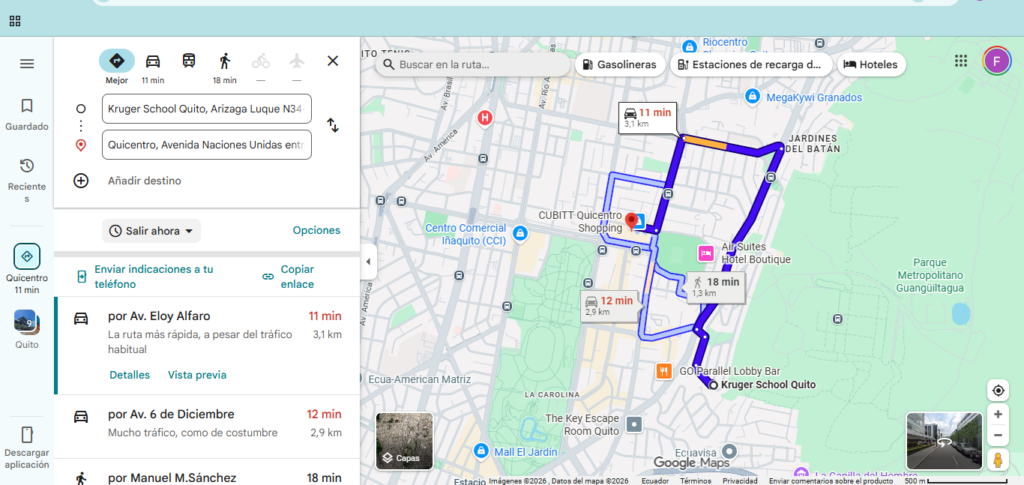
“The Route Planner Project”: Using Google Maps, students choose two famous landmarks in their city. They must map the route using public transport and write a short (50-word) guide for a tourist. They must include: 1) The best transport to take, 2) The cost (approximate fare), and 3) One piece of advice (e.g., “You should take the bus because it is fast”).
EX:
SESSION 3: CONSOLIDATION (80 min)
Part 1 – ( 2 x 40min)
Assessment Activity

Period 1 (Writing & Research): Students design a “Transport Brochure” for their city. They must use the 6 vocabulary words and correctly apply can/should to describe transit options for a specific traveler profile (e.g., a student, a tourist, an elderly person).
Period 2 (Speaking): “The Travel Agency Role-Play.” In pairs, one student is a traveler and the other is a station agent. They must perform a 2-minute dialogue solving a transport problem (e.g., finding a lost ticket, asking for a route, or checking a departure time) using the learned vocabulary and grammar.
NEE – Agregar el tipo de adaptaciones curriculares
Principio II: Pautas 6.1 – 6.3 – 6.4
Principio III: Pautas 7.1 – 8.1 – 9.1
ALUMNO 1: Constante monitoreo. Dar tiempo adicional para el desarrollo de la actividad y se reduce el número de ejercicios o se modifican los ejercicios con un nivel de dificultad reducido, de acuerdo con sus necesidades académicas.
ALUMNO 2: Constante monitoreo, Dar tiempo adicional para el desarrollo de la actividad y se reduce el número de ejercicios o se modifican los ejercicios con un nivel de dificultad reducido, de acuerdo con sus necesidades académicas.
ALUMNO 3: Constante monitoreo. Corroborar que el contenido entregado en clase haya sido comprendido por la estudiante mediante retroalimentación.