
Daily routines
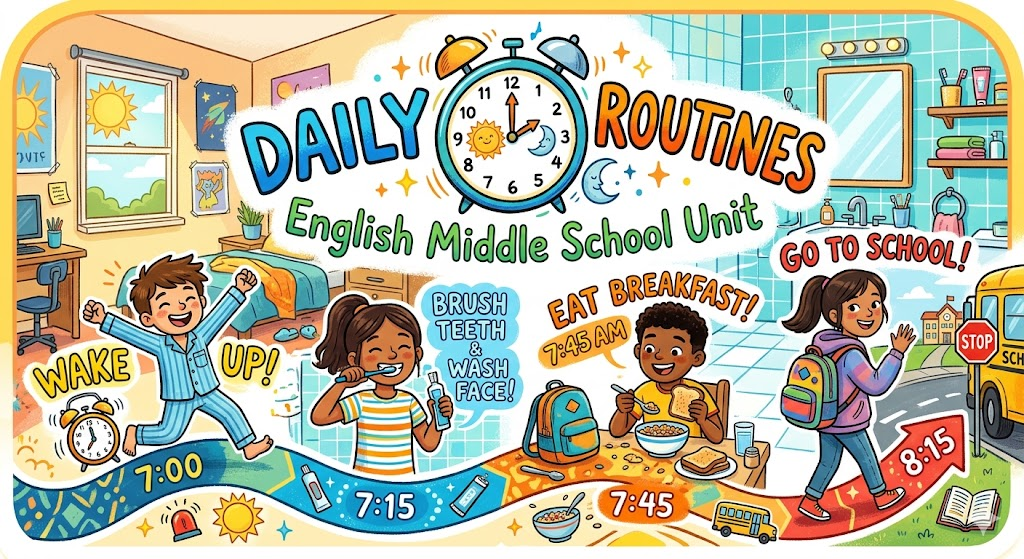
SKILLS
EFL 4.2.2 – Ask and answer questions about everyday activities using simple structures and time expressions.EFL 4.3.4 – Find specific info in short, straightforward digital texts (like a daily schedule or blog post).EFL 4.4.4 – Write simple, linked sentences to describe a timeline of events using basic connectors (first, then, after).
REAL-LIFE APPLICATION
Talking about daily routines allows A2 students to share their personal world and connect with others. In real life, mastering this language helps teenagers manage digital calendars, explain their school schedules to international pen-pals, talk about family responsibilities, and build healthy habits by comparing their personal timelines with friends.
LEARNING ACTIVITIES
SESSION 1 (80 min) ANTICIPATION
Part 1 – ( 10-15 minutes)
Anticipation Activity:
Anticipation Activity: “The Mystery Timeline”
- Objective: Activate prior knowledge of time and basic verbs.
- Instruction:
- Display a chaotic, scrambled digital timeline of a typical teenager’s day on a shared screen (e.g., 7:00 PM: Go to school / 7:00 AM: Do homework / 4:00 PM: Wake up).
- Ask students to use the digital chat or raise their hands to call out the mistakes.
- Together, quickly drag and drop the events into the correct chronological order to preview the concept of a “routine.”
CONSTRUCTION
Part 2: Vocabulary Development (15 min)
The teacher explicitly introduces key vocabulary needed for the lesson, ensuring students clearly understand meaning and use. The words include:
1.Wake up / Get up (Distinguish between opening eyes and leaving the bed)
2.Brush my teeth / hair
3.Get dressed / Get Ready
4.Attend online classes / Go to school
5.Do homework
6.Go to sleep / Go to bed
Part 3: Grammar Introduction using Presentation (20 min)
Grammar Introduction:
Simple Present & Time Connectors
- Theory to Present:
- Present Simple for Habits: Focus on 1st and 3rd person singular (I wake up vs. He wakes up).
- Prepositions of Time: At + specific time (at 6:30), In + part of the day (in the morning).
- Sequence Connectors: First, Then, After that, Finally.
- Instruction: Use a quick 4-slide presentation. Use colored text to highlight the -s on third person verbs and show how connectors act as bridges to glue sentences together.
SESSION 2: CONSTRUCTION – REINFORCEMENT (40 min)
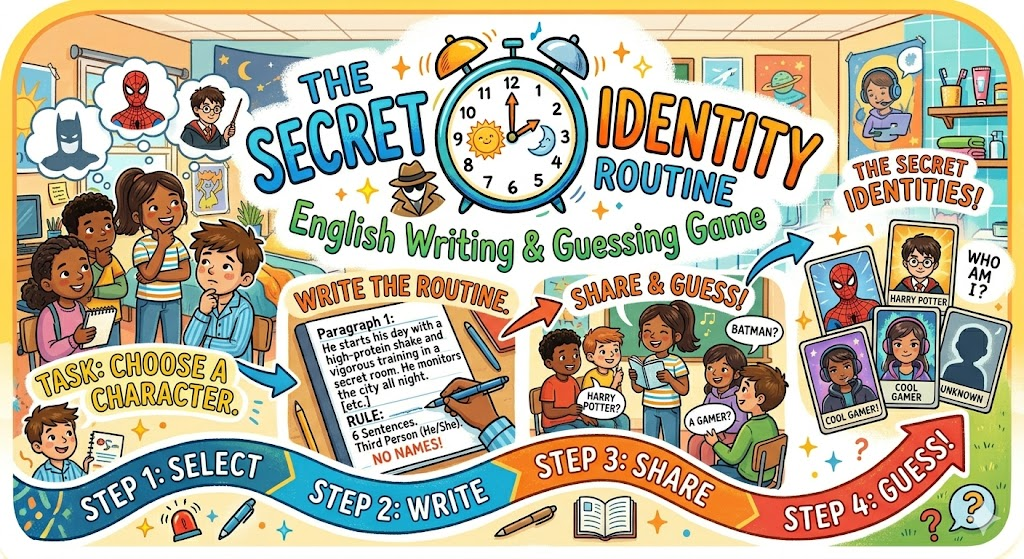
“The Secret Identity Routine”
Instruction: A creative, fun writing and guessing game.
Task: Students choose a famous character (e.g., Batman, Spider-Man, Harry Potter, or a famous gamer) and write a short 6-sentence paragraph describing that character’s daily routine in the third person (He/She/It), without naming them.
Digital Step: Students post their paragraphs anonymously to a collaborative wall (like Padlet). The rest of the class reads the routines and comments on the posts to guess who the character is.
SESSION 3: CONSOLIDATION (80 min)
Part 1 – ( 2 x 40min)
Period 1: Digital Portfolio Writing (40 Mins)
Task: Students work individually to create a short, illustrated digital layout (using Google Slides or Canva) titled “My Typical Digital Day.”
Requirements: Write a 60–80 word paragraph describing their routine. They must include at least 4 of the new vocabulary phrases, correct use of third-person if mentioning a family member/friend, and at least 3 time prepositions/connectors.
Period 2: Peer-to-Peer Interview (40 Mins)
Task: Pair students up in digital breakout rooms.
Instruction: Using a provided checklist, Student A interviews Student B about their routine (“What time do you do homework?” / “Do you play video games in the afternoon?”). Student B answers using complete sentences. They swap roles after 10 minutes.
Submission: Each student submits a brief 3-sentence summary of their partner’s routine to the teacher to assess listening and 3rd-person grammar tracking.
NEE – Agregar el tipo de adaptaciones curriculares
Principio II: Pautas 6.1 – 6.3 – 6.4
Principio III: Pautas 7.1 – 8.1 – 9.1
ALUMNO 1: Constante monitoreo. Dar tiempo adicional para el desarrollo de la actividad y se reduce el número de ejercicios o se modifican los ejercicios con un nivel de dificultad reducido, de acuerdo con sus necesidades académicas.
ALUMNO 2: Constante monitoreo, Dar tiempo adicional para el desarrollo de la actividad y se reduce el número de ejercicios o se modifican los ejercicios con un nivel de dificultad reducido, de acuerdo con sus necesidades académicas.
ALUMNO 3: Constante monitoreo. Corroborar que el contenido entregado en clase haya sido comprendido por la estudiante mediante retroalimentación.