
K-Learning Project
SKILLS
EFL 4.1.9. Recognize the consequences of one’s actions by demonstrating responsible decision-making at school, online, at home and in the community.
EFL 4.2.10. Sustain a conversational exchange on a familiar, everyday subject when carrying out a collaborative task.


REAL-LIFE APPLICATION
This project helps students speak about AI ethics in a clear and responsible way. Students learn to explain how people are affected by AI decisions, why some actions may be unfair, and what should be done. The passive voice helps them sound more formal because it focuses on the issue and the affected people, not only on who caused the problem.
LEARNING ACTIVITIES
SESSION 1 (80 min) ANTICIPATION

Part 1: AI Ethics Line (20 min)
The teacher reads short AI ethics statements and students move to one side of the room if they agree, the other side if they disagree, or the middle if they are unsure. After each statement, two or three students explain their position briefly. The teacher guides students to notice that AI is not only a technology topic; it also affects privacy, fairness, learning, and responsibility.
Statements:
AI should be allowed for homework.
Students should be told when AI is used.
AI-generated images can be dangerous.
Schools should check if students use AI.
AI can help students learn better.
AI can make unfair decisions.
Personal data should be protected from AI tools.
AI should not replace teachers.
Fake AI content should be removed.
Students should learn how to use AI responsibly.
CONSTRUCTION
Part 2: Vocabulary Development (15 min)
The teacher introduces vocabulary students need for the final debate. The teacher gives examples orally and asks students to repeat key words with correct pronunciation.
- AI ethics
- privacy
- fairness
- responsibility
- data
- fake content
- deepfake
- bias
- decision
- affected
- protected
- monitored
- removed
- allowed
- punished
- reported
- replaced
- created
- used responsibly
- digital safety
Part 3: Formal Passive Structures for Debate (20 min)
The teacher explains that passive voice helps students sound more formal during debate. Instead of saying “People use AI badly,” students can say “AI is sometimes used irresponsibly.” Instead of saying “Someone shared a fake image,” students can say “A fake image was shared.” The teacher writes examples and students identify the structure: be + past participle. The teacher reminds students that in a debate, passive voice helps focus on the problem, consequence, or affected group.
Passive Voice PresentationPart 4: Debate Position Cards (25 min)
Students receive position cards with simple AI ethics dilemmas. They choose one card and prepare a 30-second opinion using at least two passive structures. The teacher gives a speaking frame to support fluency: “I believe that… because…” “This issue is important because…” “People are affected when…” “For this reason, … should be…” Students practice with a partner and receive quick feedback.
Position cards:
- AI should be allowed for homework.
- AI should not be used in exams.
- AI-generated images should be labeled.
- Students’ data should be protected.
- AI tools should be used only with teacher guidance.
- Fake AI videos should be removed.
- AI should not replace human creativity.
- Schools should teach AI ethics.
- AI use should be reported in assignments.
- Students should be punished for copying AI answers.
SESSION 2: CONSTRUCTION – REINFORCEMENT (40 min)
Part 1 – Passive Voice Speed Circle (15 min)
Students stand in a circle. The teacher gives an active sentence about AI, and the student must quickly say a passive version. If they need help, they can ask a classmate. This makes grammar practice oral, fast, and active instead of written.
Prompt sentences:
- People use AI in schools.
- Students copy answers.
- Apps collect data.
- Someone created a fake image.
- Teachers check assignments.
- Platforms block harmful posts.
- AI changes opinions.
- Schools protect privacy.
- Students report problems.
- People share misinformation.
Part 2 – Debate Micro-Rebuttal Game (15 min)
Students work in pairs. Student A gives a simple opinion, and Student B must respond respectfully using one passive structure. The teacher reminds them that a rebuttal is not just saying “no”; it is giving a reason.
Opinion prompts:
AI should always be allowed in homework.
AI should never be used by students.
Deepfakes are not a serious problem.
Privacy is not important online.
AI can replace teachers.
Students should not learn AI ethics.
Fake content is easy to recognize.
AI mistakes are not dangerous.
Personal data can be shared freely.
AI is always fair.
Part 3 – Debate Exit Line (10 min)
Each student writes and says one final debate sentence using passive voice. The teacher chooses a few examples and gives quick correction.
SESSION 3: CONSOLIDATION (80 min)

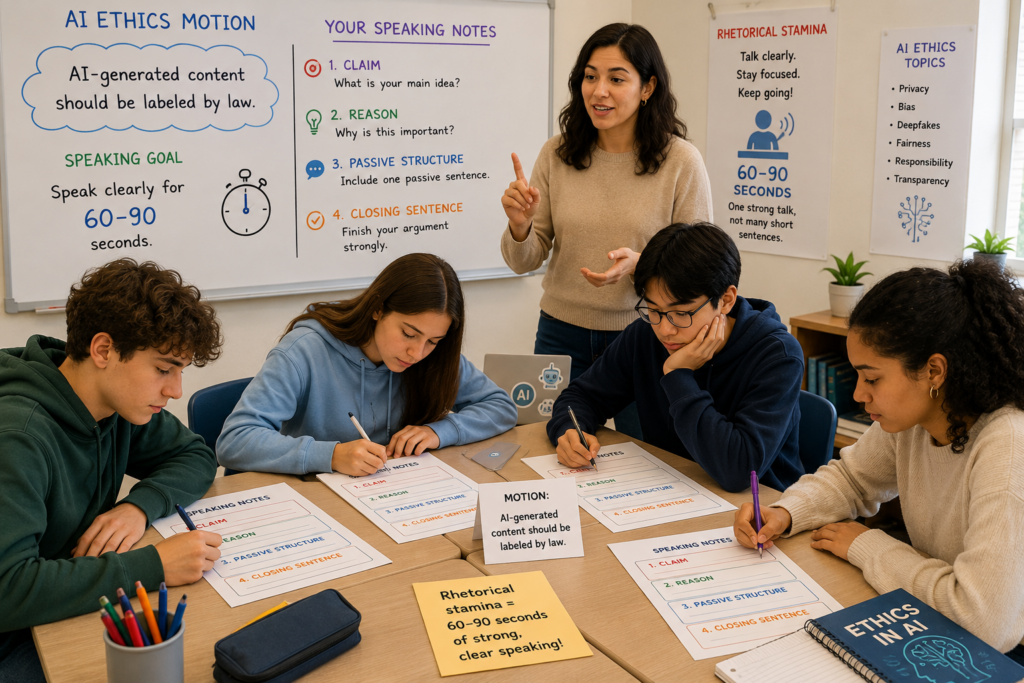
Part 1 – Preparation: Debate Stamina Warm-Up (15 min)
Students choose one AI ethics motion and prepare speaking notes, not a full script. They must include one claim, one reason, one passive structure, and one closing sentence. The teacher reminds them that rhetorical stamina means speaking clearly for 60–90 seconds without stopping after one sentence.
Part 2 – Mini Debate Carousel (50 min)
Students rotate in pairs. At each station, one student speaks for 60–90 seconds, and the other gives a short response. Then they switch. This format keeps everyone speaking instead of only watching a few classmates. Students must use at least three passive structures during their speaking turn. The teacher circulates with the rubric and evaluates selected students.
Part 3 – Speaker Reflection Circle (15 min)
Students share one sentence they used successfully and one thing they want to improve. The teacher closes by reinforcing that formal debate requires clear language, ethical thinking, and respectful disagreement.
 RUBRIC:
AI Ethics Debate
NEE – Agregar el tipo de adaptaciones curriculares
Principio II: Pautas 6.1 – 6.3 – 6.4
Principio III: Pautas 7.1 – 8.1 – 9.1
ALUMNO 1: Constante monitoreo. Dar tiempo adicional para el desarrollo de la actividad y se reduce el número de ejercicios o se modifican los ejercicios con un nivel de dificultad reducido, de acuerdo con sus necesidades académicas.
ALUMNO 2: Constante monitoreo, Dar tiempo adicional para el desarrollo de la actividad y se reduce el número de ejercicios o se modifican los ejercicios con un nivel de dificultad reducido, de acuerdo con sus necesidades académicas.
ALUMNO 3: Constante monitoreo. Corroborar que el contenido entregado en clase haya sido comprendido por la estudiante mediante retroalimentación.