
Ethical Dilemmas

SKILLS
EFL 4.1.9. Recognize the consequences of one’s actions by demonstrating responsible decision-making at school, online, at home and in the community, while considering ethical standards, safety concerns, social norms and mutual respect.
EFL 4.1.10. Recognize and appreciate individual and group similarities and differences by establishing and maintaining healthy and rewarding online and face-to-face relationships based on communication and cooperation.


REAL-LIFE APPLICATION
This topic helps students understand that ethical decisions are part of everyday life. They learn to discuss situations where people are affected by rules, choices, unfair treatment, or social pressure. They also learn to use the passive voice to focus on what happened and who was affected, instead of only focusing on who did the action. In real life, this helps students talk about school problems, online behavior, community issues, and fairness in a respectful and responsible way.
LEARNING ACTIVITIES
SESSION 1 (80 min) ANTICIPATION
Part 1: Ethical Corners (20 min)
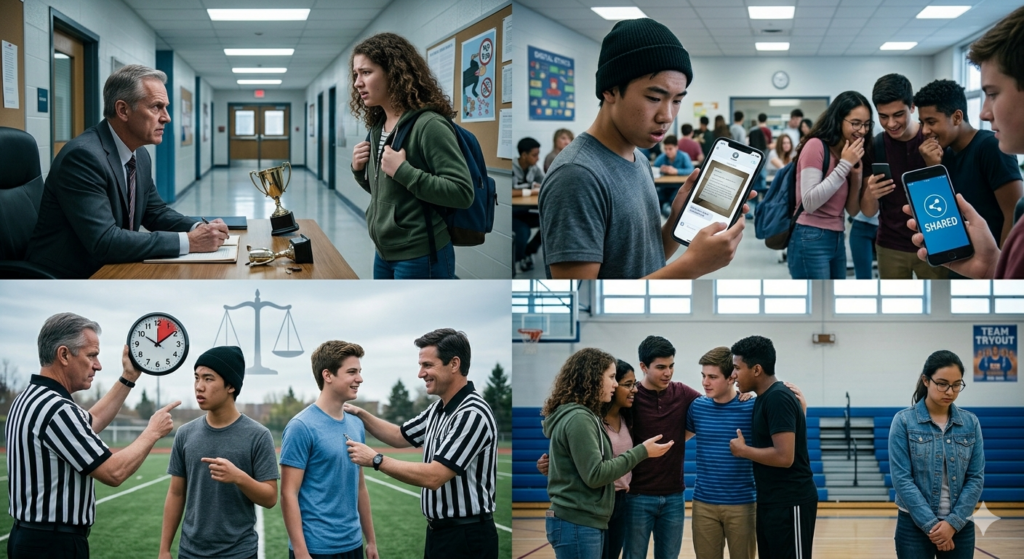
The teacher places four dilemma statements in different corners of the classroom: “A student is blamed unfairly,” “A private message is shared,” “A rule is applied differently to different people,” and “A group is excluded from an activity.” Students walk to the corner they think is the most serious and explain their choice in simple English. The teacher guides the discussion by asking: “Who is affected?” and “What consequence is created?” This activates ethical thinking before teaching grammar.
CONSTRUCTION
Part 2: Vocabulary Development (15 min)
The teacher introduces vocabulary students need to discuss ethical dilemmas:
- ethical dilemma
- fairness
- consequence
- responsibility
- discrimination
- privacy
- respect
- decision
- affected
- blamed
- excluded
- protected
- punished
- reported
- treated
- allowed
- forbidden
- community
- rule
- choice
The teacher gives short examples: “A student was blamed unfairly,” “Privacy must be protected,” and “Rules should be applied equally.” Students repeat the words and classify them into people, actions, and values.
Part 3: Grammar Input: Passive Voice (20 min)
The teacher explains that the passive voice is used when the result, action, or affected person is more important than the person who did the action. The teacher writes examples on the board: “The message was shared,” “The student is protected,” “The rule has been changed,” and “The problem will be reported.” Students notice the pattern: be + past participle. The teacher explains that the verb “be” changes depending on the tense, but the past participle stays the same.
Here is a guide that provides a detailed overview of various tenses in English and their corresponding passive forms.
Part 4: Ethical Case Sorting (25 min)
Students receive short ethical cases and sort passive sentences into the correct case.
For example, “A photo was posted without permission,” “A student was excluded from the group,” and “The rule has been ignored.” After sorting, students choose one case and write two passive sentences describing what happened and who was affected. The teacher monitors closely and helps students use the correct form of “be.”
Short ethical cases + passive sentences to sort
SESSION 2: CONSTRUCTION – REINFORCEMENT (40 min)
Part 1 – Passive Voice Detective (15 min)
The teacher gives students short headlines or school-related statements:
- A New School Rule Was Announced Today.
- A Student Was Praised for Helping a Classmate.
- The Classroom Door Was Left Open After Break.
- A Group Project Was Presented Without All Members.
- A Private Message Was Shared During Class.
- The Lost Notebook Was Returned to Its Owner.
- Several Students Were Invited to Join the Debate Team.
- A Poster Was Removed from the Hallway.
- The Problem Was Reported to the Teacher.
- A Class Activity Was Changed at the Last Minute.
Students underline the passive structure and identify the tense. Examples include: “The decision was criticized,” “The rules are followed,” and “The problem has been reported.” This activity helps students see passive voice in context without repeating previous activity formats.
Part 2 – Sentence Repair Lab (15 min)
Students correct incorrect passive sentences. Examples: “The student blamed unfairly,” “The message was share,” and “The rules is applied.” The teacher reminds them that passive voice needs the correct form of “be” plus the past participle. Students correct individually first and then compare with a partner before the teacher reviews answers.
Sentence Repair Lab – Passive Voice
Part 3 – Ethical Exit Ticket (10 min)

Students write one passive sentence about an ethical situation at school or online. Examples: “Privacy must be respected,” or “A student was treated unfairly.” The teacher collects a few examples and gives quick feedback on grammar and meaning.
SESSION 3: CONSOLIDATION (80 min)
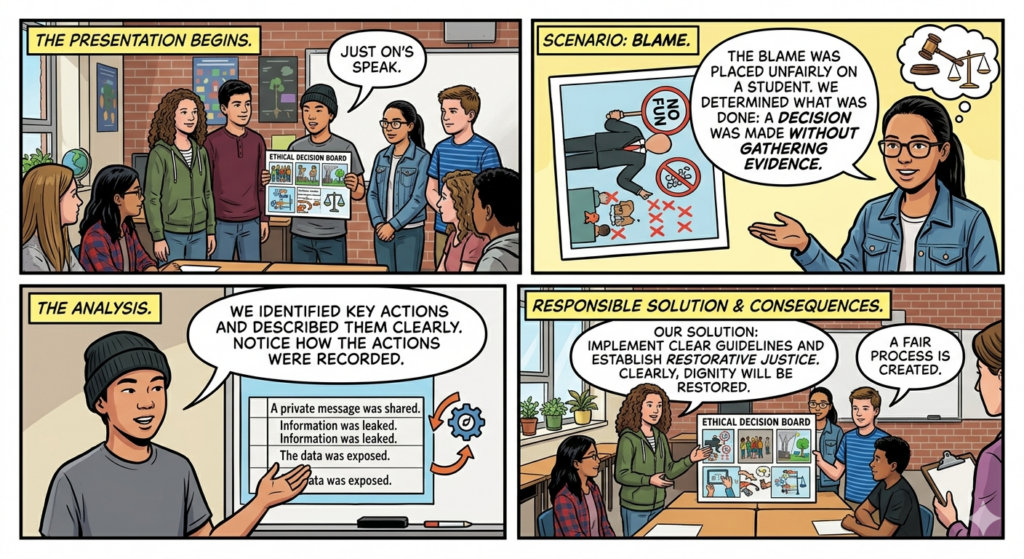
Part 1 – Preparation: Ethical Decision Board (15 min)
Students work in small groups and choose one ethical dilemma card. They complete a decision board with three sections: what happened, who was affected, and what should be done. They must include at least two passive voice sentences. The teacher reminds them that the goal is to explain the situation clearly and propose a responsible decision.
Part 2 – Group Decision Presentation (45 min)

Each group presents its ethical decision board. Students explain the dilemma, describe what was done using passive voice, and propose a responsible solution. This is not a debate or role-play; it is a short decision presentation where students must show that they understand the ethical problem and can express consequences clearly.
Part 3 – Listener Judgment Card (20 min)
While listening, classmates complete a small judgment card: “What happened?”, “Who was affected?”, and “Was the solution fair?” The teacher uses this to keep the audience active and to reinforce ethical reasoning. The teacher closes the session by highlighting strong passive voice examples and correcting frequent errors.
 RUBRIC:
Ethical Dilemmas Rubrics
NEE – Agregar el tipo de adaptaciones curriculares
Principio II: Pautas 6.1 – 6.3 – 6.4
Principio III: Pautas 7.1 – 8.1 – 9.1
ALUMNO 1: Constante monitoreo. Dar tiempo adicional para el desarrollo de la actividad y se reduce el número de ejercicios o se modifican los ejercicios con un nivel de dificultad reducido, de acuerdo con sus necesidades académicas.
ALUMNO 2: Constante monitoreo, Dar tiempo adicional para el desarrollo de la actividad y se reduce el número de ejercicios o se modifican los ejercicios con un nivel de dificultad reducido, de acuerdo con sus necesidades académicas.
ALUMNO 3: Constante monitoreo. Corroborar que el contenido entregado en clase haya sido comprendido por la estudiante mediante retroalimentación.