End-of-Level Review Phase
SKILLS
EFL 4.2.13 Interact with reasonable ease in structured situations and short conversations within familiar contexts, provided that speech is given clearly, slowly and directly.
EFL 4.4.7 Use the process of prewriting, drafting, revising, peer editing and proofreading to produce well-constructed informational texts.
REAL-LIFE APPLICATION
This final topic helps students understand that English is not only a subject they studied during the year; it is a tool they can use to participate in the world. Through global citizenship, students use English to understand information, listen critically, express opinions, write formal messages, interact respectfully, and propose actions that can improve their school or community. This is useful for future presentations, interviews, exchange programs, academic projects, social campaigns, and everyday situations where students need to communicate with purpose and responsibility.
LEARNING ACTIVITIES
SESSION 1 (80 min) ANTICIPATION
Part 1: Global Citizen Skill Quest — 20 min
The teacher presents the opening image or a short UNESCO global citizenship video segment.
Students are told that this final topic is a “skill quest,” not a normal review. The class identifies which skills are needed to complete a real global citizenship mission: reading information, listening to opinions, writing a message, speaking clearly, and interacting with others.
The teacher gives a mission prompt:
“Your school wants one student-led project that improves the community. You must understand the issue, listen to different views, write a message, present your idea, and make a collaborative decision.”
Students first discuss what skills they will need. This makes the review meaningful because the skills are not isolated. Students see that real communication requires them to move between input, thinking, output, and interaction.
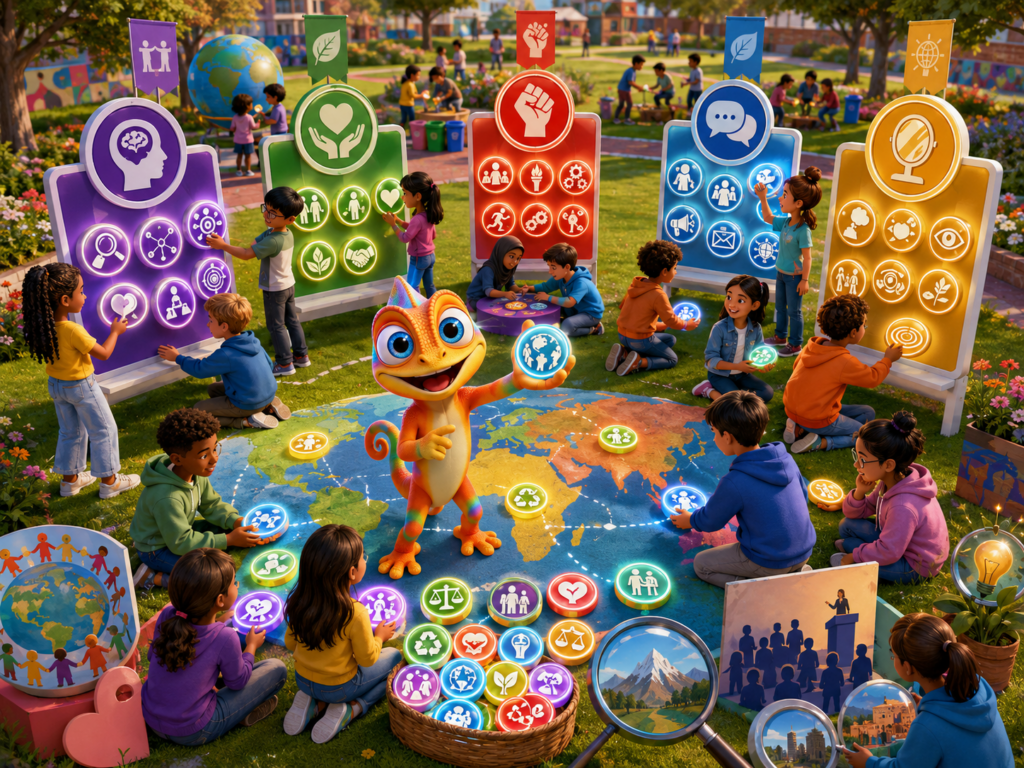
Part 2: Vocabulary Activation: Global Citizen Signal Flags — 15 min
• global citizenship
• community action
• shared responsibility
• human rights
• sustainability
• inclusion
• respect
• empathy
• cultural awareness
• environmental action
• digital citizenship
• local problem
• global issue
• evidence
• main idea
• supporting detail
• speaker attitude
• formal message
• collaborative decision
• solution
• impact
• recommendation
• reflection
• stamina
• interaction
• audience
• perspective
• commitment
• leadership
• continuous learning
Students work with the vocabulary list above. They place vocabulary under the five signal flags and justify their choices. The teacher should ask students to explain their thinking, not just place the word.
For example, if a student places speaker attitude under understand, they explain that listening to attitude helps them understand what a person really thinks or feels.
Part 3: Extended Explanation: What Is an Integrated Skills Milestone? — 25 min
The teacher explains that an integrated skills milestone is a final performance where students combine several English skills to complete one meaningful task.
In real life, people rarely use one skill alone.
For example, if students want to propose a school action, they may read a short text, listen to someone’s opinion, discuss possible solutions, write a formal message, and present their final idea.
The teacher explains the five skill layers:
Reading: students identify the main idea and supporting details.
Listening: students identify the message, attitude, and important information.
Writing: students organize a clear formal message.
Speaking: students explain a problem, solution, reason, and impact.
Interaction: students ask, respond, clarify, and reach a decision.
The teacher also explains stamina. Stamina means students can keep communicating with control. This means writing a short formal message, speaking for around 90 seconds, listening more than once, and participating in a pair decision without stopping after one short answer.
Part 4: Language Teaching Idea: Skill Relay Compass — 20 min
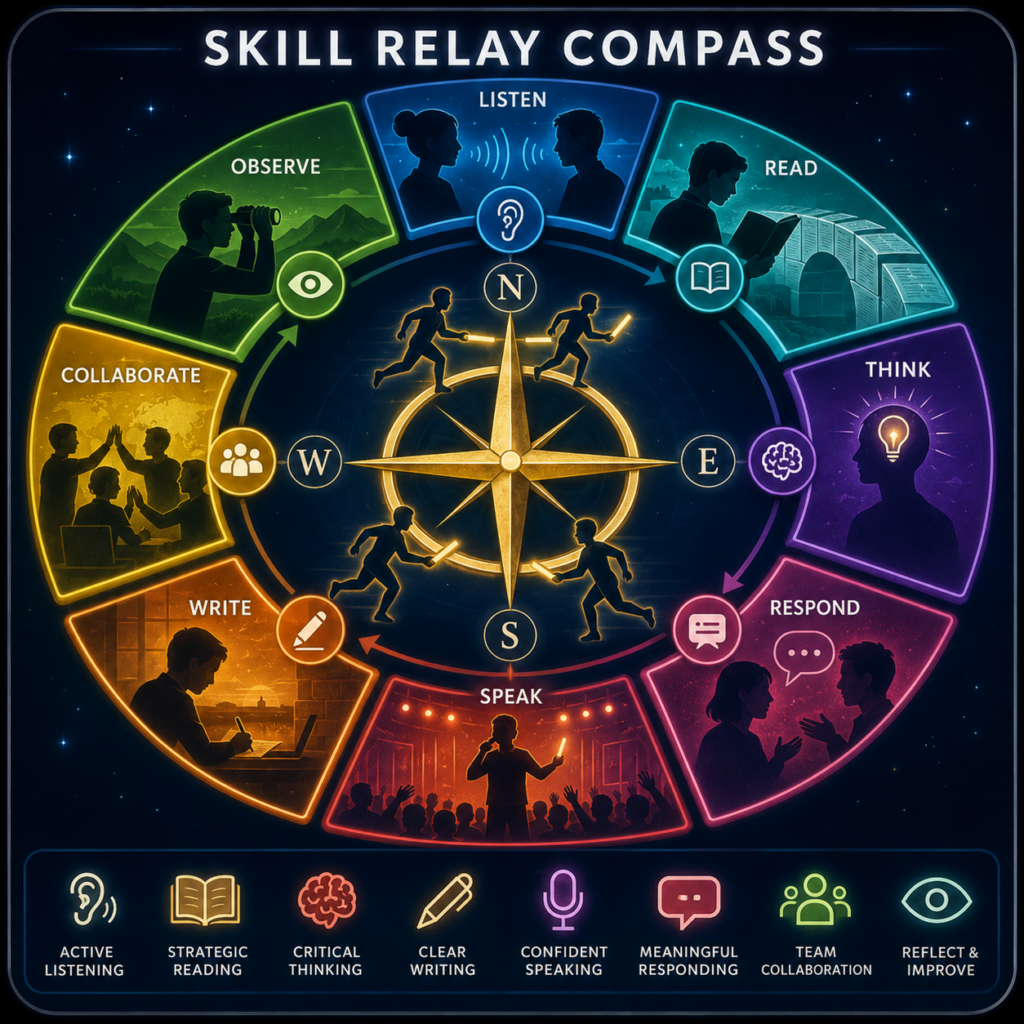
Students use a “Skill Relay Compass.” The compass has four directions: information, opinion, action, and impact. The teacher gives a short global citizenship issue, such as paper waste, digital kindness, inclusion, or water use. Students must move through the compass and produce one sentence at each point.
Example:
Information: “Many students throw away usable paper.”
Opinion: “I think this is a serious problem.”
Action: “We should create a reuse box.”
Impact: “This will reduce waste and help students save materials.”
This activity teaches structure, speaking, and reasoning at the same time. It prepares students for the final test because they practice turning input into organized output.
SESSION 2: CONSTRUCTION – REINFORCEMENT (40 min)
Part 1 – Source Rescue Mission — 15 min
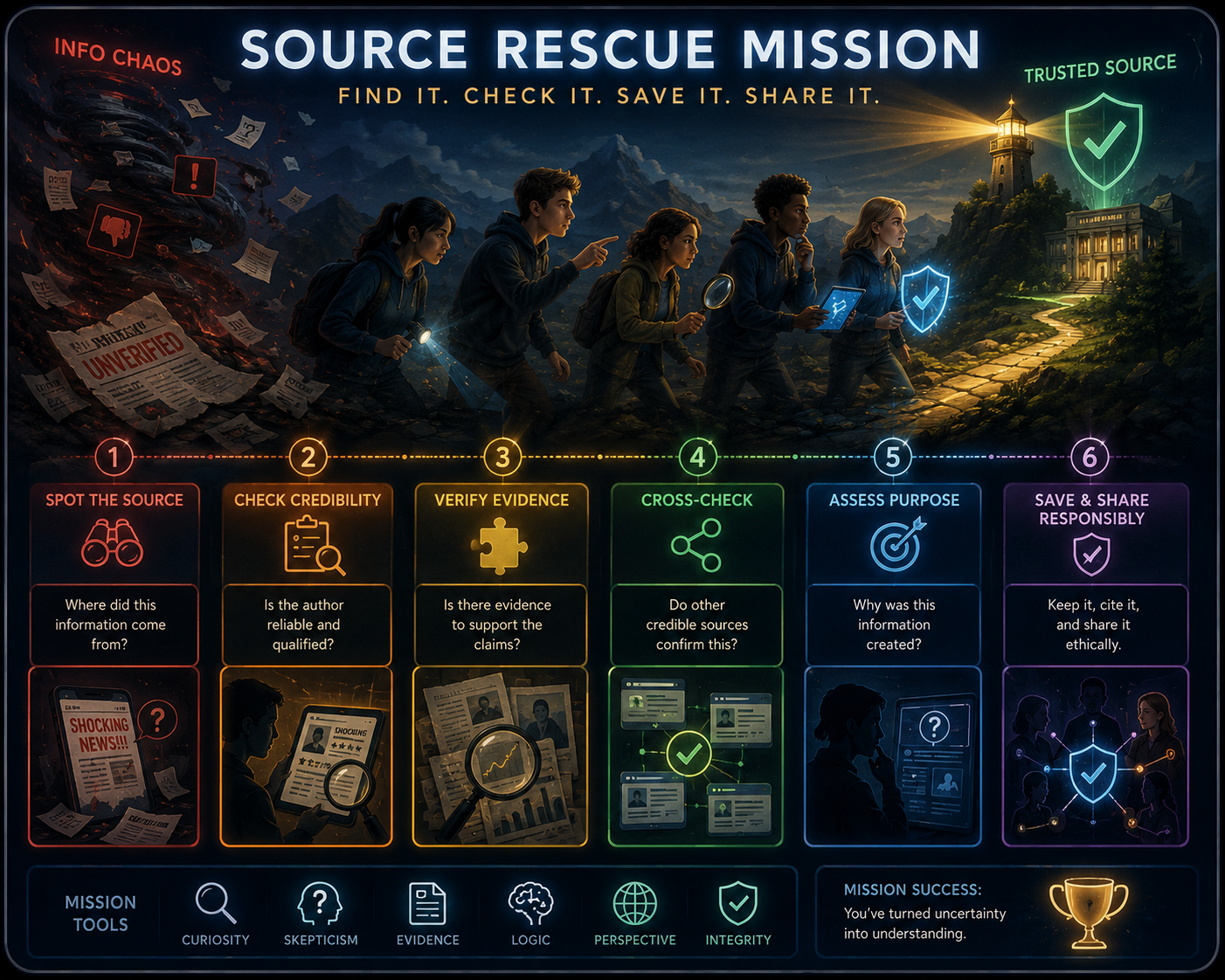
Students receive three short information pieces about a school issue: one useful source, one weak source, and one opinion. Their job is to “rescue” the best evidence. They must decide which information is most useful for a final message and explain why.
Three Short Information Pieces
Piece A: One Useful Source (Data-Driven & Verifiable)
“According to the school’s monthly environmental waste audit, students throw away an average of 450 single-use plastic bottles every week. Our local recycling station confirms that only 15% of these bottles are actually recycled; the rest go directly to the city landfill.”
Piece B: One Weak Source (Vague & Unreliable)
“A blog post written by a random teenager on the internet says that using plastic bottles is super bad for the planet and that we should probably just stop buying them completely because they look ugly in trash cans and make schools look messy.”
Piece C: One Opinion (Emotional & Personal)
“I really think the school cafeteria should stop selling plastic water bottles immediately because it makes me angry to see students throwing them on the floor, and honestly, reusable metal flasks look much cooler anyway.”
This activity helps students avoid using random information. They learn that evidence must be relevant, clear, and connected to the action they want to propose.
Part 2 – 90-Second Voice Builder — 15 min
Students choose one global citizenship issue and build a 90-second message using four parts: problem, reason, solution, and impact. They practice once with a partner. The partner listens for organization, not perfection.
Global Citizenship Issues
Digital Footprint and Online Reputation
- Problem: Young people post impulsive content online without realizing that their digital footprint is permanent and visible to future universities or employers.
Cyberbullying and Digital Peer Pressure
- Problem: Aggressive messaging, exclusion in group chats, and unrealistic social media standards harm the mental health and emotional well-being of classmates.
Local Food Waste in School Communities
- Problem: Tons of perfectly edible food are thrown away daily in school cafeterias and local homes while community families face economic hardship and hunger.
Fast Fashion and Consumer Responsibility
- Problem: Buying cheap, low-quality clothes following social media trends creates massive textile pollution and relies on unfair labor practices in developing countries.
Urban Green Spaces and Biodiversity Loss
- Problem: Local parks and neighborhood green areas are being replaced by concrete or polluted with plastic litter, destroying local ecosystems and habitats for urban wildlife.
The teacher reminds them that a strong final message does not need complicated grammar. It needs clear structure, enough development, and a confident voice.
Part 3 – Legacy Micro-Reflection Card — 10 min
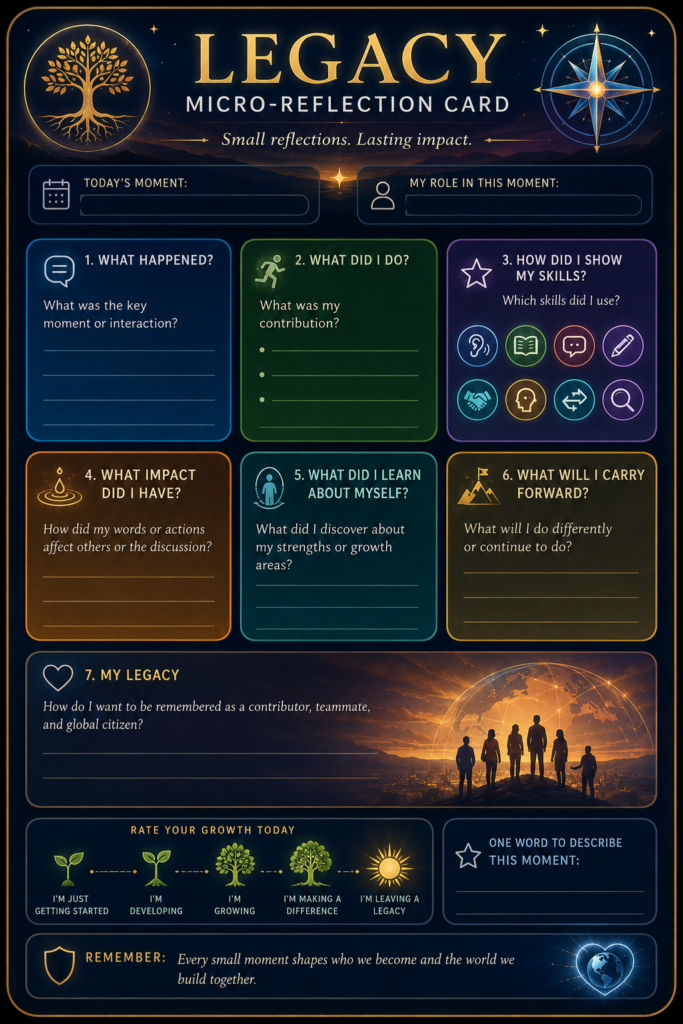
Students complete a small reflection card:
One English skill I improved is…
One global issue I can explain better is…
One action I can take is…
Then students exchange cards with a partner and choose one sentence to read aloud. This closes the lesson through reflection and peer recognition, not an exit sentence.
SESSION 3: CONSOLIDATION (80 min)
Part 1- Preparation: Five-Keyword Final Card — 10 min
Students prepare five keywords only:
problem
reason
solution
impact
message
The teacher explains that the card is not a script. Students must use it to organize their thoughts while still speaking naturally.
Part 2 – Final Integrated Skills Test — 55 min
Students complete the final integrated test. The test includes:
Reading: short global citizenship text
Listening: teacher-read audio script
Writing: 90–110 word formal message
Speaking: 90-second Global Citizen Message
Interaction: pair decision task
This test works as the final milestone because it asks students to demonstrate all skills in one coherent performance.
Part 3 – Legacy Capsule Launch — 15 min
Students choose one “legacy capsule” to complete:
My English voice
My strongest skill
My global citizen action
My next learning goal
They write one sentence and place it in a physical or digital capsule. Then several volunteers read theirs aloud. This gives the year a symbolic closing and helps students connect language learning with future growth.
“Education is the most powerful weapon which you can use to change the world.”
Nelson Mandela
RUBRIC:
Global Citizenship
NEE – Agregar el tipo de adaptaciones curriculares
Principio II: Pautas 6.1 – 6.3 – 6.4
Principio III: Pautas 7.1 – 8.1 – 9.1
ALUMNO 1: Constante monitoreo. Dar tiempo adicional para el desarrollo de la actividad y se reduce el número de ejercicios o se modifican los ejercicios con un nivel de dificultad reducido, de acuerdo con sus necesidades académicas.
ALUMNO 2: Constante monitoreo, Dar tiempo adicional para el desarrollo de la actividad y se reduce el número de ejercicios o se modifican los ejercicios con un nivel de dificultad reducido, de acuerdo con sus necesidades académicas.
ALUMNO 3: Constante monitoreo. Corroborar que el contenido entregado en clase haya sido comprendido por la estudiante mediante retroalimentación.