
Media & AI

SKILLS
EFL 4.1.9. Recognize the consequences of one’s actions by demonstrating responsible decision-making at school, online, at home and in the community, while considering ethical standards, safety concerns, social norms and mutual respect.
EFL 4.3.5. Use everyday reference material in order to select information appropriate to the purpose of an inquiry and relate ideas from one written source to another.


REAL-LIFE APPLICATION
This topic helps students understand how information is shared, changed, reported, or censored in digital spaces. Students learn how to report what another person said without repeating the exact words, which is useful when summarizing news, explaining conversations, or discussing what people say online. In daily life, this helps them avoid spreading misinformation. In personal development, it helps them become more responsible digital citizens. In academic and social contexts, it helps them report information clearly and evaluate how AI and media influence society.
LEARNING ACTIVITIES
SESSION 1 (80 min) ANTICIPATION
Part 1: Message Change Challenge (20 min)

The teacher begins by showing the opening image and asking: What happens when information is shared many times online? Students first write one quick idea individually. Then the teacher whispers or shows a short sentence to one student, such as: “The school blocked a fake news post.” The sentence is passed from student to student in small groups, and the final version is compared with the original. The teacher guides students to notice how messages can change when they are repeated, summarized, or misunderstood. This prepares them for reported speech without starting with grammar rules.
CONSTRUCTION
Part 2: Vocabulary Development (15 min)
The teacher introduces the vocabulary students need to understand media and AI conversations. The words are presented with examples, not isolated definitions. Students repeat the words, identify familiar ones, and copy the vocabulary list.
- censorship
- fake news
- AI-generated
- content
- source
- headline
- post
- comment
- report
- statement
- question
- claim
- suggest
- deny
- warn
- misinformation
- social
- media
- algorithm
- privacy
- reliable
- biased
The teacher gives model sentences: “A source can be reliable or biased,” “AI-generated content can be helpful, but it can also spread misinformation,” and “Some posts are removed because of censorship.” Students choose five words and write one simple sentence for each.
Part 3: Grammar Input: Reported Statements (20 min)
The teacher explains that reported speech is used when we tell someone what another person said, but not always with the exact words. The teacher writes two examples on the board: Direct speech: “AI can create fake images.” Reported speech: She said that AI could create fake images. The teacher explains that in reported speech, pronouns and verbs often change. The teacher focuses on basic changes: am/is → was, are → were, can → could, will → would, and present simple → past simple. Students underline what changed in each example.
Direct and Reported Speech (Tenses)Part 4: Reported Speech Card Match (25 min)
Students receive direct speech cards and reported speech cards. Their task is to match each direct statement with the correct reported version. After matching, students explain one change they noticed. The teacher checks the cards and reinforces that reported speech is not only grammar; it is also a way to report information responsibly.
SESSION 2: CONSTRUCTION – REINFORCEMENT (40 min)
Part 1 – Reported Question Puzzle (15 min)
The teacher explains that reported questions do not use normal question order. Students compare: Direct question: “Is this news real?” Reported question: She asked if the news was real. Direct question: “Who created this post?” Reported question: He asked who had created the post. Students then complete a puzzle where they rebuild reported questions from scrambled words.
Exercise: Put the words in the correct order.
- asked / if / the headline / was / real / She
- wanted to know / who / the post / had created / He
- asked / whether / the source / was / reliable / They
- wondered / why / the comment / had been removed / I
- asked / if / AI / could / write articles / The student
Part 2 – Media Message Filter (15 min)
Students receive short online statements and decide whether each one is a fact, opinion, claim, warning, or suggestion. Then they report it using a reporting verb. The teacher models: Direct: “This app collects your data.” Reported: The expert warned that the app collected users’ data.
Exercise: Report each sentence using the verb in parentheses.
- “This video is fake.” (claim)
- “Do not share your password.” (warn)
- “Students should check the source.” (suggest)
- “I did not create that image.” (deny)
- “AI can make mistakes.” (say)
Part 3 – Exit Report (10 min)
Each student writes two reported speech sentences based on media or AI. One sentence must report a statement, and one sentence must report a question. The teacher collects a few examples and corrects common mistakes on the board.
SESSION 3: CONSOLIDATION (80 min)
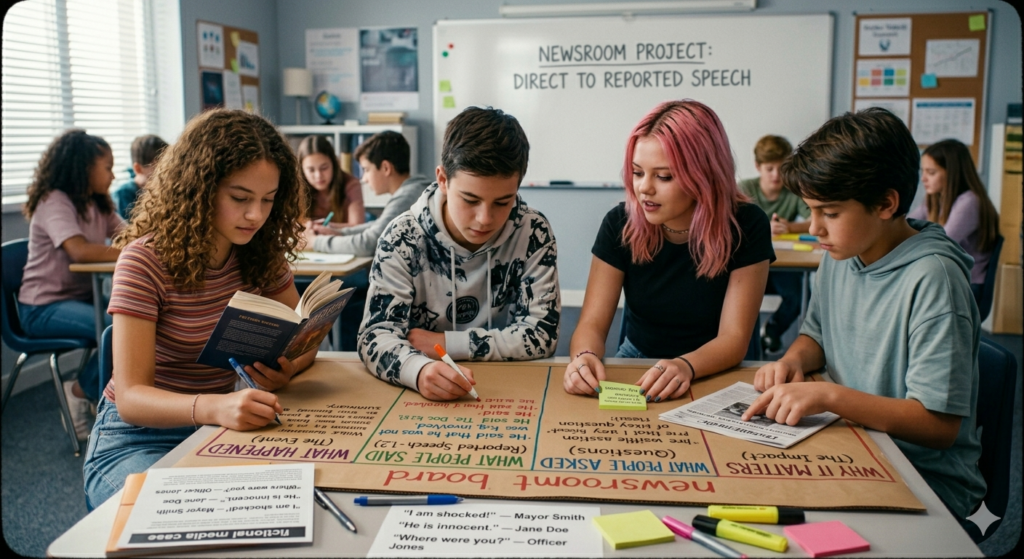
Part 1 – Preparation: AI Newsroom Report Board (15 min)
Students work in small groups and receive a short fictional media case. Each case includes three direct quotes from different people. The group must transform the quotes into reported speech and organize them on a “newsroom report board.” The board must include: what happened, what people said, what people asked, and why the issue matters.
Cases:
- A fake AI-generated photo of a teacher was shared in a class group.
- A social media post was removed because it criticized a school rule.
- A news headline about teenagers and AI was misleading.
- A student used AI to write a post but denied it.
- A platform blocked comments about a controversial topic.
Part 2 – Group Newsroom Report (45 min)
Each group presents its report board to the class. This is not a role-play; students speak as student reporters summarizing what others said. They must use at least four reported speech sentences, including at least one reported question. The teacher evaluates grammar accuracy, clarity, responsible reporting, and group communication.
Model:
The teacher said that the image had been created by AI.
A student claimed that the post was only a joke.
Another student asked if the image could be deleted.
The group concluded that digital responsibility was necessary.
Part 3 – Responsible Reporter Reflection (20 min)
Students individually answer: Why is it important to report information accurately? The teacher uses this reflection to connect reported speech with ethical communication, not just grammar.
 RUBRIC:
Media AI
NEE – Agregar el tipo de adaptaciones curriculares
Principio II: Pautas 6.1 – 6.3 – 6.4
Principio III: Pautas 7.1 – 8.1 – 9.1
ALUMNO 1: Constante monitoreo. Dar tiempo adicional para el desarrollo de la actividad y se reduce el número de ejercicios o se modifican los ejercicios con un nivel de dificultad reducido, de acuerdo con sus necesidades académicas.
ALUMNO 2: Constante monitoreo, Dar tiempo adicional para el desarrollo de la actividad y se reduce el número de ejercicios o se modifican los ejercicios con un nivel de dificultad reducido, de acuerdo con sus necesidades académicas.
ALUMNO 3: Constante monitoreo. Corroborar que el contenido entregado en clase haya sido comprendido por la estudiante mediante retroalimentación.