
Advanced Writing
SKILLS
EFL 4.4.5. Recognize that various types of writing require different language, formatting and special vocabulary.
EFL 4.4.7. Use the process of prewriting, drafting, revising, peer editing and proofreading (i.e., “the writing process”) to produce well-constructed informational texts.
REAL-LIFE APPLICATION
This topic helps students understand that academic writing is not just about writing more words; it is about organizing ideas clearly and using language that fits the purpose. Students learn how an essay is built, how formal register sounds, and how punctuation can make ideas clearer. In real life, this helps them write better assignments, explain opinions with structure, and communicate ideas in a more academic and responsible way.
LEARNING ACTIVITIES
SESSION 1 (80 min) ANTICIPATION
Part 1: Essay Puzzle Table (20 min)
The teacher gives groups a short mixed-up essay divided into sentence strips. The strips include an introduction, thesis statement, supporting ideas, evidence, and conclusion, but they are not labeled. Students must organize the strips in the order they think makes the most sense. The teacher asks: What makes a text feel organized? Groups explain their order, and the teacher guides students to notice that academic essays follow a structure, not a random collection of ideas.
Academic Essays
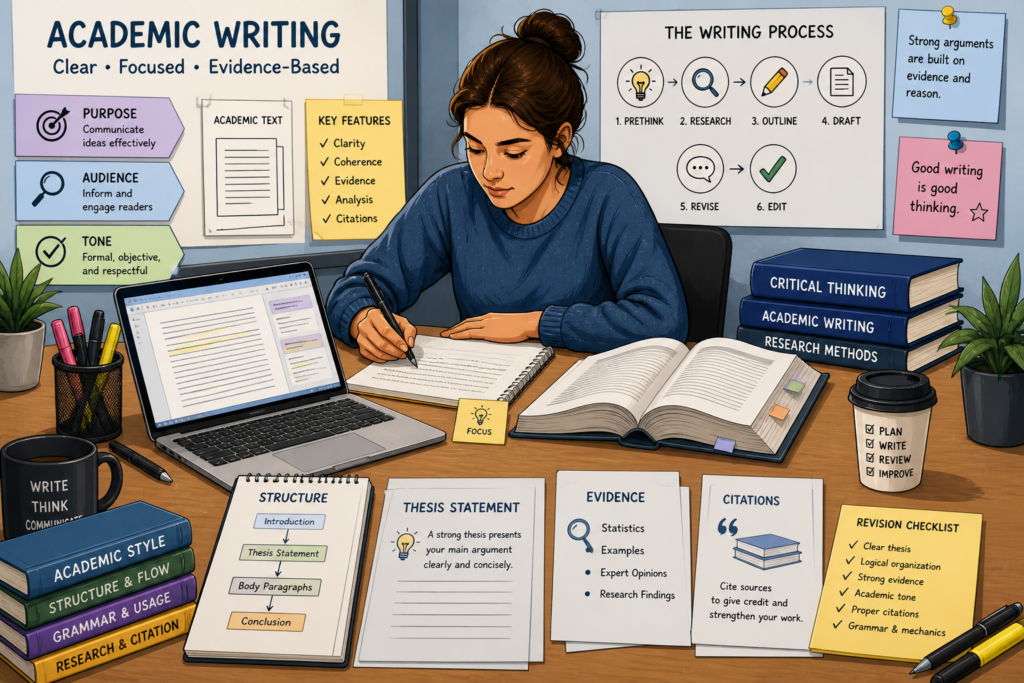
An academic essay is a formal text that explains, analyzes, or argues an idea in a clear and organized way. It is not written like a casual opinion or conversation. It needs a clear position, logical order, formal language, and supporting ideas.
Basic Structure
1. Introduction
The introduction presents the topic and prepares the reader. It usually ends with the thesis statement.
The thesis statement is the main idea or position of the essay.
Example:
Artificial intelligence can support education, but it must be used responsibly to protect students’ learning process.
2. Body Paragraphs
The body paragraphs develop the thesis. Each paragraph should focus on one main idea.
A strong body paragraph usually includes:
Topic sentence: introduces the main idea of the paragraph.
Evidence or example: supports the idea.
Explanation: shows why the evidence matters.
Link: connects the paragraph back to the thesis.
Example:
AI can help students understand difficult topics. For example, it can explain concepts in different ways and give immediate feedback. However, students must still evaluate the information because AI can make mistakes.
3. Conclusion
The conclusion closes the essay. It should not simply repeat the introduction. It should summarize the main idea and leave a final reflection.
Example:
In conclusion, AI can be a useful academic tool when students use it critically. The goal is not to replace thinking, but to support learning.
Simple Formula
Introduction = What is the topic and what is your position?
Body = Why is your position valid?
Conclusion = What should the reader understand at the end?
Mixed-Up Essay Sentence Strips
CONSTRUCTION
Part 2: Vocabulary and Register Development (15 min)
The teacher introduces essential academic writing vocabulary. The vocabulary should be written as a clear list and then connected to examples.
- thesis statement
- introduction
- body paragraph
- topic sentence
- supporting detail
- evidence
- explanation
- conclusion
- formal register
- informal register
- argument
- counterargument
- transition
- coherence
- audience
- purpose
The teacher explains that formal register avoids casual expressions such as “kids,” “stuff,” “a lot of things,” or “I think it’s super bad.” Students replace informal expressions with academic alternatives.
Part 3: Grammar and Punctuation Input: Semicolons and Colons (25 min)
The teacher explains that semicolons and colons help writers control the flow of academic writing. A semicolon links two closely related complete ideas: “Media influences public opinion; it can also shape political decisions.” A colon introduces evidence, explanation, or a list: “Students need three skills: critical thinking, research, and self-editing.” The teacher emphasizes that students should not use these marks randomly; they must serve meaning.
Part 4: Essay Skeleton Builder (20 min)
Students receive an essay topic such as “Should students use AI for homework?” They do not write the full essay yet. Instead, they complete an essay skeleton with one thesis, two supporting ideas, one counterargument, and one conclusion idea. The teacher reminds students that the purpose is planning, not final writing. Students must include one colon in their plan and one sentence that could later use a semicolon.
Essay topics:
- Should social media platforms be responsible for controlling fake news?
- Should AI tools be allowed in school assignments?
- Should students’ online activity be monitored for safety?
- Should schools limit the use of mobile phones in class?
- Should governments regulate AI-generated content?
- Should influencers be held accountable for the information they share?
- Should digital privacy be more important than public security?
- Should schools teach media literacy as a required subject?
- Should companies be allowed to collect user data for AI development?
- Should censorship be used to prevent harmful online content?
SESSION 2: CONSTRUCTION – REINFORCEMENT (40 min)
Part 1 – Register Surgery (15 min)
Students receive short informal academic sentences and transform them into formal register. This activity is different from the Wednesday puzzle because students focus on tone and word choice. The teacher reminds them that academic writing should sound clear, precise, and respectful, not conversational.
Exercise
Rewrite in formal academic register.
- I think AI is kind of scary.
- Fake news is a big mess online.
- Students use AI because it makes homework easy.
- Social media is everywhere and people like it.
- This topic is really important for everyone.
- Some people don’t care about checking sources.
Part 2 – Punctuation Flow Challenge (15 min)
Students receive pairs of sentences and decide whether to connect them with a semicolon or rewrite them with a colon. The teacher asks students to explain why the punctuation choice works. This reinforces punctuation as a tool for meaning, not decoration.
Part 3 – Exit Revision (10 min)
Each student revises one sentence from their essay skeleton using either a semicolon or a colon. The teacher collects examples and gives fast feedback. The goal is to confirm that students can apply punctuation to improve clarity.
SESSION 3: CONSOLIDATION (80 min)
Part 1 – Preparation: Essay Structure Clinic (15 min)
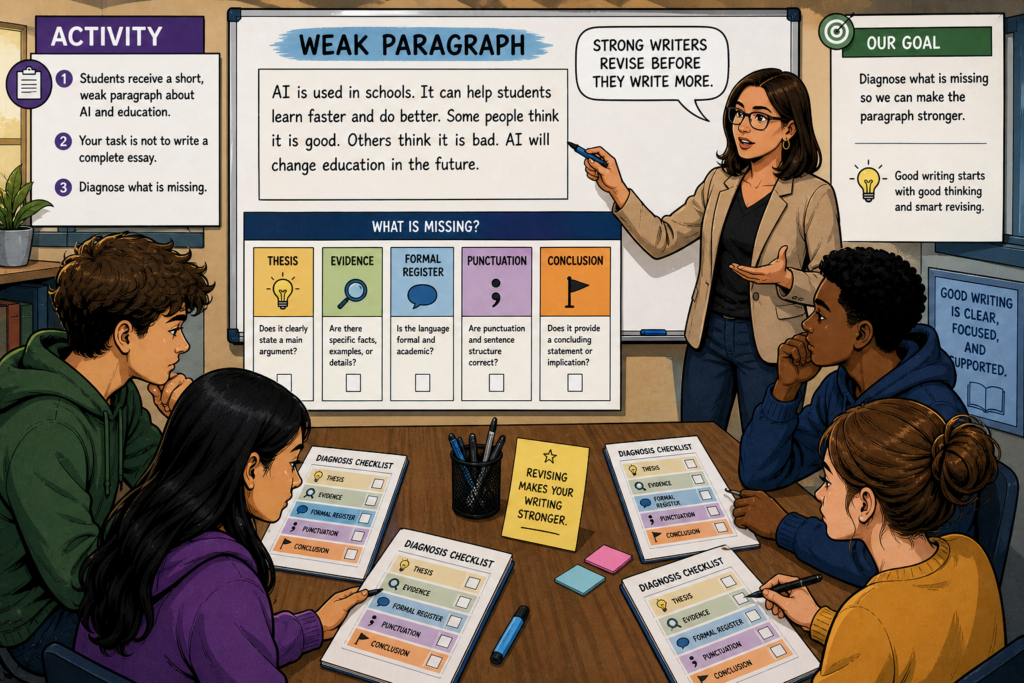
Students receive a short weak paragraph about AI and education. Their task is not to write a complete essay. Instead, they must diagnose what is missing: thesis, evidence, formal register, punctuation, or conclusion. The teacher explains that strong writers revise before they write more.

Part 2 – Paragraph Flow Challenge (45 min)
Students work individually first and then with a partner to improve the weak paragraph. They must add a clearer topic sentence, replace informal language, add one colon, add one semicolon, and improve the final sentence. This graded task evaluates practical writing improvement, not memorization. The teacher monitors and checks that students can explain why they changed each part.
EXAMPLE
Original weak paragraph
AI is useful for students. It helps with homework. Some students like it because it is fast. But it can also be bad.
Improved paragraph
AI can support student learning when it is used responsibly. It offers several academic benefits: quick explanations, study support, and access to information. However, students must evaluate its answers carefully; AI can provide inaccurate or incomplete information. Therefore, AI should be used as a learning tool, not as a replacement for student thinking.
What changed
Topic sentence improved:
“AI can support student learning when it is used responsibly.”
Informal language replaced:
“bad” → “inaccurate or incomplete information”
Colon added:
“benefits: quick explanations, study support, and access to information.”
Semicolon added:
“carefully; AI can provide inaccurate or incomplete information.”
Final sentence
Part 3 – Peer Editing Check (20 min)
Students exchange improved paragraphs and use a checklist. They check whether the paragraph has formal register, one colon, one semicolon, and clear organization. The teacher closes by highlighting strong examples and explaining that academic writing improves through revision.
 RUBRIC:
Academic Essays
NEE – Agregar el tipo de adaptaciones curriculares
Principio II: Pautas 6.1 – 6.3 – 6.4
Principio III: Pautas 7.1 – 8.1 – 9.1
ALUMNO 1: Constante monitoreo. Dar tiempo adicional para el desarrollo de la actividad y se reduce el número de ejercicios o se modifican los ejercicios con un nivel de dificultad reducido, de acuerdo con sus necesidades académicas.
ALUMNO 2: Constante monitoreo, Dar tiempo adicional para el desarrollo de la actividad y se reduce el número de ejercicios o se modifican los ejercicios con un nivel de dificultad reducido, de acuerdo con sus necesidades académicas.
ALUMNO 3: Constante monitoreo. Corroborar que el contenido entregado en clase haya sido comprendido por la estudiante mediante retroalimentación.