
Historical Rights
SKILLS
EFL 4.1.9. Recognize the consequences of one’s actions by demonstrating responsible decision-making at school, online, at home and in the community.
EFL 4.2.12. Describe habits, routines, past activities and experiences within the personal and educational domains.


REAL-LIFE APPLICATION
This topic helps students understand that past decisions can affect people’s lives today. They learn to express regrets or alternative outcomes using the third conditional, and they also learn to connect past events with present consequences using mixed conditionals. In real life, this helps students reflect on history, fairness, rights, and responsible decision-making.
LEARNING ACTIVITIES
SESSION 1 (80 min) ANTICIPATION
Part 1: Anticipation: Rights Timeline Walk (20 min)
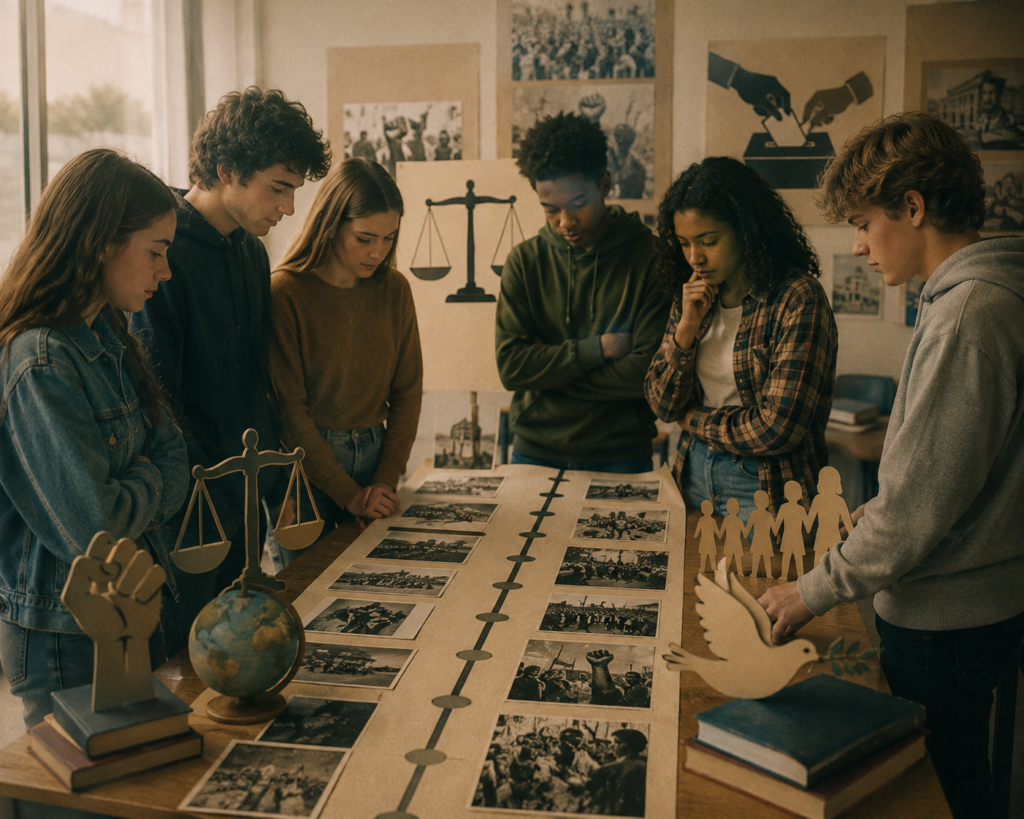
The teacher places simple historical rights situations around the classroom. Students walk around, read each situation, and decide whether the situation shows fairness, unfairness, progress, or regret. The teacher asks: “What could have changed if people had acted differently?” This activates historical thinking before introducing conditional grammar.
Situation cards:
Some children were not allowed to go to school.
Some people were not allowed to vote.
Workers did not have safe conditions.
Women were not treated equally.
Indigenous communities were ignored.
People protested for equal rights.
Some laws protected only certain groups.
Students demanded better education.
Communities defended their land.
People fought against discrimination.
CONSTRUCTION
Part 2: Vocabulary Development (15 min)
The teacher introduces vocabulary connected to historical rights and consequences.
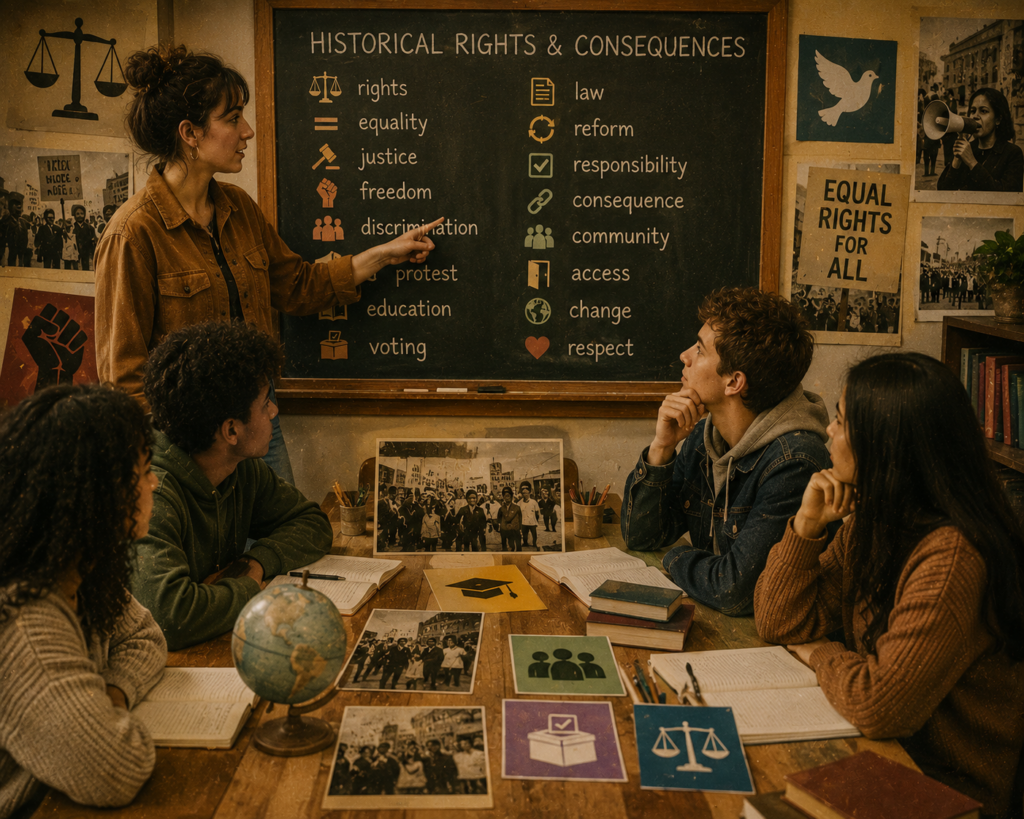
rights
equality
justice
freedom
discrimination
protest
law
reform
consequence
regret
opportunity
access
education
voting
fairness
protection
community
responsibility
decision
change
Part 3: Grammar Input: Third Conditional (20 min)
The teacher explains the third conditional:
Third Conditional
It is used to talk about situations that did not happen in the past and to speculate on what could have happened if circumstances were different. It’s a way of expressing regret, missed opportunities, or simply imagining different outcomes.
Form: If + past perfect, would + have + past participle.
Examples:
- “If I had studied harder, I would have passed the exam.”
- “If she had left earlier, she would have caught the train.”
- “If they had known about the event, they would have attended.”
The teacher writes: “If children had received education, they would have had more opportunities.” Students identify the past condition and the imagined result.
Part 4: Regret Cards: “History Could Have Changed” (25 min)
Students receive regret cards and complete oral sentences using the third conditional. This makes grammar practice active and reflective. Students work in pairs: Student A reads the card, and Student B completes the sentence.
Cards:
- Children were not allowed to study.
- A community was not heard.
- Workers were not protected.
- A law was unfair.
- People did not respect differences.
- A school ignored students’ needs.
- A group lost access to land.
- Leaders did not act quickly.
- People believed stereotypes.
- Citizens could not vote.
Sentence frame:
“If __________ had __________, __________ would have __________.”
SESSION 2: CONSTRUCTION – REINFORCEMENT (40 min)
Part 1 – Mixed Conditional Human Chain (15 min)
Students form a human chain. One student says a past cause, and the next student says a present result. The teacher explains that mixed conditionals connect an unreal past with a present consequence.
Structure: If + past perfect, would + base verb.
Example: “If people had protected rights earlier, society would be more equal today.”
Exercise:
Say each sentence in two different tones: friendly and professional.
- I see your point.
- That might work.
- Could you clarify that?
- I agree up to a point.
- I’m not sure I follow.
- That seems unusual.
- Let’s think it through.
- Could we try another option?
- I hadn’t thought of that.
- Let’s keep the tone respectful.
Part 2 – Consequence Switch Game (15 min)
Students receive cards with past situations and present consequences. They must match them and say the complete mixed conditional aloud.
Past cards:
People were denied education.
Workers were not protected.
Communities were ignored.
Women did not have equal rights.
Discrimination was accepted.
Voting was limited.
Laws were unfair.
Children worked instead of studying.
Culture was not respected.
People were silenced.
Present consequence cards:
Some communities would have more opportunities today.
Workers would be safer today.
Society would be more inclusive today.
More women would be represented today.
People would treat differences with more respect today.
Democracy would be stronger today.
Justice would be more equal today.
More adults would have better jobs today.
Cultural identity would be stronger today.
People would speak more freely today.
Part 3 – Exit Oral Sentence (10 min)
Each student says one mixed conditional about rights. The teacher corrects structure and pronunciation quickly.
Examples:
“If education had been equal, more people would have opportunities today.”
“If discrimination had ended earlier, society would be more respectful today.”
SESSION 3: CONSOLIDATION (80 min)
Part 1 – Preparation: Communication Repair Game (15 min)
Students choose one historical rights issue and prepare a short oral explanation. They must include one third conditional and one mixed conditional. They prepare notes, not a full script.
Topics:
- Access to education
- Voting rights
- Workers’ rights
- Women’s rights
- Indigenous rights
- Freedom of expression
- Anti-discrimination laws
- Children’s rights
- Cultural rights
- Environmental rights
Part 2 – Oral Timeline Stations (50 min)
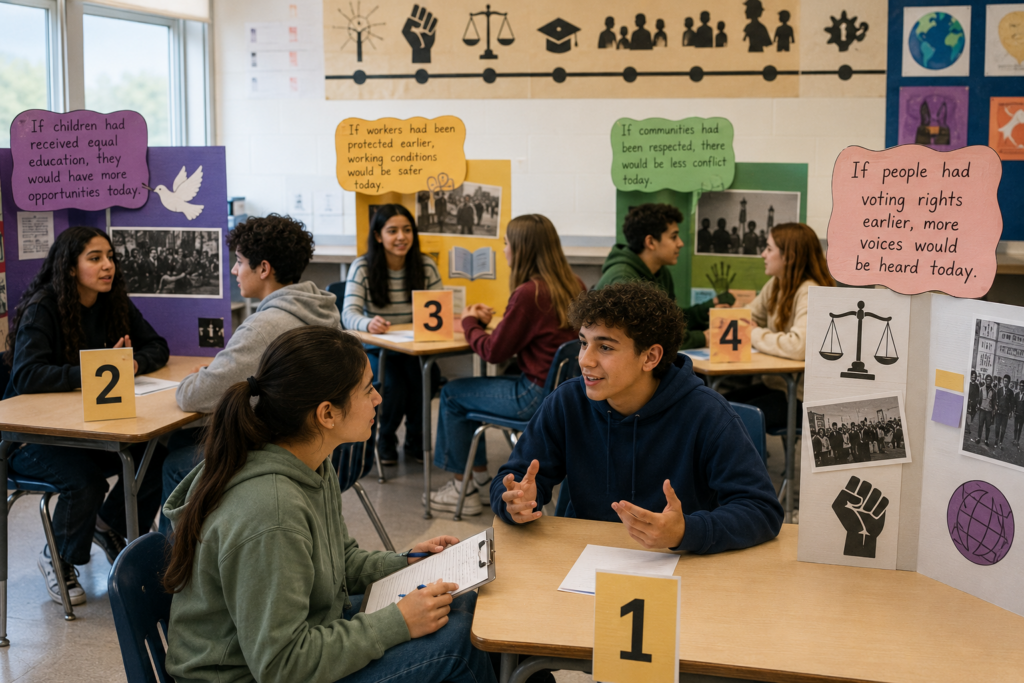
Students rotate through stations. At each station, one student explains the issue in 45–60 seconds using conditional sentences. The listener asks one follow-up question. This keeps the activity oral, active, and different from previous written consolidations.
Required structure
- Describe the historical issue.
- Use one third conditional.
- Use one mixed conditional.
- Explain why the issue matters today.
Part 3 – Reflection Vote (15 min)
Students vote for the issue they think had the strongest impact on the present. They must explain their choice in one oral sentence using “because.” The teacher closes by connecting historical rights, consequences, and responsible decisions.
 RUBRIC:
Historical Rights Rubrics
NEE – Agregar el tipo de adaptaciones curriculares
Principio II: Pautas 6.1 – 6.3 – 6.4
Principio III: Pautas 7.1 – 8.1 – 9.1
ALUMNO 1: Constante monitoreo. Dar tiempo adicional para el desarrollo de la actividad y se reduce el número de ejercicios o se modifican los ejercicios con un nivel de dificultad reducido, de acuerdo con sus necesidades académicas.
ALUMNO 2: Constante monitoreo, Dar tiempo adicional para el desarrollo de la actividad y se reduce el número de ejercicios o se modifican los ejercicios con un nivel de dificultad reducido, de acuerdo con sus necesidades académicas.
ALUMNO 3: Constante monitoreo. Corroborar que el contenido entregado en clase haya sido comprendido por la estudiante mediante retroalimentación.