
Vocational Excellence
SKILLS
EFL 4.2.12 Describe habits, routines, past activities and experiences within the personal and educational domains.
EFL 4.1.9 Recognize the consequences of one’s actions by demonstrating responsible decision-making at school, online, at home and in the community.


REAL-LIFE APPLICATION
This topic helps students explain services people need in professional life. They learn to say that someone arranges for another person to complete a task. For example, “I had my logo designed” means I did not design it myself; I paid or asked someone to do it. This is useful for careers, businesses, repairs, legal documents, personal branding, and entrepreneurship.

LEARNING ACTIVITIES
SESSION 1 (80 min) ANTICIPATION
Part 1: Anticipation: Service Fair Walk (20 min)
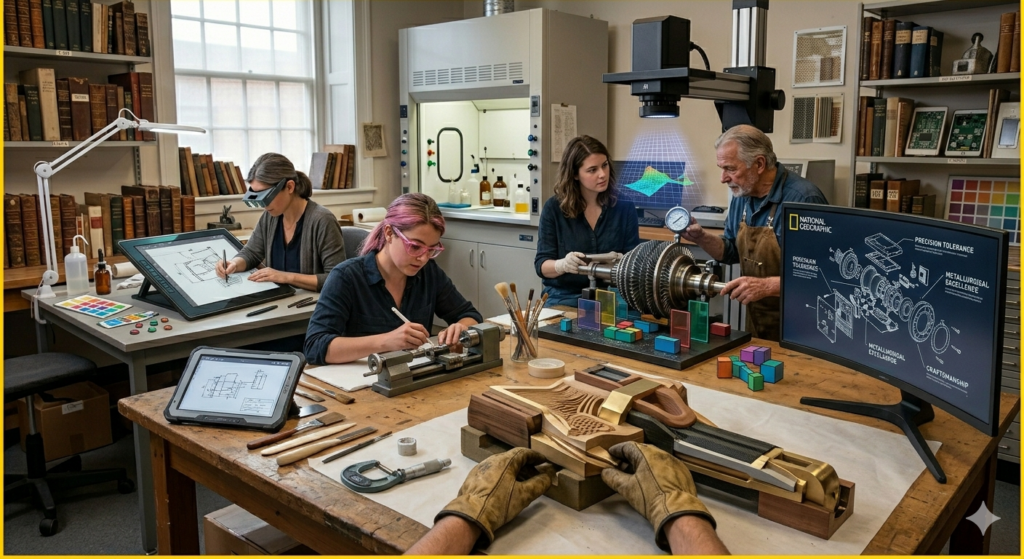
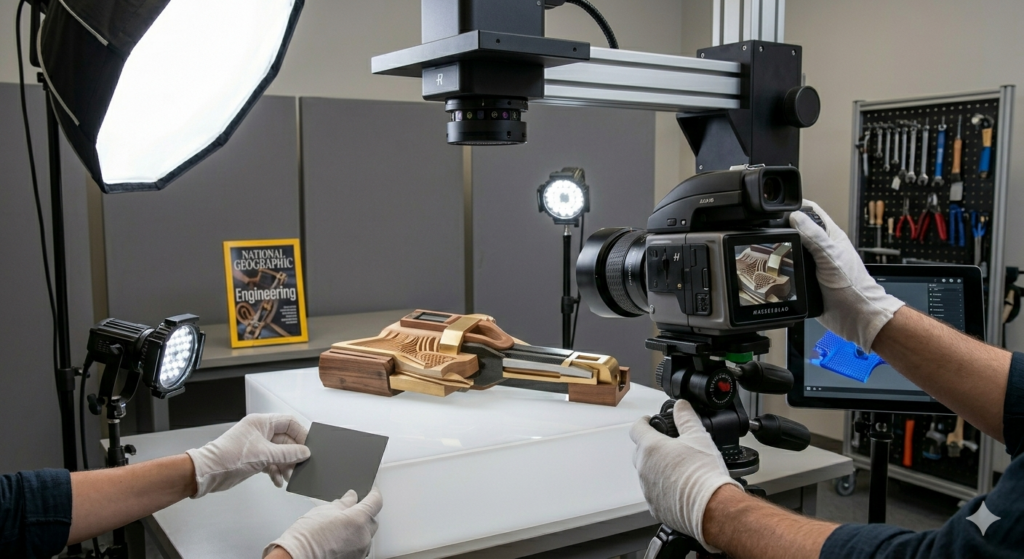
The teacher shows images of different services: a repaired phone, a designed logo, a printed business card, a checked contract, a cleaned workspace, and a fixed website. Students move around the room and guess who did each service. The teacher asks: “Do professionals do everything alone, or do they get help from specialists?” This introduces the idea of outsourcing and causative structures.



CONSTRUCTION
Part 2: Vocabulary Development (15 min)
The teacher introduces career, entrepreneurship, and service vocabulary.
- career
- entrepreneur
- service
- customer
- client
- contract
- repair
- design
- logo
- website
- business card
- product
- invoice
- delivery
- legal rights
- responsibility
- payment
- agreement
- guarantee
- professional

Part 3: Grammar Input: Have/Get Something Done (25 min)
The teacher explains:
Causative Structures: Have/Get Something Done
We use causative structures when a person does not do the action personally, but arranges for another person or professional to do it.
The structure is:
subject + have/get + object + past participle
Examples:
I had my website designed.
This means: I did not design the website. A designer designed it for me.
She got her phone repaired.
This means: She did not repair the phone. A technician repaired it for her.
Difference between “have” and “get”
Have something done sounds more neutral, formal, or professional.
Example:
The entrepreneur had the contract reviewed by a lawyer.
Get something done sounds more conversational or everyday.
Example:
The entrepreneur got the logo redesigned.
Both are correct. The difference is mostly tone.
Why this is useful
This structure is common in professional and business situations because entrepreneurs cannot do everything alone. They often need specialists.
Examples:
A designer creates the logo.
→ The entrepreneur had the logo created.
A lawyer checks the contract.
→ The entrepreneur had the contract checked.
A technician repairs the website.
→ The entrepreneur got the website repaired.
A printer prints the business cards.
→ The entrepreneur got the business cards printed.
Simple explanation for students
When I say:
I repaired my laptop.
It means I did the action myself.
When I say:
I got my laptop repaired.
It means another person repaired it for me.
More examples
- I had my hair cut.
- She got her phone fixed.
- They had their house painted.
- We got our photos taken.
- He had his contract checked.
- The company got its website updated.
- The client had the product delivered.
- The entrepreneur got her logo designed.
- The business had its invoice prepared.
- The startup got its packaging redesigned.
Exercise: Complete the sentences with the correct past participle.
I got my phone ______ yesterday. She had her logo ______ by a designer.
We got our business cards ______ for the fair.
He had his contract ______ before signing it.
They got their website ______ last week.
The customer had the product ______ to her house.
I got my laptop ______ before the presentation.
The entrepreneur had her photos ______ professionally.
We got our classroom booth ______ for the event.
He had the invoice ______ by the accountant.
Word bank:
repaired
designed
printed
checked
updated
delivered
fixed
taken
decorated
prepared
Part 4: Service Menu Challenge (20 min)
Students work in groups and create a simple “service menu” for a student entrepreneur. They choose five services someone might need to start a small business. Then they say what the entrepreneur had or got done. This is oral and creative because students imagine a real business.Students practice ranking speculation from strong evidence to possibility to criticism. The teacher gives one decision, and students must create three sentences: one with must have, one with might have, and one with should have. Then they explain which sentence is strongest and why.
Service ideas:
- logo design
- website creation
- product photos
- business card printing
- contract checking
- package design
- social media post design
- product delivery
- equipment repair
- price list printing
Speaking frame:
“Our entrepreneur got the logo designed.”
“She had the product photos taken.”
“He got the business cards printed.”
SESSION 2: CONSTRUCTION – REINFORCEMENT (40 min)
Part 1 – Career Repair Relay (15 min)
Students work in teams. The teacher says a problem, and students must answer with a causative sentence. The first team to create a correct sentence wins a point. This keeps grammar active and fast.
Problems:
- My phone is broken.
- My logo looks bad.
- My contract has mistakes.
- My website is old.
- My product photos are blurry.
- My business cards are not ready.
- My laptop is slow.
- My package design is boring.
- My invoice is incorrect.
- My presentation poster is unfinished.
Part 2 – Legal Rights Mini-Mission (15 min)
The teacher gives short situations where a customer or entrepreneur has a problem. Students decide what right or responsibility is involved and say one causative sentence.
Situations:
- A customer paid, but the product was not delivered.
- A student used another person’s logo.
- A client signed a contract without reading it.
- A phone repair was badly done.
- A business used a photo without permission.
- A customer did not receive an invoice.
- A product was damaged during delivery.
- A seller promised a guarantee but ignored it.
- A student entrepreneur copied a brand name.
- A client asked for work but did not pay.
Part 3 – Exit Service Sentence (10 min)
Each student says one sentence about a service they would get done for a future career or business. The teacher corrects structure and pronunciation.
Examples:
“I would get my website designed.”
“I would have my contract checked.”
“I would get my logo created.”
SESSION 3: CONSOLIDATION (80 min)
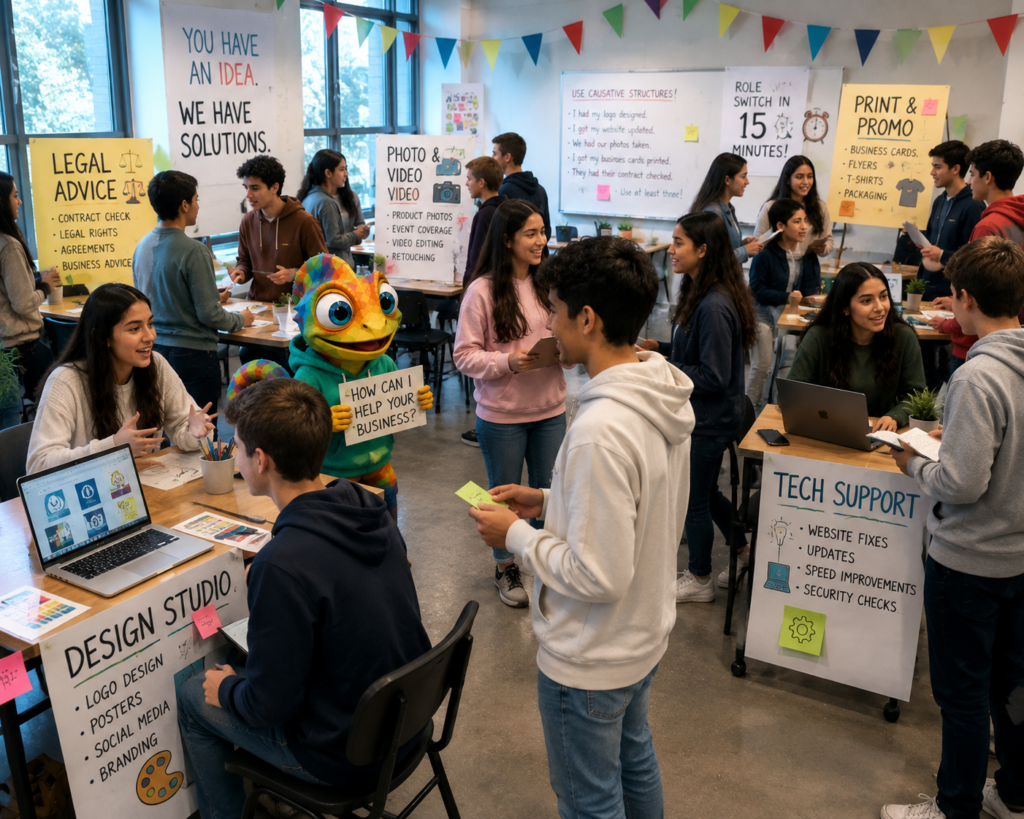
Part 1 – Preparation: Career Service Fair (15 min)
Students prepare a mini booth for a service business. They choose a service, decide what problem it solves, and prepare three causative sentences. They cannot write a full script; they only prepare keywords.
Service booth options:
- logo design
- phone repair
- website update
- contract checking
- product photography
- business card printing
- delivery service
- school tutoring
- poster design
- laptop repair
Part 2 – Interactive Career Service Fair (50 min)
Half of the class becomes service providers and half becomes clients. Clients walk around asking what they can have or get done. Providers explain their service and give advice. After 15 minutes, roles switch. This works like a fun mini-marketplace, not a presentation. Students must use at least three causative structures during the interaction.
Part 3 – Client Reflection Circle (15 min)
Students share which service they would use and why. The teacher closes by connecting careers, entrepreneurship, responsibility, and legal rights.
 RUBRIC:
Vocational Excellence Rubrics
NEE – Agregar el tipo de adaptaciones curriculares
Principio II: Pautas 6.1 – 6.3 – 6.4
Principio III: Pautas 7.1 – 8.1 – 9.1
ALUMNO 1: Constante monitoreo. Dar tiempo adicional para el desarrollo de la actividad y se reduce el número de ejercicios o se modifican los ejercicios con un nivel de dificultad reducido, de acuerdo con sus necesidades académicas.
ALUMNO 2: Constante monitoreo, Dar tiempo adicional para el desarrollo de la actividad y se reduce el número de ejercicios o se modifican los ejercicios con un nivel de dificultad reducido, de acuerdo con sus necesidades académicas.
ALUMNO 3: Constante monitoreo. Corroborar que el contenido entregado en clase haya sido comprendido por la estudiante mediante retroalimentación.