
Peer Reviewing

SKILLS
EFL 4.4.8 Use the process of prewriting, drafting, revising, peer editing and proofreading to produce well-constructed informational texts.
EFL 4.1.9 Recognize the consequences of one’s actions by demonstrating responsible decision-making at school, online, at home and in the community.


REAL-LIFE APPLICATION
This topic helps students understand that reviewing someone’s work is not the same as criticizing the person. Peer reviewing means reading carefully, identifying what works well, and suggesting specific improvements. Students also learn how dashes and parentheses can make writing more stylish, clear, and natural.
LEARNING ACTIVITIES
SESSION 1 (80 min) ANTICIPATION
Part 1: Anticipation: Feedback or Attack? (20 min)
The teacher shows students short comments and asks them to decide if each one is helpful feedback or hurtful criticism. Students stand on one side of the room for “helpful” and the other side for “not helpful.” After each choice, students explain why. The teacher emphasizes that good feedback is specific, respectful, and focused on the work.
CONSTRUCTION
Part 2: Vocabulary Development (15 min)
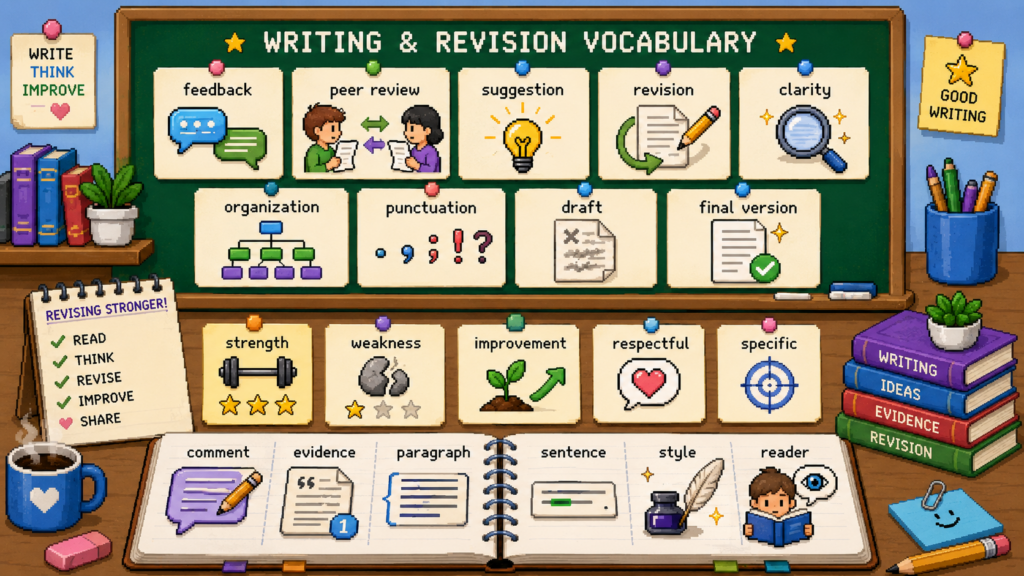
The teacher introduces vocabulary for peer reviewing and revision.
- feedback
- peer review
- suggestion
- revision
- clarity
- organization
- punctuation
- draft
- final version
- strength
- weakness
- improvement
- respectful
- specific
- comment
- evidence
- paragraph
- sentence
- style
- reader
Part 3: Grammar/Punctuation Input: Dashes and Parentheses (25 min)
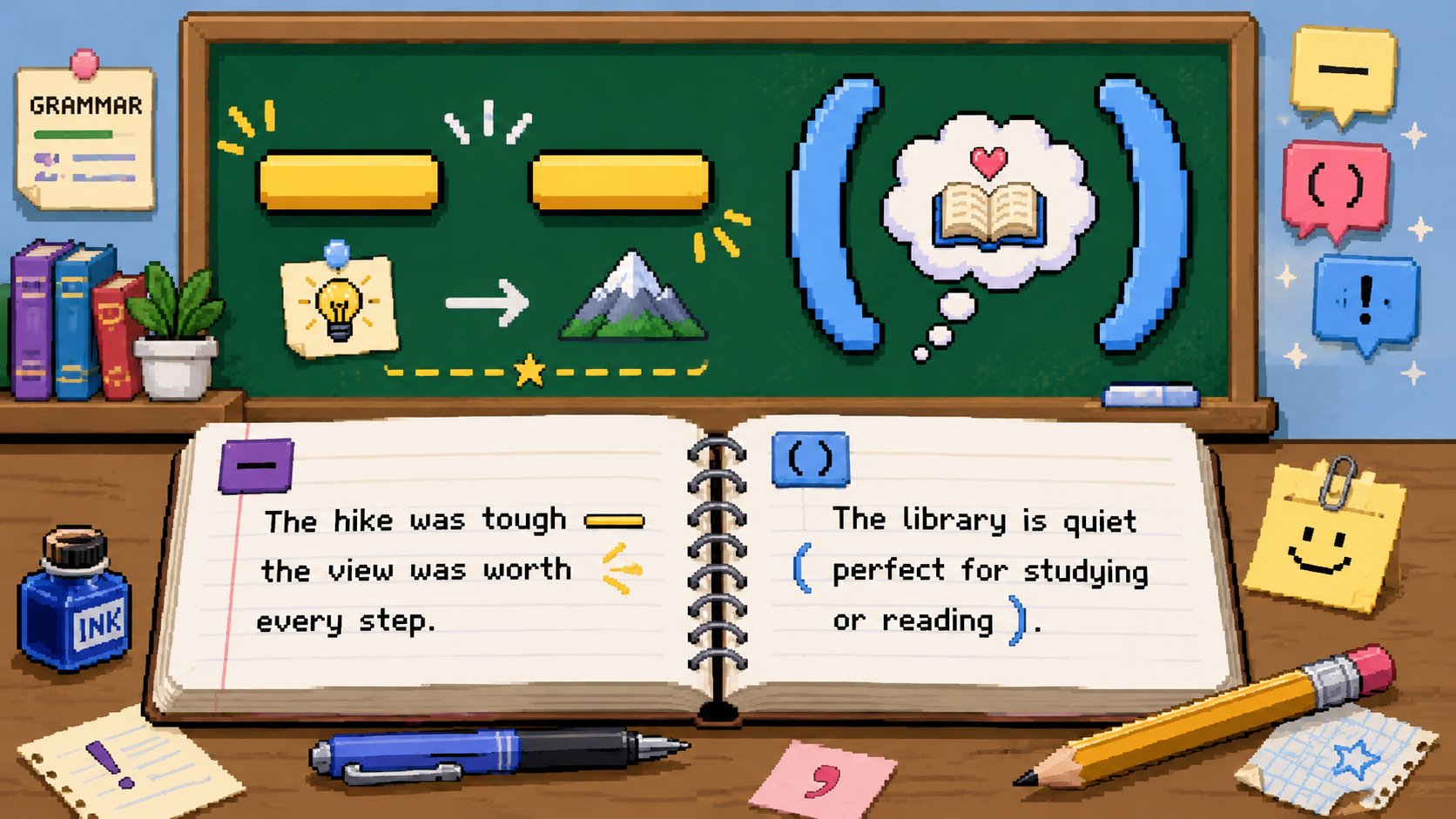
The teacher explains that dashes and parentheses add extra information, but they create different effects.
A dash adds emphasis or a sudden extra idea.

Parentheses add extra information in a softer way.
Examples:
The conclusion needs more detail — especially about the main consequence.
The conclusion needs more detail (especially about the main consequence).
The dash feels stronger. Parentheses feel quieter.
If you want to learn more, check out this link to the BBC webpage:
How to use parentheses and dashes
Exercise: Choose dash or parentheses.
The paragraph has one strong idea ___ the example about education.
The introduction is clear ___ but the thesis is too general.
The text needs more evidence ___ statistics, examples, or facts.
The second sentence ___ the one about legal rights ___ is confusing.
Your conclusion is effective ___ it connects to the reader.
The argument is interesting ___ although it needs support.
Add one transition ___ for example, “however” or “therefore.”
The title ___ Vocational Excellence ___ connects well to the topic.
Your idea is strong ___ now make it more specific.
The final sentence needs revision ___ it repeats the same idea.
Part 4: Feedback Upgrade Challenge (20 min)
Students receive vague comments and upgrade them into useful peer review comments. They must include one positive comment and one suggestion.
Exercise: Improve the feedback.
- This is bad.
- I don’t like it.
- Your grammar is wrong.
- It is confusing.
- Add more.
- This paragraph is weak.
- The ending is not good.
- Your punctuation is bad.
- I don’t understand.
- It needs work.
SESSION 2: CONSTRUCTION – REINFORCEMENT (40 min)
Part 1 – Punctuation Style Surgery (15 min)
Students receive plain sentences and improve them with dashes or parentheses. The goal is not only correctness but style.
Exercise: Add a dash or parentheses.
- Peer review helps writers improve their drafts especially before the final version.
- The introduction is strong but the thesis needs revision.
- The paragraph includes one useful example a personal experience.
- The conclusion repeats the same idea this makes it less effective.
- Feedback should be respectful not personal.
- The second paragraph the longest one needs clearer organization.
- The writer uses good vocabulary however some words are repeated.
- The text has one main problem lack of evidence.
- The final sentence the one about responsibility is powerful.
- Revision takes time but it improves the final result.
Part 2 – Peer Review Hot Seat (15 min)
One student reads a short paragraph aloud. Three classmates become “reviewers”: one comments on clarity, one on organization, and one on style. Each reviewer must give one respectful sentence. The student in the hot seat chooses one suggestion to apply.
Useful sentence frames:
- One strength is…
- One part that could be clearer is…
- You could improve this by…
- I suggest adding…
- The punctuation could help here because…
Part 3 – Exit Feedback Line (10 min)
Each student writes and says one helpful feedback sentence using either a dash or parentheses.
Example:
Your second idea is strong — add one example to make it clearer.
SESSION 3: CONSOLIDATION (80 min)
Part 1 – Preparation: Peer Review Studio Walk (15 min)
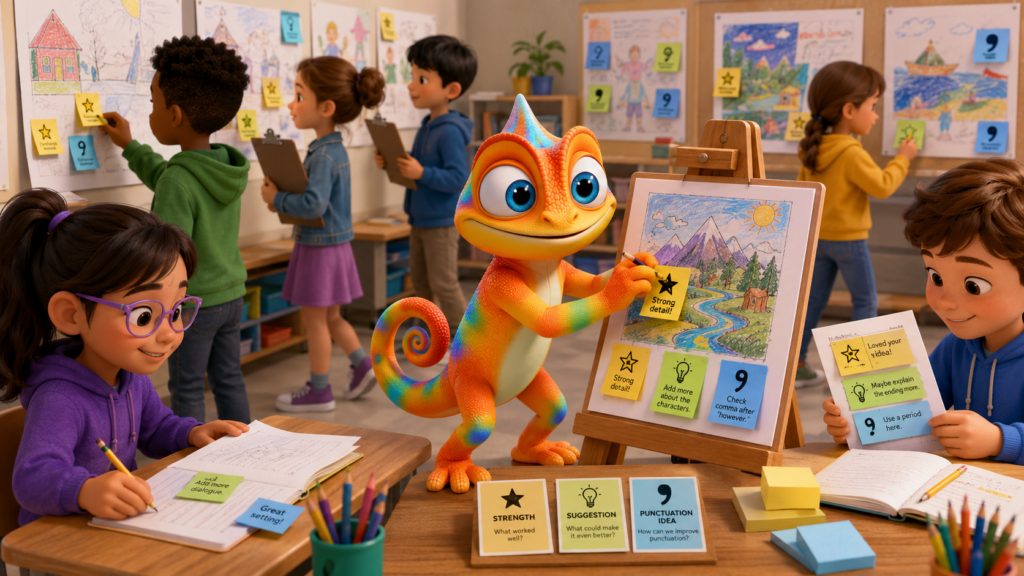
Students rotate around the room and leave feedback on classmates’ work. They must write one strength, one suggestion, and one punctuation idea. Then they return to their own draft and read the feedback they received. This activity is active and interactive because students move, read, review, and revise.
Required feedback:
- one strength
- one suggestion
- one dash or parenthesis recommendation
Part 2 – Revision Mini-Conference (20 min)
Students rotate around the room and leave feedback on classmates’ work. They must write one strength, one suggestion, and one punctuation idea. Then they return to their own draft and read the feedback they received. This activity is active and interactive because students move, read, review, and revise.
Required feedback:
- one strength
- one suggestion
- one dash or parenthesis recommendation
Part 3 – Revision Mini-Conference (20 min)
Students pair up and explain one change they will make based on feedback. They must say why the change improves the text. The teacher closes by emphasizing that peer review is useful when feedback is respectful, specific, and connected to revision.
 RUBRIC:
Peer Reviewing
NEE – Agregar el tipo de adaptaciones curriculares
Principio II: Pautas 6.1 – 6.3 – 6.4
Principio III: Pautas 7.1 – 8.1 – 9.1
ALUMNO 1: Constante monitoreo. Dar tiempo adicional para el desarrollo de la actividad y se reduce el número de ejercicios o se modifican los ejercicios con un nivel de dificultad reducido, de acuerdo con sus necesidades académicas.
ALUMNO 2: Constante monitoreo, Dar tiempo adicional para el desarrollo de la actividad y se reduce el número de ejercicios o se modifican los ejercicios con un nivel de dificultad reducido, de acuerdo con sus necesidades académicas.
ALUMNO 3: Constante monitoreo. Corroborar que el contenido entregado en clase haya sido comprendido por la estudiante mediante retroalimentación.