
Unit 2: K-Learning Project
SKILLS
EFL 4.4.8 Convey information and ideas through simple transactional or expository texts on familiar subjects using ICT tools and conventions and features of English appropriate to audience and purpose.
EFL 4.1.9 Recognize the consequences of one’s actions by demonstrating responsible decision-making at school, online, at home and in the community.


REAL-LIFE APPLICATION
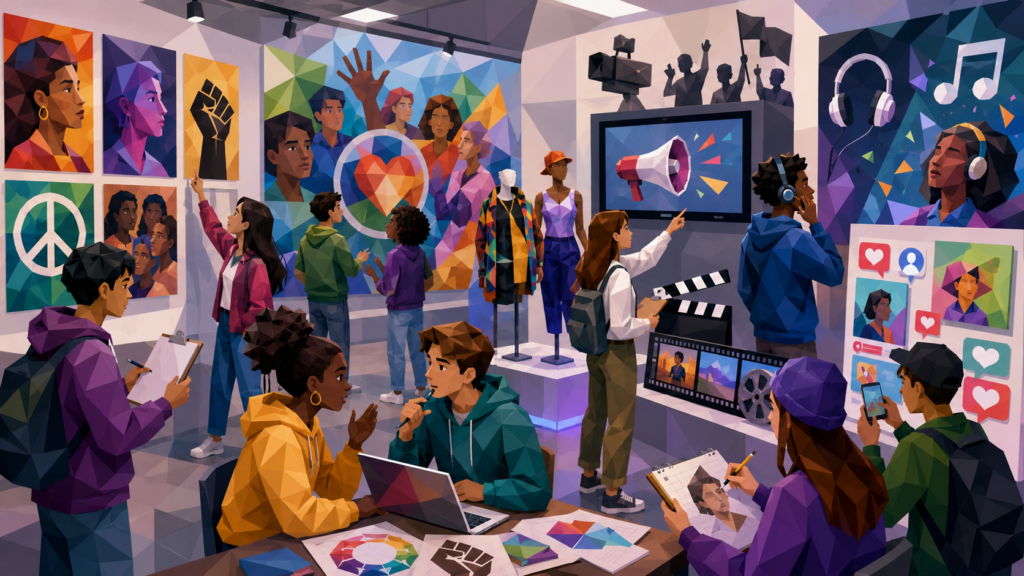
This project helps students understand that cultural products are not just entertainment or decoration. A song, mural, movie, poster, clothing style, meme, advertisement, or traditional object can communicate ideas about identity, power, rights, history, gender, class, community, or social change. Students learn to look closely, identify a message, and explain how the product affects people or reflects society.
LEARNING ACTIVITIES
SESSION 1 (80 min) ANTICIPATION

Part 1: Anticipation: Culture Detective Gallery (20 min)
The teacher reads short AI ethics statements and students move to one side of the room if they agree, the other side if they disagree, or the middle if they are unsure. After each statement, two or three students explain their position briefly. The teacher guides students to notice that AI is not only a technology topic; it also affects privacy, fairness, learning, and responsibility.

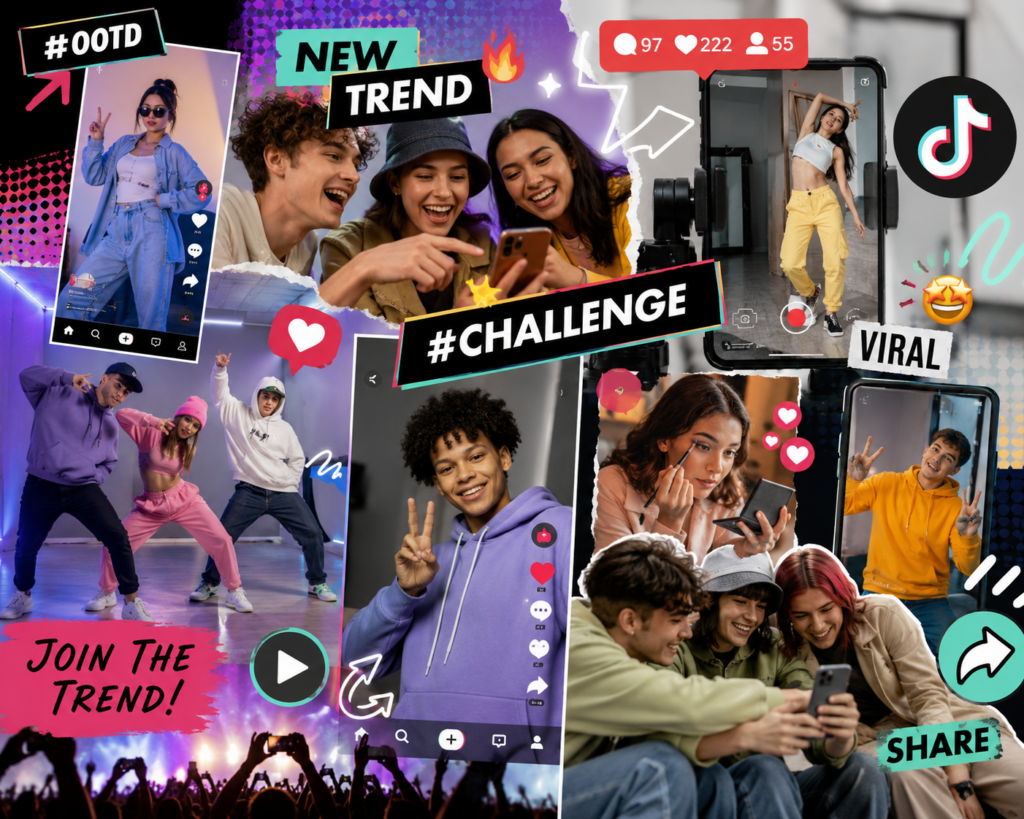
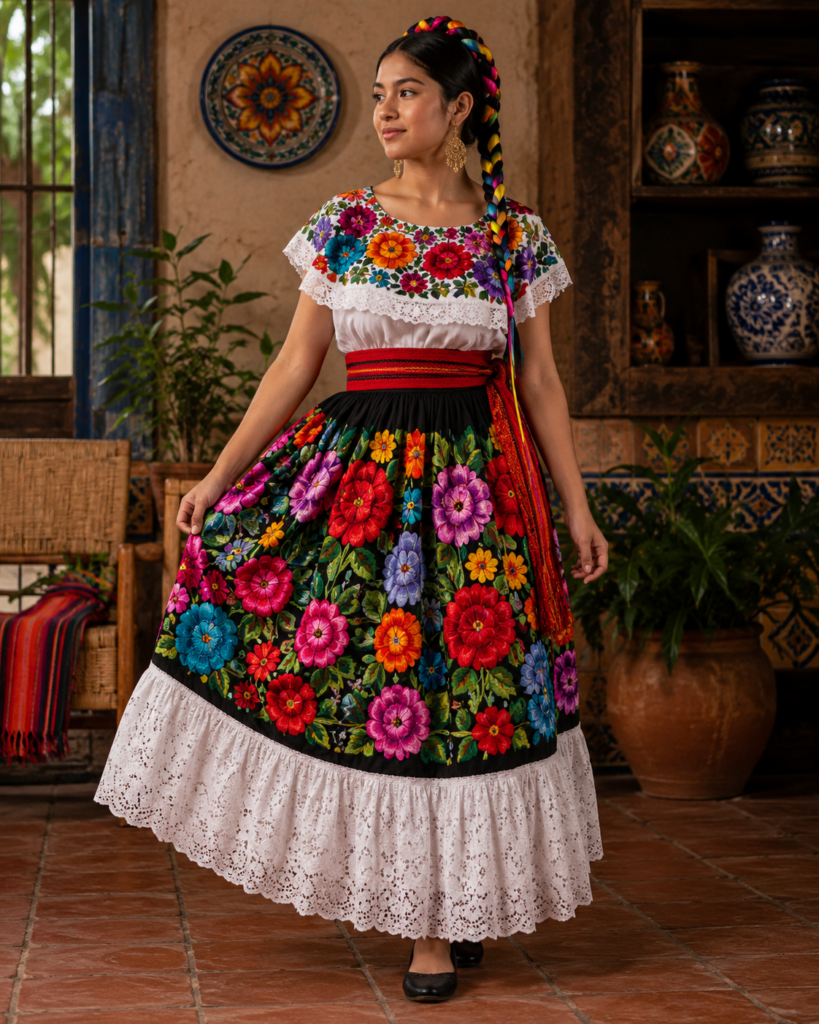
Quick Observation Questions:
What colors do you notice first?
What people or objects appear?
What emotion does it create?
What message might it send?
Who might feel represented?
Who might feel excluded?
What social issue could be connected?
Is it traditional, modern, or both?
Is it made to entertain, inform, protest, or sell?
What question would you ask about it?
CONSTRUCTION
Part 2: Vocabulary Development (15 min)
The teacher introduces vocabulary students need to analyze cultural products.
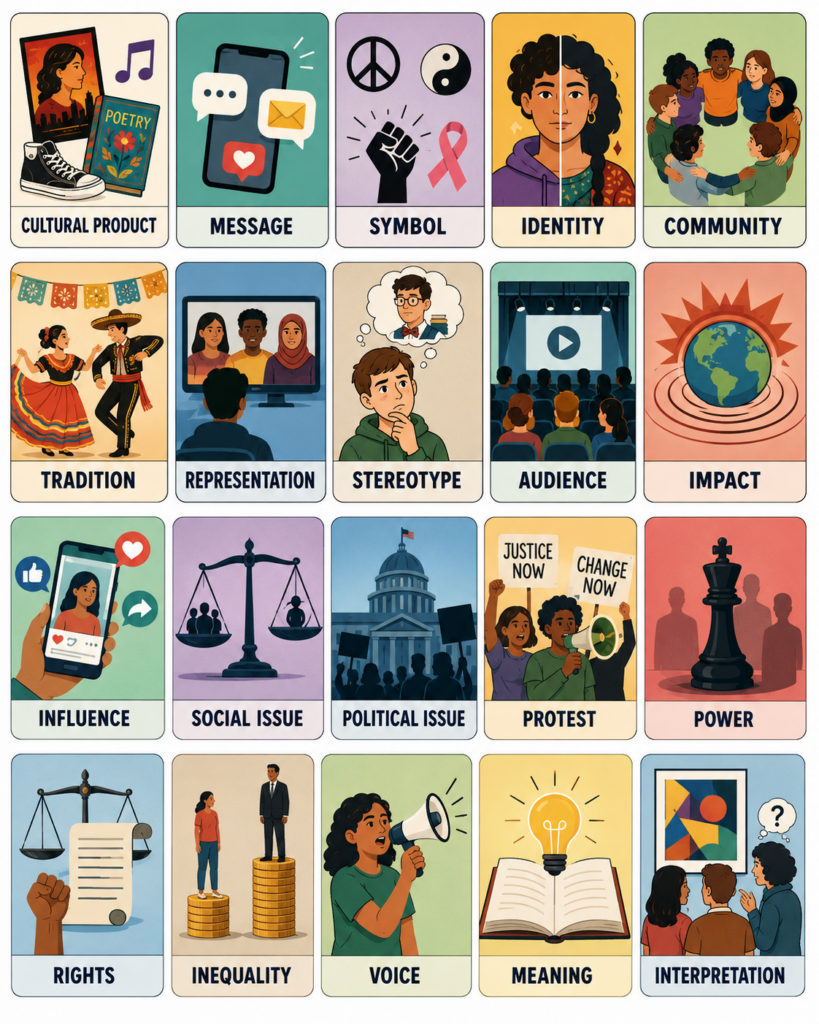
cultural product
message
symbol
identity
community
tradition
representation
stereotype
audience
impact
influence
social issue
political issue
protest
power
rights
inequality
voice
meaning
interpretation
Part 3: Analytical Input: What Does It Mean to Deconstruct? (20 min)
Explanation:
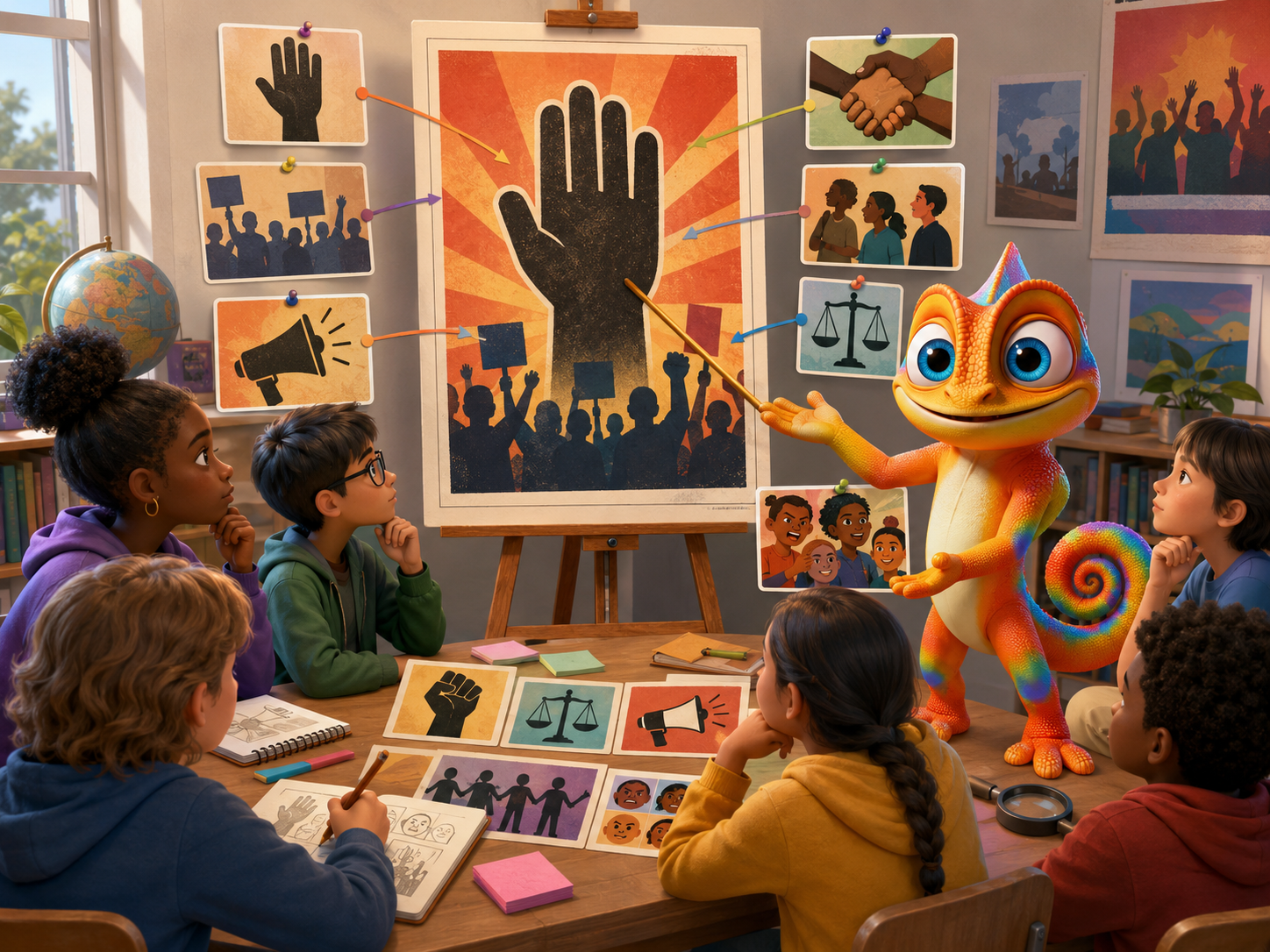
What Does It Mean to Deconstruct a Cultural Product?
To deconstruct a cultural product means to break it into parts and analyze how those parts create meaning. Students move beyond simple opinions like “I like it” or “I don’t like it.” Instead, they explain what they notice, what symbols may represent, what social issue appears, and how the product could influence people.
A cultural product can be:
- a song
- a mural
- a movie
- a meme
- a fashion style
- a poster
- a social media trend
Example:
A protest poster with a raised hand may symbolize resistance, unity, and the demand for rights.
Simple Structure
1. What is it?
Identify the product.
“It is a protest poster.”
2. What do you notice?
Describe important details.
“I notice dark colors and raised hands.”
3. What does it represent?
Explain the possible meaning.
“The raised hand may represent resistance and unity.”
4. What issue does it connect to?
Connect it to society or politics.
“It connects to equality and human rights.”
5. What impact can it have?
Explain how people may react.
“It may inspire people to speak out against injustice.”
Exercise: Cultural product and Message
Part 4: Object Autopsy Table (25 min)
Students work in small groups. Each group receives one image of a cultural product. They complete an “object autopsy” orally before writing anything. One student describes the object, one identifies symbols, one explains possible message, and one connects it to a social issue. The teacher circulates and helps students move from description to analysis.
Cultural product options:
- A mural about equality
- A song about migration
- A poster about climate action
- A traditional clothing item
- A movie poster about discrimination
- A meme about student pressure
- A public statue
- A social media campaign
- A sports team symbol
- A festival mask
Speaking frame:
“This product is…”
“I notice…”
“This may symbolize…”
“It connects to…”
“It can affect people because…”
SESSION 2: CONSTRUCTION – REINFORCEMENT (40 min)
Part 1 – Symbol Auction (15 min)
The teacher shows symbols such as a dove, chains, a bridge, a mask, a flag, a broken wall, a raised hand, a microphone, a clock, and a mirror. Groups “bid” on the symbol they think is most powerful for social impact. They must explain their choice in one oral sentence. This makes analysis playful and competitive.
Explain the possible meaning of each symbol.
- Dove
- Chain
- Bridge
- Mask
- Flag
- Broken wall
- Raised hand
- Microphone
- Clock
- Mirror
Part 2 – Impact Speed Talk (15 min)
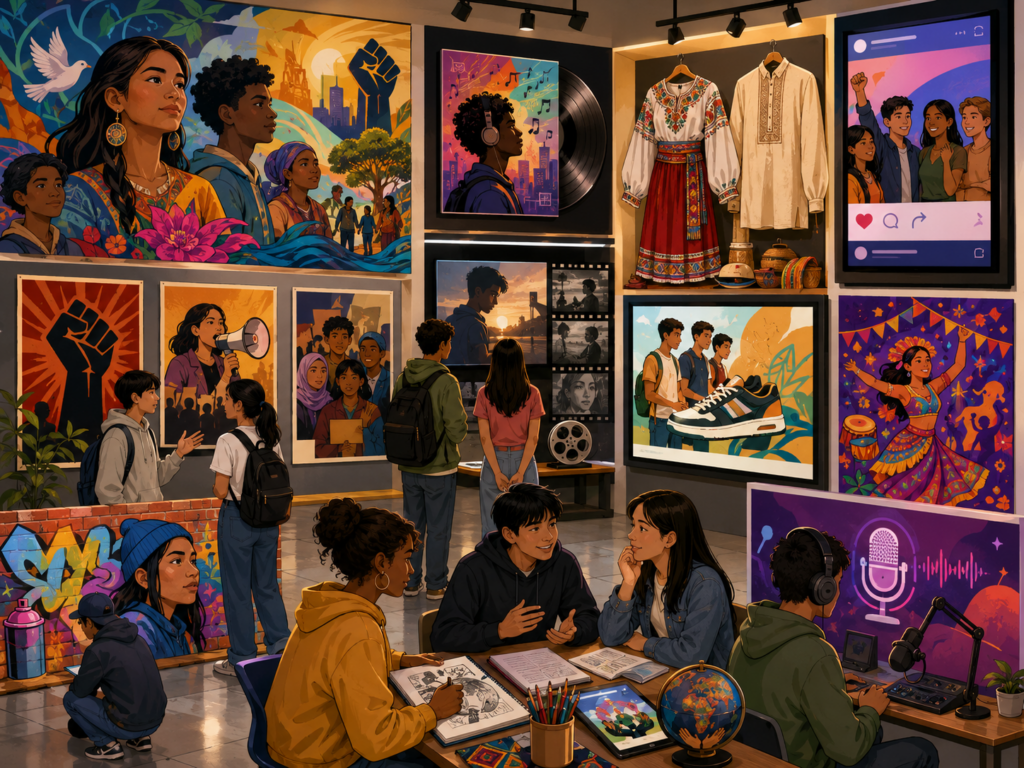
Students stand in two lines facing each other. The teacher shows a cultural product image. Student A has 30 seconds to describe it. Student B has 30 seconds to explain its possible impact. Then one line moves, and students repeat with a new partner and new image. This builds oral stamina before the final 90-second task.
Part 3 – Exit Analysis Line (10 min)
Each student writes and says one analytical sentence.
Frames:
“This product represents…”
“This product may influence people because…”
“This product connects to the issue of…”
“This product gives voice to…”
SESSION 3: CONSOLIDATION (80 min)
Part 1 – Preparation: Cultural Product Museum (15 min)
Students choose one AI ethics motion and prepare speaking notes, not a full script. They must include one claim, one reason, one passive structure, and one closing sentence. The teacher reminds them that rhetorical stamina means speaking clearly for 60–90 seconds without stopping after one sentence.
Cultural product choices:
A mural
A song
A movie poster
A traditional object
A clothing item
A social media trend
A protest poster
A festival performance
A public statue
An advertisement
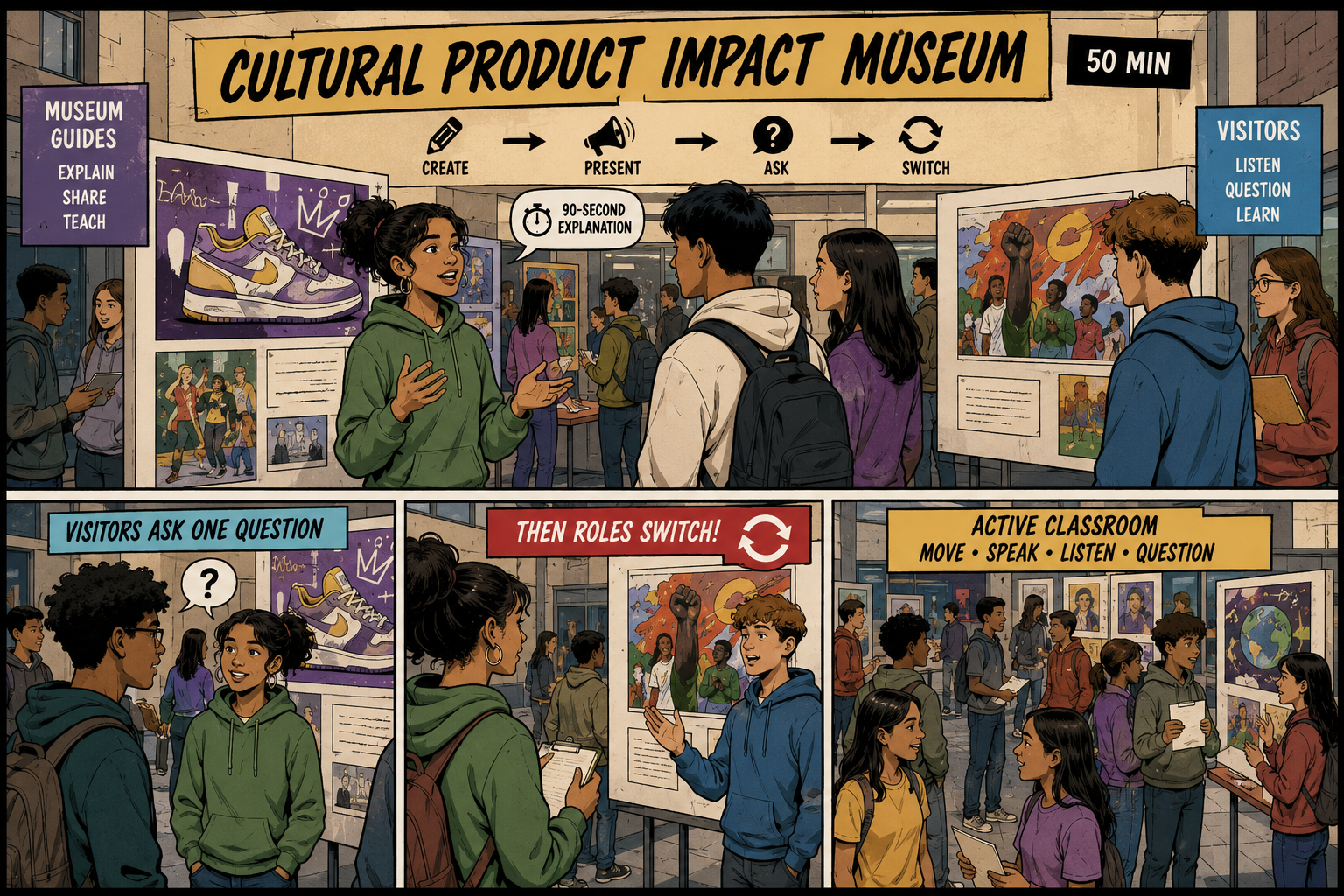
Part 2 – Cultural Product Impact Museum (50 min)
Students create a small museum station with an image or drawing of their cultural product. Half of the class becomes museum guides, and the other half becomes visitors. Each guide gives a 90-second explanation. Visitors ask one question. Then roles switch. This keeps the class active because students move, speak, listen, and question.
Required structure:
- Identify the product.
- Describe two visible details.
- Explain one symbol.
- Explain one social or political connection.
- Explain possible impact.
- Answer one visitor question.
Visitor questions:
- Who is represented in this product?
- What message does it communicate?
- What symbol is most important?
- What social issue is connected?
- Who might agree with the message?
- Who might disagree with the message?
- Why is this product important?
- How could it influence young people?
- Does it challenge stereotypes?
- Does it show tradition, change, or both?
Part 3 – Museum Reflection Vote (15 min))
Students vote for the cultural product with the strongest impact, not the prettiest product. They must explain their vote using one analytical sentence. The teacher closes by explaining that cultural products shape the way communities see themselves and others.
 RUBRIC:
KLearning Cultural Product
NEE – Agregar el tipo de adaptaciones curriculares
Principio II: Pautas 6.1 – 6.3 – 6.4
Principio III: Pautas 7.1 – 8.1 – 9.1
ALUMNO 1: Constante monitoreo. Dar tiempo adicional para el desarrollo de la actividad y se reduce el número de ejercicios o se modifican los ejercicios con un nivel de dificultad reducido, de acuerdo con sus necesidades académicas.
ALUMNO 2: Constante monitoreo, Dar tiempo adicional para el desarrollo de la actividad y se reduce el número de ejercicios o se modifican los ejercicios con un nivel de dificultad reducido, de acuerdo con sus necesidades académicas.
ALUMNO 3: Constante monitoreo. Corroborar que el contenido entregado en clase haya sido comprendido por la estudiante mediante retroalimentación.