
Environmental Advocacy
SKILLS
EFL 4.3.4 Find the most important information in print or online sources in order to support an idea or argument.
EFL 4.4.4 Write to describe feelings/ opinions in order to effectively influence an audience. (Example: persuade, negotiate, argue, etc.)


REAL-LIFE APPLICATION

This topic helps students speak and write about environmental action in a future-focused way. They learn to explain what people will be doing at a specific future moment and what communities will have achieved by a future deadline. This is useful when students create environmental campaigns, discuss sustainable habits, understand climate-related messages, participate in school projects, and imagine how young people can influence the future.
LEARNING ACTIVITIES
SESSION 1 (80 min) ANTICIPATION
Part 1: Future Postcards from 2050 (20 min)
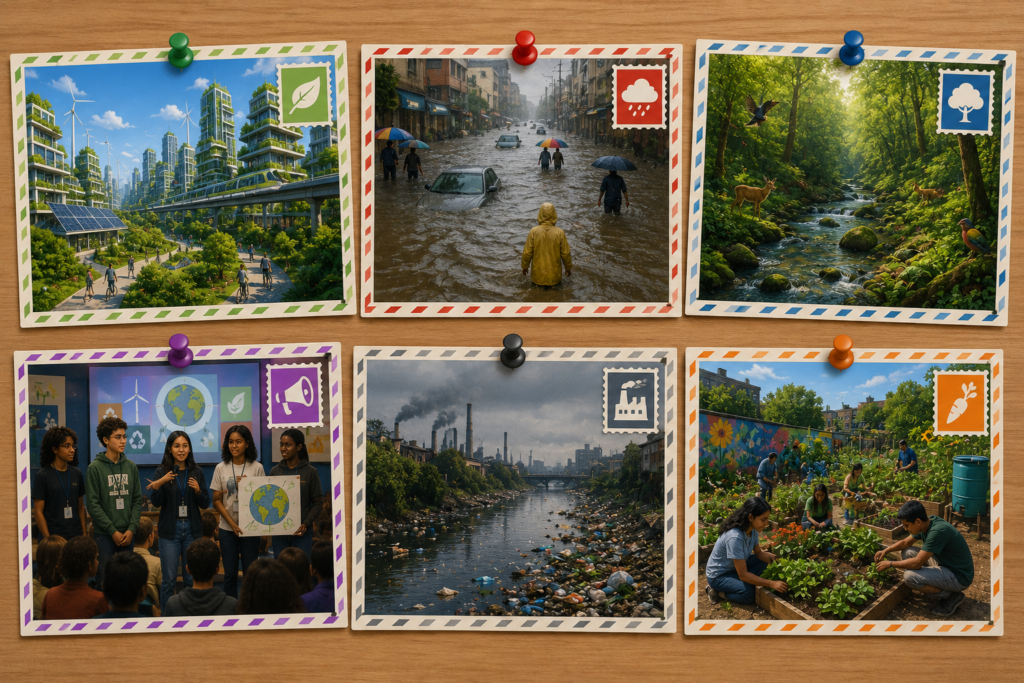
The teacher gives groups “future postcards” with images only. Each postcard shows a possible future: a green city, a flooded street, a restored forest, students presenting at a climate event, a polluted river, or a community garden.
Students choose one postcard and answer orally:
What is happening in this future?
What problem probably existed before?
What action did people take?
What will people be doing in this scene?
What will they have changed by this future year?
The teacher guides students from simple observations to future forms.
Simple answer:
“People are planting trees.”
Future Continuous:
“In 2050, people will be planting trees to protect the city.”
Future Perfect:
“By 2050, the community will have planted many trees.”
The purpose is to make students notice the difference between a future action in progress and a future result that is already complete.
Part 2: Vocabulary Activation: Eco-Gesture Gallery (15 min)
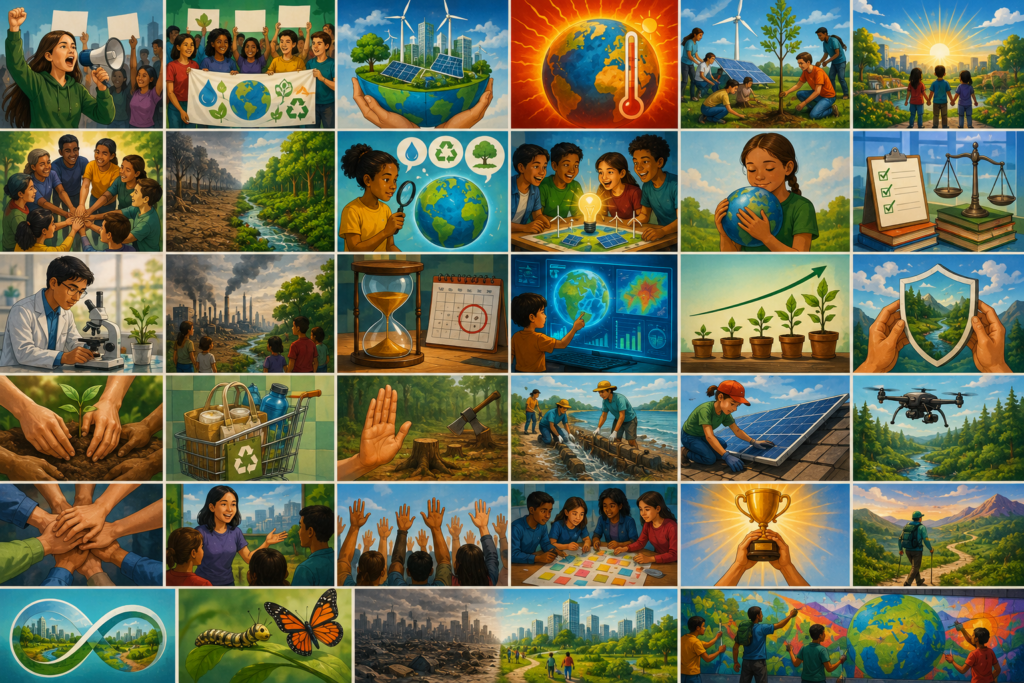
students create silent gestures for key environmental advocacy words. One student chooses a word, creates a gesture, and the group guesses. Then the student uses the word in a sentence about the future.
advocacy
campaign
sustainable development
global warming
climate action
future generation
community
restoration
awareness
solution
responsibility
evidence
impact
deadline
prediction
progress
protect
restore
reduce
prevent
adapt
improve
monitor
support
persuade
participate
organize
achieve
continue
transform
Part 3: Grammar Input: Future Clock vs. Future Finish Line (25 min)
The teacher explains the two grammar forms using two visual symbols.
The Future Clock represents Future Continuous. It focuses on an action that will be happening at a specific time in the future.
Structure:
subject + will be + verb-ing
Examples:
“Tomorrow at 10:00, students will be presenting their campaign.”
“In 2035, communities will be using more sustainable transport.”
“During the climate event, volunteers will be explaining their ideas.”
“At this time next year, our class will be working on a new advocacy project.”
The Future Finish Line represents Future Perfect. It focuses on an action that will be completed before a future deadline.
Structure:
subject + will have + past participle
Examples:
“By 2030, the city will have planted more trees.”
“By the end of the campaign, students will have created three awareness videos.”
“By next Friday, our group will have prepared the presentation.”
“By the time the event starts, volunteers will have organized the materials.”
The teacher compares both forms:
Future Continuous answers: What will be happening at that future moment?
Future Perfect answers: What will be completed by that future deadline?
Comparison:
“At 9:00 tomorrow, students will be cleaning the beach.”
This means the cleaning action will be happening at 9:00.
“By 12:00 tomorrow, students will have cleaned the beach.”
This means the cleaning action will be finished before or at 12:00.
The teacher emphasizes that students should look for time clues:
Future Continuous time clues:
- at 10:00 tomorrow
- this time next year
- during the campaign
- while the event is happening
- in 2035
Future Perfect time clues:
- by 2030
- by the end of the project
- by next Friday
- by the time the event starts
- before the deadline
Part 4: Climate Time Tunnel Challenge (20 min)
The classroom becomes a “time tunnel.” The teacher places two paths on the floor:
Path A: Future Clock
Path B: Future Finish Line
Students receive environmental advocacy situations. They must choose the correct path, stand there, and say a complete sentence.
Situations:
- The campaign is happening tomorrow at noon.
- The campaign is finished by Friday.
- Students are speaking during the event.
- The community completes the tree project by 2030.
- Volunteers are collecting evidence next Saturday.
- The group finishes the video before the presentation.
Examples:
“Tomorrow at noon, students will be presenting their climate campaign.”
“By Friday, students will have completed the campaign plan.”
SESSION 2: CONSTRUCTION – REINFORCEMENT (40 min)
Part 1 – Deadline or Moment? Floor Debate (15 min)
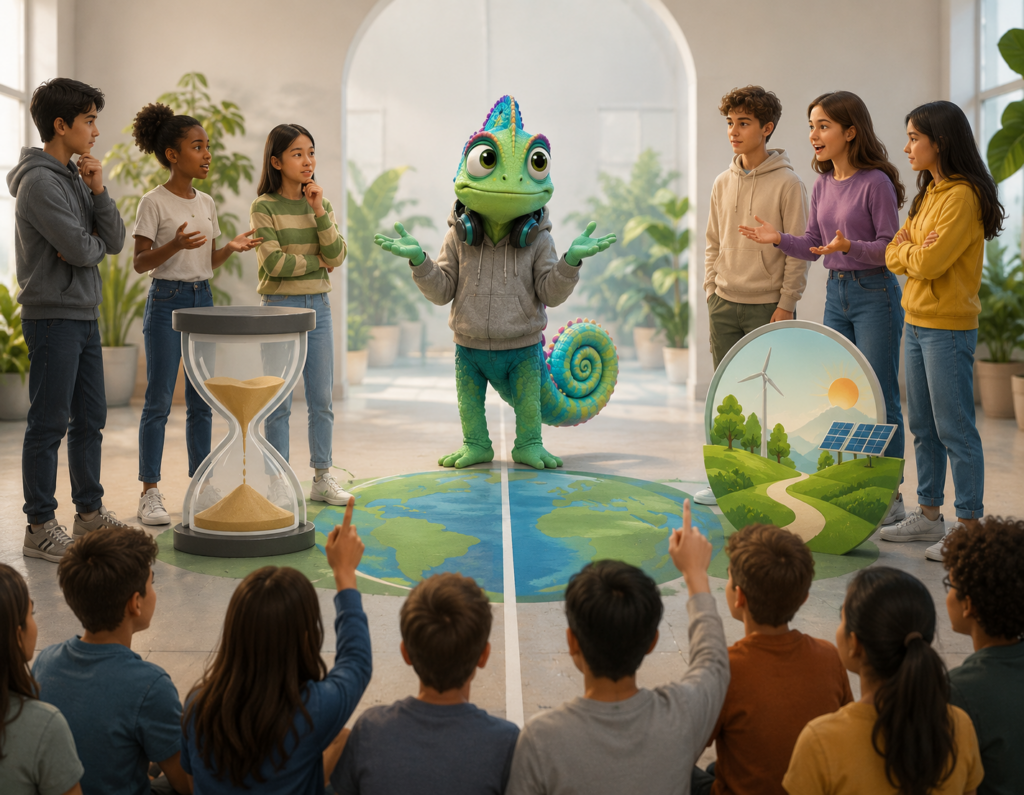
The teacher reads time expressions. Students move to one side of the room for “deadline” and the other side for “moment.” After choosing, they create an environmental sentence.
Time expressions:
- by 2030
- at 8:00 tomorrow
- by the end of the campaign
- during the climate fair
- this time next year
- by next semester
- while students are presenting
- before the deadline
- in 2040
- by the time the meeting starts
Example:
“By 2030, our city will have improved public transport.”
“During the climate fair, students will be explaining sustainable ideas.”
Part 2 – Advocacy Soundtrack Speaking (15 min)
The teacher plays short sound effects: rain, traffic, waves, crowd applause, birds, construction, a microphone, wind, footsteps, and a school bell. Students choose which environmental advocacy action the sound connects to and create a future sentence.
Examples:
“I hear traffic. In the future, people will be using cleaner transportation.”
“I hear waves. By 2035, coastal communities will have built safer spaces.”
“I hear a microphone. Tomorrow, students will be speaking about climate action.”
This activity helps students connect sound, imagination, and grammar.
Part 3 – Exit Future Pair (10 min)
Each student says two connected sentences:
One Future Continuous sentence.
One Future Perfect sentence.
Example:
“Next week, my team will be preparing an awareness poster. By Friday, we will have finished the design.”
SESSION 3: CONSOLIDATION (80 min)
Part 1 – Preparation: Future Advocacy Capsule (15 min)
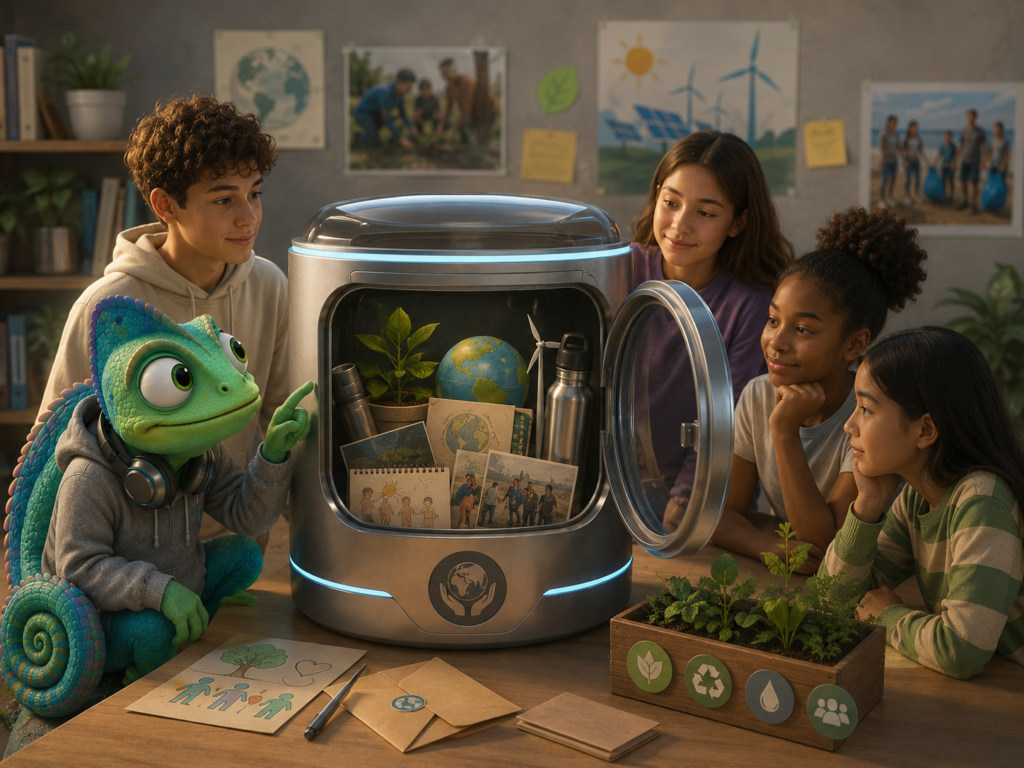
Students prepare a small “Future Advocacy Capsule.” It can be a box, envelope, digital slide, or visual card. It must include only symbols or keywords, not full paragraphs.
The capsule must show:
- environmental problem
- future action in progress
- future result completed
- one reason
- one call to action
Required language:
“At this time in the future…”
“Students will be…”
“By…”
“We will have…”
“This matters because…”
“We should…”
Part 2 – Future Advocacy Capsule Showcase (50 min)
Students present their capsule in small groups. This is not a regular poster presentation. The capsule is opened slowly, object by object or symbol by symbol. Each object activates one part of the speech.
Example:
Object 1: tree icon
“One problem is the loss of green areas.”
Object 2: microphone icon
“During the campaign, students will be speaking to the community.”
Object 3: calendar icon
“By the end of the month, we will have shared our message with three classes.”
Object 4: hand icon
“We should participate because small actions create visible change.”
Presentation requirements:
- one Future Continuous sentence
- one Future Perfect sentence
- one environmental vocabulary word
- one reason
- one call to action
Part 3 – Reflection: Future Voice Circle (15 min)
Students complete one sentence orally:
“One action young people will be doing in the future is…”
“By the end of this unit, I will have learned…”
“One environmental message I can share is…”
RUBRIC: Environmental Advocacy
NEE – Agregar el tipo de adaptaciones curriculares
Principio II: Pautas 6.1 – 6.3 – 6.4
Principio III: Pautas 7.1 – 8.1 – 9.1
ALUMNO 1: Constante monitoreo. Dar tiempo adicional para el desarrollo de la actividad y se reduce el número de ejercicios o se modifican los ejercicios con un nivel de dificultad reducido, de acuerdo con sus necesidades académicas.
ALUMNO 2: Constante monitoreo, Dar tiempo adicional para el desarrollo de la actividad y se reduce el número de ejercicios o se modifican los ejercicios con un nivel de dificultad reducido, de acuerdo con sus necesidades académicas.
ALUMNO 3: Constante monitoreo. Corroborar que el contenido entregado en clase haya sido comprendido por la estudiante mediante retroalimentación.