
Persuasive Tools
SKILLS
EFL 4.4.4. Write to describe feelings/ opinions in order to effectively influence an audience. (Example: persuade, negotiate, argue, etc.)
EFL 4.4.5. Recognize that various types of writing require different language, formatting and special vocabulary. (Example: a recipe, a letter, etc.)


REAL-LIFE APPLICATION

This topic helps students make their opinions sound stronger, clearer, and more convincing. They learn that persuasion is not only about saying “I think.” It is also about choosing sentence structures and connectors that guide the audience. Inversion helps make a message more dramatic or memorable, while connectors such as notwithstanding and consequently help organize contrast and result.
Students can use this language in campaign messages, short speeches, persuasive posters, school proposals, oral presentations, opinion paragraphs, and leadership activities.
LEARNING ACTIVITIES
SESSION 1 (80 min) ANTICIPATION
Part 1: Weak Message vs. Powerful Message — 20 min
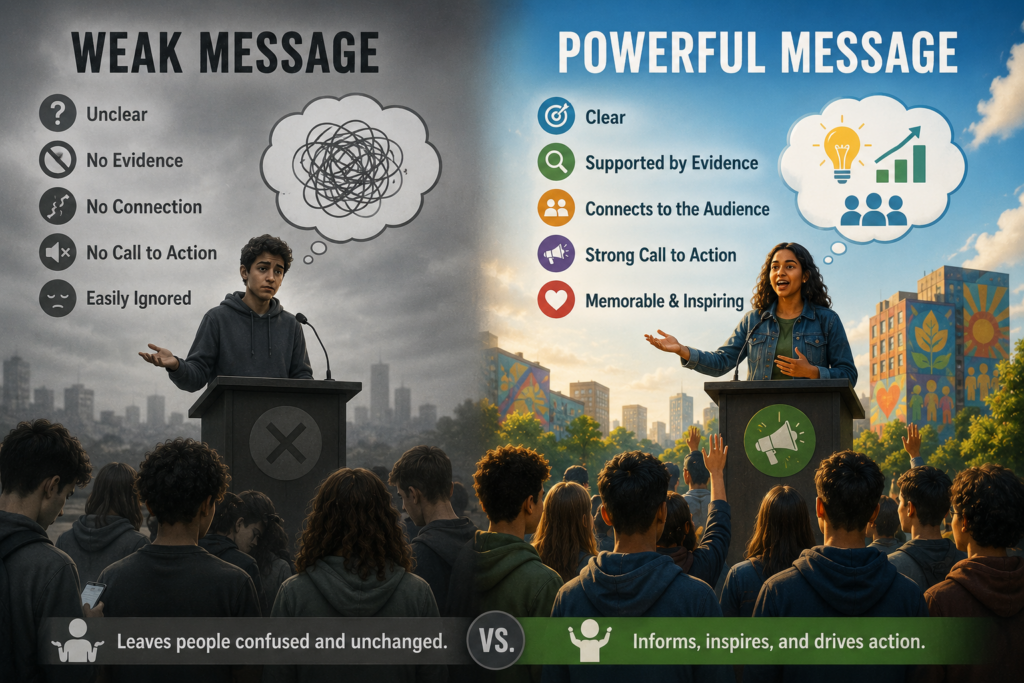
The teacher presents two versions of the same message on a public billboard-style image.
Weak version:
“Students should help more.”
Powerful version:
“Not only should students speak about change, but they should also lead it.”
Students do not receive the grammar rule yet. They compare both messages and answer:
Which message sounds stronger?
Which message sounds more formal?
Which message would work better in a campaign?
What changed in the sentence order?
What words made the message more persuasive?
The purpose is to make students feel the rhetorical effect before studying the structure.
Part 2: Vocabulary Activation: Campaign Soundcheck — 15 min
Students test vocabulary as if they were preparing for a public campaign. The teacher shows a word on screen, and students must say it with the correct persuasive tone: calm, urgent, formal, hopeful, or serious.
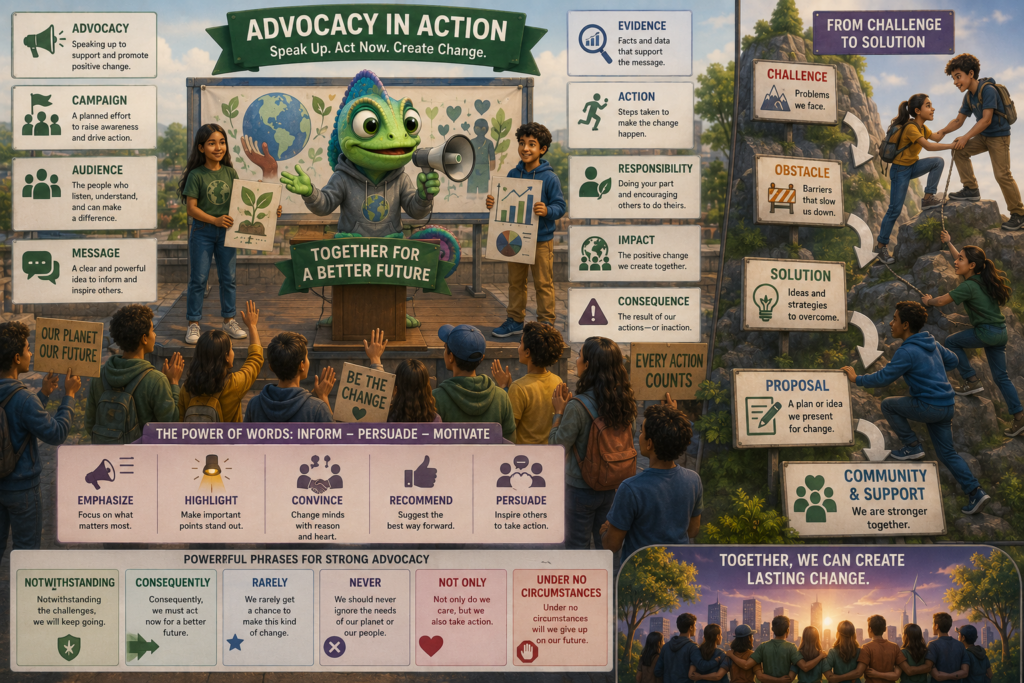
advocacy
campaign
audience
message
evidence
action
responsibility
impact
consequence
challenge
solution
obstacle
proposal
community
support
persuade
emphasize
highlight
convince
recommend
notwithstanding
consequently
rarely
never
not only
under no circumstances.
Part 3: Grammar Input: The Persuasion Spotlight Method — 25 min
The teacher explains that inversion is like putting a spotlight on the most important part of a sentence.

Normally, English uses this order:
Subject + verb
Example:
“We should never ignore the problem.”
With inversion, the sentence begins with a strong negative or restrictive expression, and then the auxiliary comes before the subject:
Never + auxiliary + subject + verb
Example:
“Never should we ignore the problem.”
This structure sounds more formal, dramatic, and persuasive. It is useful in speeches, campaign messages, opinion writing, and formal arguments.
Common inversion patterns:
Never should we ignore this issue.
Rarely do students get the chance to lead real change.
Seldom do people change without a clear reason.
Under no circumstances should we waste water.
Not only should we speak, but we should also act.
The teacher explains the connector difference:
Notwithstanding means “despite” or “even though there is a difficulty.” It introduces contrast.
Example:
“Notwithstanding the difficulty, students can still create change.”
Consequently means “as a result.” It introduces consequence.
Example:
“Students ignored the recycling system. Consequently, waste increased.”
The University of Waterloo Writing and Communication Centre explains that transition words show how ideas relate to each other and help make an argument more convincing.
Part 4: Persuasion Parkour — 20 min

The floor becomes a sentence obstacle course. Each platform represents a stronger level of persuasion:
Platform 1: normal sentence
Platform 2: stronger vocabulary
Platform 3: inversion
Platform 4: connector
Platform 5: final campaign line
Example path:
Normal sentence: “We should save water.”
Stronger vocabulary: “We should protect our water resources.”
Inversion: “Under no circumstances should we waste water.”
Connector: “Consequently, our school will become more responsible.”
Final line: “Under no circumstances should we waste water; consequently, every student must act today.”
Students move through the platforms and speak each version aloud.
SESSION 2: CONSTRUCTION – REINFORCEMENT (40 min)
Part 1 – Billboard Rewrite Challenge — 15 min
Students receive weak campaign messages and rewrite them for a public billboard.
Weak messages:
Save energy.
Recycle more.
Help the community.
Use less plastic.
Respect public spaces.
Students must create stronger versions using either inversion or advanced connectors.
Example:
Weak: “Recycle more.”
Improved: “Not only does recycling reduce waste, but it also builds responsibility.”
Part 2 – Connector Trial — 15 min
Students act as logic judges. The teacher reads persuasive sentences with connectors. Students decide whether the connector works.
Example:
“The campaign was difficult. Consequently, students tried harder.”
Students explain:
This sentence is possible, but it needs clearer cause and result.
Better: “The campaign was difficult; notwithstanding, students continued participating.”
This activity helps students understand that advanced connectors are not decoration. They must match the logic.
Part 3 – Exit Emphasis Line — 10 min
Each student says one persuasive sentence using one of these frames:
Never should we…
Rarely do students…
Notwithstanding the challenge…
Consequently, we must…
SESSION 3: CONSOLIDATION (80 min)
Part 1- Public Message Design — 15 min
Students choose one issue and prepare a public persuasive message. They prepare keywords only:
issue
audience
inversion
connector
action
Part 2 – Outdoor Campaign Voice Challenge — 50 min
Students present a short public campaign message as if they were speaking in a plaza, sports field, school entrance, or community park.
Requirements:
one clear issue
one inversion sentence
one connector sentence with notwithstanding or consequently
one call to action
clear voice and persuasive tone
Example:
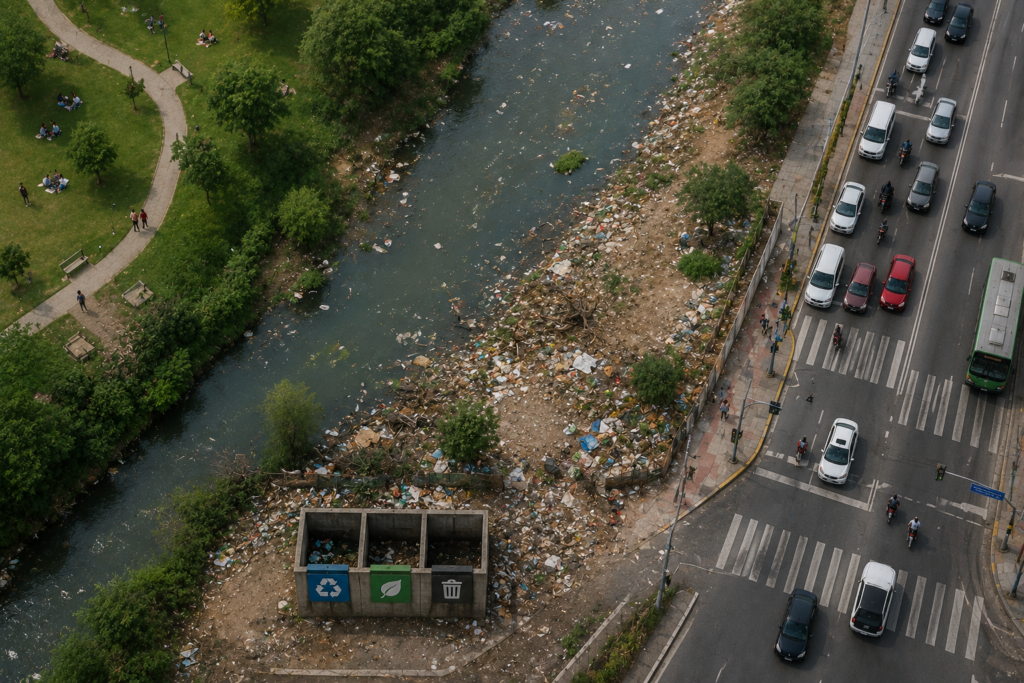
“Never should we ignore the amount of plastic we use every day. Notwithstanding the difficulty, every student can bring a reusable bottle. Consequently, our school will produce less waste. Let’s start with one simple action this week.”
Part 3 – Campaign Reflection — 15 min
Students vote for:
strongest campaign line
clearest connector use
best voice and emphasis
most realistic action
They explain their vote orally.
RUBRIC: Persuasive Tools
NEE – Agregar el tipo de adaptaciones curriculares
Principio II: Pautas 6.1 – 6.3 – 6.4
Principio III: Pautas 7.1 – 8.1 – 9.1
ALUMNO 1: Constante monitoreo. Dar tiempo adicional para el desarrollo de la actividad y se reduce el número de ejercicios o se modifican los ejercicios con un nivel de dificultad reducido, de acuerdo con sus necesidades académicas.
ALUMNO 2: Constante monitoreo, Dar tiempo adicional para el desarrollo de la actividad y se reduce el número de ejercicios o se modifican los ejercicios con un nivel de dificultad reducido, de acuerdo con sus necesidades académicas.
ALUMNO 3: Constante monitoreo. Corroborar que el contenido entregado en clase haya sido comprendido por la estudiante mediante retroalimentación.