
Critical Listening

SKILLS
EFL 4.2.3 Follow and understand short, straightforward audio messages and/or the main idea/dialogue of age-appropriate audio-visual presentations if delivered clearly and supported by visuals.
EFL 4.2.6 Use other students’ contributions in class as models for their own.


REAL-LIFE APPLICATION

Critical listening helps students understand spoken English more deeply because speakers do not always say everything directly. A speaker may sound confident, doubtful, worried, surprised, critical, or neutral depending on tone, pauses, word choice, and emphasis. This skill is useful when students listen to interviews, videos, academic explanations, school announcements, podcasts, presentations, debates, and English exams where they must infer attitude and meaning beyond the exact words.
LEARNING ACTIVITIES
SESSION 1 (80 min) ANTICIPATION
Part 1: Sound Without Words (20 min)
The teacher plays short non-verbal sounds or voice-like reactions: a confident “hmm,” a doubtful pause, a surprised reaction, a disappointed sigh, an excited tone, and a calm neutral tone.
Students do not receive written sentences at first. They only listen and decide what attitude the sound suggests.
Then the teacher reads the same sentence in different tones:
“That is an interesting idea.”
Students decide whether the speaker sounds genuinely interested, doubtful, sarcastic, surprised, or polite but unconvinced. The teacher explains that the words alone are not enough. The same sentence can communicate different meanings depending on tone, stress, speed, and pause.
This creates the foundation for critical listening: students learn that listening means interpreting sound, not only recognizing vocabulary.
Part 2: Vocabulary Activation: Tone Radar Challenge (15 min)

• critical listening
• speaker attitude
• tone
• mood
• nuance
• emphasis
• pause
• stress
• pitch
• volume
• speed
• hesitation
• certainty
• uncertainty
• confidence
• doubt
• surprise
• concern
• criticism
• support
• neutral
• positive
• negative
• cautious
• implied meaning
• main idea
• detail
• evidence
• clue
• context
• visual support
• prediction
• confirmation
• interpretation
• inference
– purpose
• opinion
• reaction
• reliable
• unclear
Students use the vocabulary list above and place selected words on the Tone Radar. The teacher should ask students to justify each placement with a listening example. If a group places “pause” under uncertainty, they must explain why. If another group places “emphasis” under confidence, they must explain how emphasis can show certainty.
The teacher can extend the activity by saying a short line and asking students to identify which vocabulary word helped them understand the attitude.
Example:
“I suppose that could work.”
Students may identify uncertainty, caution, hesitation, or doubt. The teacher reinforces that more than one word may be possible if students can justify it with evidence.
Part 3: Extended Listening Input: Main Idea, Detail, and Attitude Are Different
The teacher explains that a formal opinion essay is different from a casual opinion.
The teacher explains that students often listen only for information, but critical listening requires three levels.
Level 1: Main idea
This answers: What is the speaker mainly talking about?
Example: “The speaker is talking about a school campaign.”
Level 2: Detail
This answers: What specific information did the speaker mention?
Example: “The campaign started last month and involved two classes.”
Level 3: Speaker attitude
This answers: How does the speaker feel or what position does the speaker take?
Example: “The speaker sounds cautiously positive because they say the campaign helped, but it still needs more support.”
Students need to understand that attitude is not always stated directly. A speaker may not say, “I am doubtful.” Instead, the speaker may use phrases such as:
“It might work.”
“I’m not fully convinced.”
“That is one possible explanation.”
“The results are interesting, but…”
The teacher should model a short audio script twice. The first time, students identify the main idea. The second time, they identify speaker attitude and the evidence for it.
Part 4: Language Teaching Idea: Attitude Weather Map
The teacher introduces an “Attitude Weather Map” instead of a traditional grammar chart. Each attitude has a weather symbol:
Sunny: confident or positive
Cloudy: uncertain or cautious
Stormy: critical or negative
Windy: surprised or unexpected
Foggy: unclear or confused
Students listen to short academic comments and place them on the weather map. Then they must explain the evidence.
Example:
“The speaker says, ‘The results are promising, although more evidence is needed.’ This is cloudy because the speaker sounds positive but cautious.”
This method teaches listening nuance visually. Students learn that attitude can be mixed, not only positive or negative.
SESSION 2: CONSTRUCTION – REINFORCEMENT (40 min)
Part 1 – Audio Detective Remote (15 min)

The teacher projects a large remote control with buttons: tone, pause, stress, certainty, attitude, and evidence. Before each audio, one student chooses which button the class will focus on. If the button is “pause,” students listen only for hesitation or silence. If the button is “stress,” students listen for the word the speaker emphasizes.
This activity helps students listen with a purpose. Instead of trying to understand everything at once, they train one listening skill at a time.
Part 2 – Sound Shadow Walk (15 min)

Students listen to short comments and move to a shadow zone around the room: confident, doubtful, surprised, critical, or neutral. After moving, they explain their choice using one vocabulary word from the list.
Example:
“I chose doubtful because the speaker hesitated before answering.”
“I chose critical because the speaker stressed the word ‘problem.’”
This activity combines movement with analysis and avoids turning listening into a silent worksheet.
Part 3 – Listening Footprint Card (10 min)
Students complete a small “Listening Footprint Card” with three boxes:
- One attitude I identified
- One clue I heard
- One thing I need to listen for again
Students exchange cards with a partner, and the partner adds one short suggestion.
SESSION 3: CONSOLIDATION (80 min)
Part 1- Preparation: Critical Listening Toolkit (15 min)
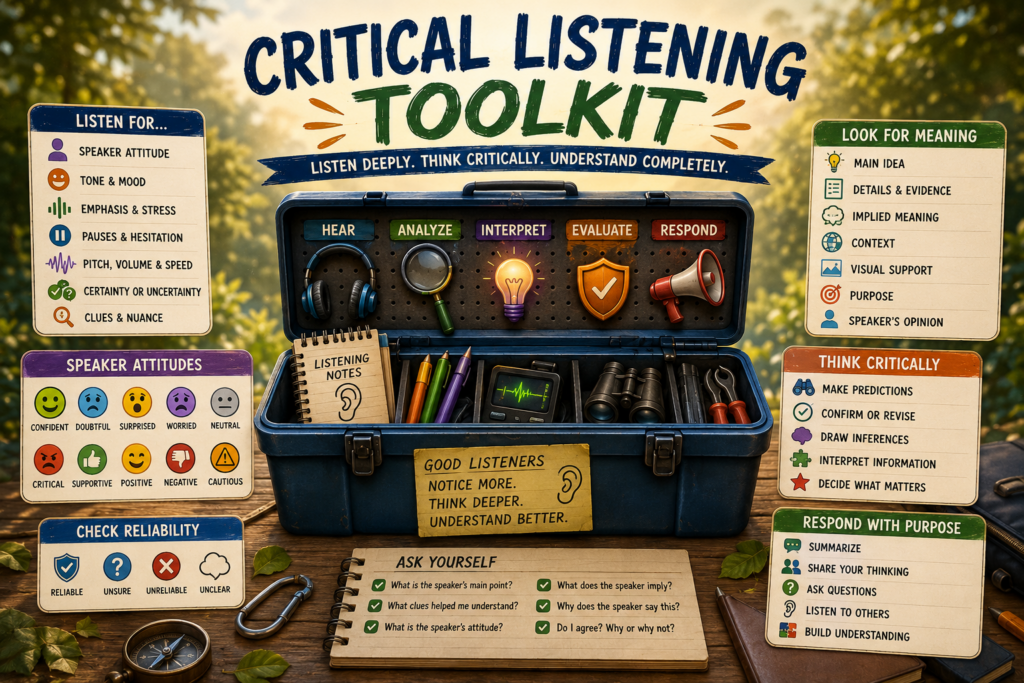
Students prepare a toolkit with five symbols:
- ear = main idea
- magnifying glass = detail
- thermometer = attitude
- cloud = uncertainty
- arrow = implied meaning
They do not write long notes. They prepare the symbols so they can listen with clear purpose.
Part 2 – Audio Mystery Trail (50 min)
The teacher plays or reads three short academic-style audios. Each audio has a different speaker attitude: one confident, one cautious, and one critical. Students work in teams to complete the Audio Mystery Trail.
For each audio, they must identify:
- main idea
- one important detail
- speaker attitude
- evidence from tone or wording
- one implied meaning
They then create a 30-second oral report.
Example:
“The audio is mainly about using digital tools for homework. One detail is that students use them for research and writing. The speaker sounds cautious because they say the tools can help, but only if students use them responsibly.”
Part 3 – Listener Evidence Wall (15 min)

Teams add one sticky note or digital note to the Listener Evidence Wall. Each note must include:
- attitude
- clue
- reason
Example:
“Attitude: cautious. Clue: ‘might help.’ Reason: the speaker does not sound completely certain.” The class does a quick gallery walk and chooses the clearest evidence note.

RUBRIC: Critical Listening
NEE – Agregar el tipo de adaptaciones curriculares
Principio II: Pautas 6.1 – 6.3 – 6.4
Principio III: Pautas 7.1 – 8.1 – 9.1
ALUMNO 1: Constante monitoreo. Dar tiempo adicional para el desarrollo de la actividad y se reduce el número de ejercicios o se modifican los ejercicios con un nivel de dificultad reducido, de acuerdo con sus necesidades académicas.
ALUMNO 2: Constante monitoreo, Dar tiempo adicional para el desarrollo de la actividad y se reduce el número de ejercicios o se modifican los ejercicios con un nivel de dificultad reducido, de acuerdo con sus necesidades académicas.
ALUMNO 3: Constante monitoreo. Corroborar que el contenido entregado en clase haya sido comprendido por la estudiante mediante retroalimentación.