
Interactive Mastery

SKILLS
EFL 4.2.13 Interact with reasonable ease in structured situations and short conversations within familiar contexts, provided that speech is given clearly, slowly and directly.
EFL 4.2.14 Ask and answer straightforward follow-up questions within familiar contexts.

REAL-LIFE APPLICATION

This topic helps students communicate more naturally in real conversations where they cannot memorize everything in advance. They learn how to keep speaking when they need time to think, how to respond to another person’s idea, how to ask for clarification, how to disagree politely, and how to make a shared decision. This is useful for speaking exams, group projects, interviews, class discussions, presentations, teamwork, and everyday conversations where students need to sound confident, respectful, and flexible.
LEARNING ACTIVITIES
SESSION 1 (80 min) ANTICIPATION
Part 1: The Conversation That Stops (20 minutes)
The teacher presents two short mini-dialogues. The first one stops quickly because both speakers give short answers. The second one continues because the speakers ask questions, respond to ideas, and invite each other to continue.
Weak dialogue:
A: I think group work is good.
B: Yes.
A: Okay.
B: Yes.
Stronger dialogue:
A: I think group work is useful because students can share ideas.
B: I agree, and I would add that it helps students practice communication. What do you think is the biggest problem with group work?
A: Maybe some students do not participate enough.
B: That is true. Maybe roles could help.
The teacher asks students what made the second dialogue better. The point is to help students notice that fluency is not only speaking fast. Fluency also means keeping the conversation alive with questions, responses, examples, and repair phrases. Students should understand that interaction is a shared responsibility; both speakers must help the dialogue continue.
Part 2: Vocabulary Activation: Conversation Move Quest (15 minutes)

• spontaneous dialogue
• long turn
• turn-taking
• interaction
• response
• clarification
• follow-up question
• opinion
• reason
• example
• agreement
• disagreement
• polite interruption
• conversation repair
• hesitation
• fluency
• confidence
• teamwork
• decision
• suggestion
• summary
• transition
• speaker
• listener
• partner
• audience
• timing
• topic
• idea
• support
• connect
• extend
• clarify
• respond
• interrupt
• summarize
• decide
Students use the vocabulary list and physically or visually place words into conversation zones. The teacher should ask students to justify their choices. For example, if students place “hesitation” under “repair,” they can explain that hesitation happens when a speaker needs time and must use phrases like “Let me think about that for a moment.” If they place “audience” under “long turn,” they can explain that a speaker must organize ideas so the audience can follow. This activity should include short oral demonstrations. Students do not simply say where a word belongs; they must show how it works in speech. The goal is to make vocabulary active, practical, and connected to the final performance.
Part 3: What Is Interactive Mastery? (25 minutes)
The teacher explains that interactive mastery means being able to participate in a conversation without depending on a memorized script. A student with interactive mastery can listen to a partner, understand the direction of the conversation, respond to what was said, and keep the dialogue moving.

There are five key parts of interactive mastery:
First, students need to start clearly. A strong speaker does not begin with only “yes” or “no.” They begin with an opinion and a reason.
Example:
“I think outdoor activities are useful because they help students feel more active.”
Second, students need to extend ideas. A short answer is not enough for a long turn. Students should add reasons, examples, or personal connections.
Example:
“For example, if students learn outside, they may remember the activity better because they connect it with movement.”
Third, students need to respond to partners. Interaction is not a collection of separate speeches. Students should show that they heard the previous idea.
Example:
“That connects with what you said about motivation.”
Fourth, students need to repair problems. If they do not understand, forget a word, or lose their idea, they should use repair phrases instead of stopping.
Examples:
“Could you repeat that?”
“Let me say that again.”
“What I mean is…”
“I forgot the word, but I mean…”
Fifth, students need to share the conversation. Strong speakers do not dominate. They invite the partner to participate.
Examples:
“What do you think?”
“Do you agree?”
“Would you add something?”
Part 4: Language Teaching Idea: Conversation Traffic System (20 minutes)
The teacher introduces conversation as a traffic system. Each phrase has a purpose.
Green light phrases move the conversation forward:
“I would add that…”
“Another reason is…”
“For example…”
Yellow light phrases slow the conversation to clarify:
“Could you explain that?”
“What do you mean by…?”
“Let me check if I understood.”
Redirection signs bring the conversation back:
“Going back to the main point…”
“Let’s return to the question.”
“The main issue is…”
Bridge phrases connect ideas:
“That connects with…”
“Building on your idea…”
“This is similar to…”
Decision phrases close the interaction:
“So, we agree that…”
“Our final decision is…”
“The best option seems to be…”
Students practice by receiving one phrase and deciding whether it is a green light, yellow light, redirection sign, bridge, or decision phrase. Then they use it in a short spoken exchange.
SESSION 2: CONSTRUCTION – REINFORCEMENT (40 min)
Part 1 – Silence Rescue Mission (15 minutes)

The teacher explains that silence is normal in spontaneous speaking, but students need strategies to recover.
In pairs, Student A begins speaking about a topic for 20 seconds and then intentionally stops. Student B must rescue the conversation using a phrase and a question.
Example:
A: “I think school projects are useful because they help students…”
B: “Maybe we can think of an example. What project helped you learn something?”
This activity teaches students that conversations do not fail because there is a pause. They fail when nobody knows how to restart. Students practice using phrases such as “Let’s look at another angle,” “Can we compare two options?”, and “What would happen if…?”
Part 2 – Partner Echo and Extend (15 minutes)
Students practice Active listening by repeating the meaning of a partner’s idea in different words and then adding something new. The teacher should model that echoing does not mean copying. It means showing understanding.
Example:
A: “Group work can be unfair.”
B: “So you mean that sometimes not everyone works equally. I would add that clear roles can help solve that problem.”
This activity is useful because many students wait for their turn instead of listening. Echo and extend forces them to build on the previous idea, which makes the interaction more natural and more advanced.
Part 3 – Two-Minute Partner Checkpoint (10 minutes)
Students complete a quick partner checkpoint instead of an exit sentence. Each pair answers orally:
Which phrase helped us continue speaking?
Which moment was difficult?
Did both partners speak?
What will we improve in the final interaction?
This closing task helps students reflect on interaction quality before Friday’s performance.
SESSION 3: CONSOLIDATION (80 min)
Part 1- Preparation: Five-Move Speaking Card (15 minutes)
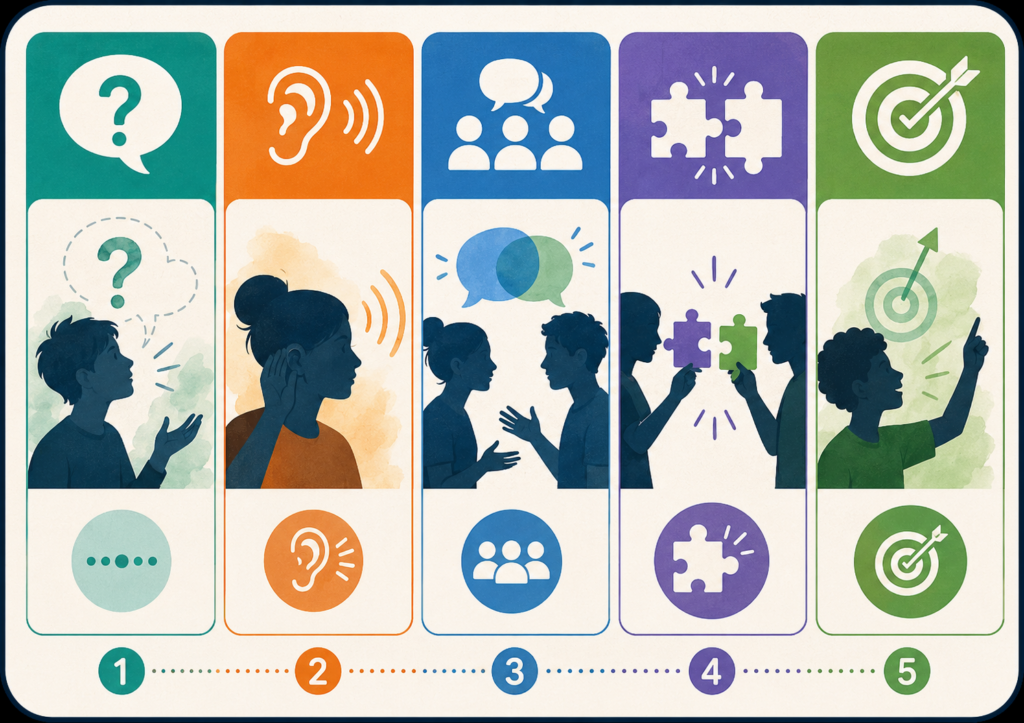
Students prepare a small speaking card with five keywords only:
opinion
reason
example
partner question
decision
The teacher should remind students that this is not a script. It is a support card to help them remember the structure. Students should not write full sentences because the goal is spontaneous interaction.
Part 2 – Final Interaction Stamina Round (50 minutes)

Students work in pairs or groups of three. They receive a decision task and must discuss it naturally. Each student must speak in one longer turn and also respond to a partner.
Possible decision tasks:
Choose the best final class project: podcast, campaign, short documentary, or live presentation.
Choose the best school improvement idea: quiet zone, peer mentors, student clubs, or digital wellbeing guide.
Choose the best English practice event: debate circle, interview fair, speaking games festival, or story night.
Requirements:
Each student gives one developed opinion.
Each student asks one follow-up question.
Each student responds to a partner’s idea.
The group uses at least two turn-taking phrases.
The group reaches a final decision.
This activity works as the final performance because students must combine long turns, spontaneous dialogue, clarification, listening, and decision-making.
Part 3 – Interaction Replay Feedback (15 minutes)
After the performance, students do not simply vote for the “best speaker.” They identify one specific interaction moment that worked well.
Feedback categories:
best clarification
best partner response
best long turn
best repair phrase
best final decision
Students explain their choice using evidence:
“I chose this pair for best clarification because they asked the partner to explain before disagreeing.”
RUBRIC:
Interactive Mastery
NEE – Agregar el tipo de adaptaciones curriculares
Principio II: Pautas 6.1 – 6.3 – 6.4
Principio III: Pautas 7.1 – 8.1 – 9.1
ALUMNO 1: Constante monitoreo. Dar tiempo adicional para el desarrollo de la actividad y se reduce el número de ejercicios o se modifican los ejercicios con un nivel de dificultad reducido, de acuerdo con sus necesidades académicas.
ALUMNO 2: Constante monitoreo, Dar tiempo adicional para el desarrollo de la actividad y se reduce el número de ejercicios o se modifican los ejercicios con un nivel de dificultad reducido, de acuerdo con sus necesidades académicas.
ALUMNO 3: Constante monitoreo. Corroborar que el contenido entregado en clase haya sido comprendido por la estudiante mediante retroalimentación.