
Global Nuances

SKILLS
EFL 4.1.8. Use suitable vocabulary, expressions, language and interaction styles and informal social or academic situations in order to communicate specific intentions in online and face-to-face interactions.
EFL 4.2.10. Sustain a conversational exchange on a familiar, everyday subject when carrying out a collaborative/paired learning activity in which there are specific instructions for a task.


REAL-LIFE APPLICATION
This topic helps students understand that English expressions can change depending on region, tone, and situation. A phrase that sounds friendly in one context may sound too casual or confusing in another. Students learn how to ask for clarification, rephrase ideas, and choose expressions that fit a school or semi-professional context. In real life, this helps them communicate better with international classmates, teachers, online contacts, and people from different cultures.
LEARNING ACTIVITIES
SESSION 1 (80 min) ANTICIPATION
Part 1: “What Did They Mean?” Expression Guessing Game (20 min)
The teacher shows or reads short expressions without explaining them first. Students guess the meaning based on context, tone, and facial expression. For example, the teacher says “That sounds fair enough,” “I’m not quite following,” or “That’s a bit tricky.” Students decide if the speaker agrees, disagrees, is confused, or needs more information. The teacher explains that in English, meaning is not always literal. Tone, context, and word choice change the message.
CONSTRUCTION
Part 2: Vocabulary and Expression Bank (15 min)
The teacher introduces expressions students can use to manage conversations politely. The focus is not memorizing slang randomly, but understanding when an expression is casual, polite, or more professional.
- I see what you mean.
- I’m not sure I follow.
- Could you explain that again?
- That sounds fair.
- I get your point.
- I see it differently.
- That might work.
- Let’s think it through.
- Could we try another option?
- I’m afraid I disagree.
- That’s a good point.
- I hadn’t thought of that.
- What do you mean by that?
- Could you rephrase that?
- Let’s clarify the idea.
- That sounds too informal.
- That sounds more professional.
- I agree up to a point.
- Can we find a middle ground?
- Let’s keep the tone respectful.
The teacher gives examples and asks students to repeat with different tones: friendly, confused, serious, and polite. This helps them notice that the same sentence can sound different depending on delivery.
Part 3: Nuance Input: Casual vs Professional Meaning (20 min)
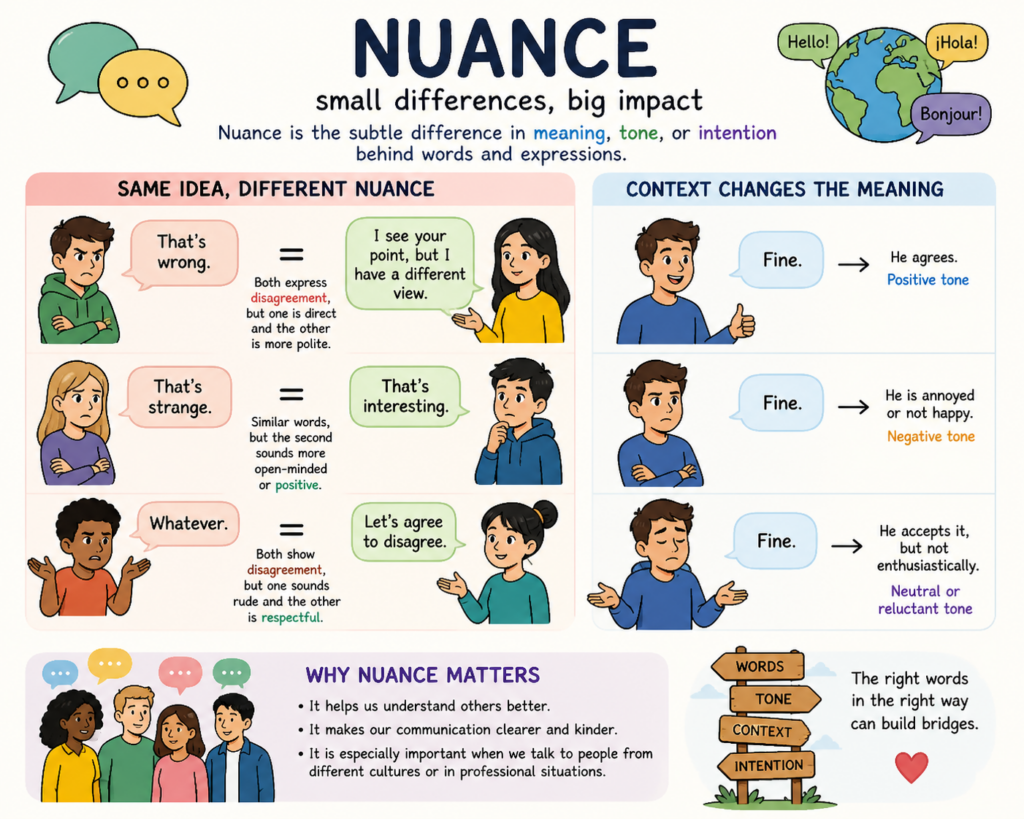
Nuance means the small difference in meaning, tone, or intention between words or expressions.
Sometimes two phrases look similar, but they do not feel the same.
Example:
“I disagree.”
This is direct.
“I see your point, but I think differently.”
This is softer and more polite.
Both mean the person does not agree, but the second one sounds more respectful.
Another example:
“That’s strange.”
This can sound negative.
“That’s interesting.”
This can sound more polite, but depending on the tone, it can also mean the person is unsure.
Nuance helps students understand not only what people say, but what they really mean.
The teacher explains that professional dialogues require careful language. Students compare casual expressions with more appropriate professional alternatives. For example, “That’s weird” can become “That seems unusual,” and “I don’t get it” can become “I’m not sure I understand.” The teacher emphasizes that students do not need to sound robotic; they need to sound clear, respectful, and appropriate.
Casual vs Professional Meaning
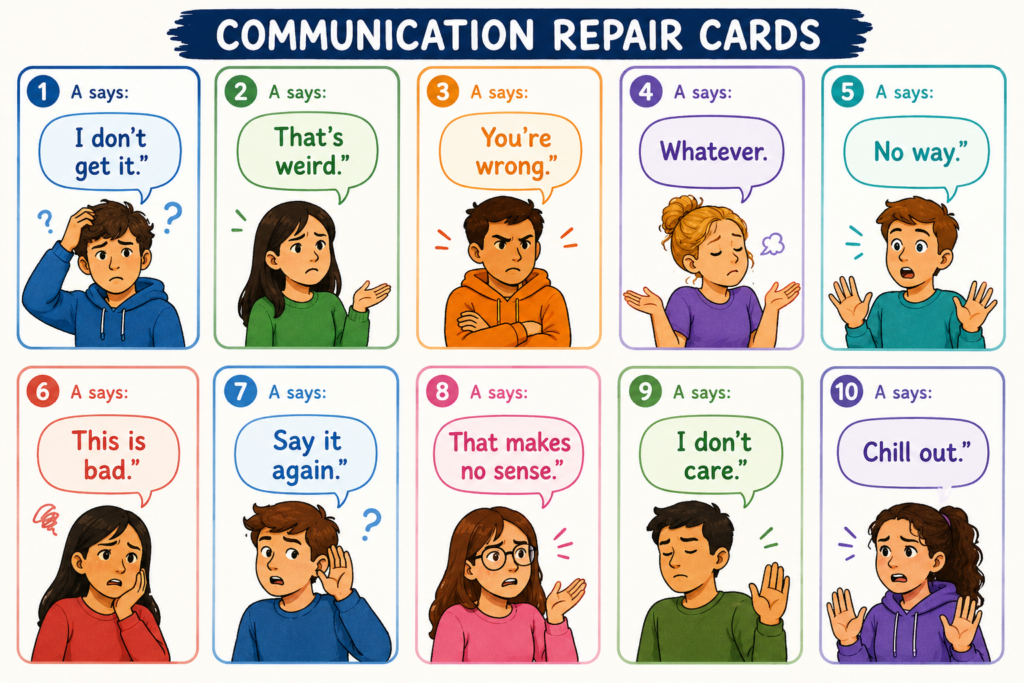
Part 4: Communication Repair Cards (25 min)
Students work in pairs with “communication repair cards.” Each card gives a small misunderstanding. One student says a casual or unclear sentence, and the other must repair the conversation using a polite phrase. The teacher models first: Student A says, “That’s weird.” Student B responds, “Do you mean that the idea seems unusual?” This activity is oral, fast, and playful, but it still builds professional speaking skills.
SESSION 2: CONSTRUCTION – REINFORCEMENT (40 min)
Part 1 – Tone Switch Challenge (15 min)
Students receive one sentence and say it in three different tones: friendly, confused, and professional. The teacher explains that tone can change how a sentence is understood. Students practice with expressions such as “I see your point,” “That might work,” and “Could you clarify?” The goal is oral control, not writing.
Exercise:
Say each sentence in two different tones: friendly and professional.
- I see your point.
- That might work.
- Could you clarify that?
- I agree up to a point.
- I’m not sure I follow.
- That seems unusual.
- Let’s think it through.
- Could we try another option?
- I hadn’t thought of that.
- Let’s keep the tone respectful.
Part 2 – Dialogue Dominoes (15 min)
Students receive shuffled dialogue lines and must build a short professional exchange. Then they perform it quickly with a partner. This is different from a role-play because students are reconstructing conversational flow before speaking. The teacher checks turn-taking, polite disagreement, and repair language.
Exercise: Put the dialogue in logical order.
“I see your point, but I think we need more information.”
“Could you clarify what you mean by ‘too risky’?”
“Maybe we should change the plan.”
“Sure. I mean that we do not have enough time.”
“That sounds fair. We could simplify the task.”
“I agree. Let’s focus on the most important part.”
“The current plan seems too risky.”
“Good idea. We can present a shorter version.”
Part 3 – Exit Micro-Dialogue (10 min)
Students create and perform a 4-line dialogue using at least two expressions from the vocabulary bank. The dialogue must include one misunderstanding and one polite repair. The teacher listens to two or three examples and corrects pronunciation, tone, and expression choice.
SESSION 3: CONSOLIDATION (80 min)
Part 1 – Preparation: Communication Repair Game (15 min)
Students prepare for an oral communication game. Each pair receives three situation cards: one misunderstanding, one disagreement, and one unclear instruction. They choose useful expressions from the vocabulary bank and decide how to respond politely. The teacher reminds them that the goal is not to memorize a script, but to react appropriately.
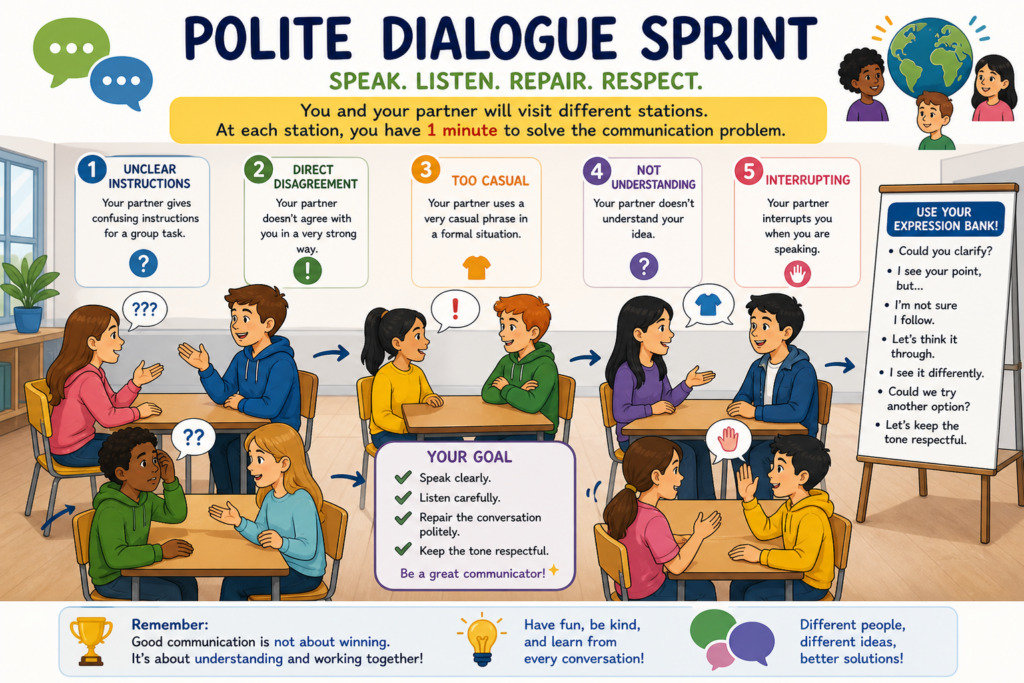
Part 2 – Polite Dialogue Sprint (45 min)
Pairs rotate through quick speaking stations. At each station, they receive a new communication problem and have one minute to solve it orally. For example, one student gives an unclear instruction, and the other must ask for clarification; one student gives a rude opinion, and the other must respond politely. The teacher evaluates spontaneous response, clarity, tone, and repair strategies.
Station cards:
Your partner gives unclear instructions for a group task.
Your partner disagrees too directly.
Your partner uses a very casual phrase in a formal situation.
Your partner does not understand your idea.
Your partner interrupts you.
Your partner says something that sounds rude but may not mean it.
Your partner gives an idea that sounds risky.
Your partner asks for help but uses informal language.
Your partner misunderstands a common expression.
Your partner wants to end the discussion without deciding.
Part 3 – Reflection Circle (20 min)
Students sit in a circle and share one expression that helped them sound more respectful or professional. The teacher closes by explaining that fluency is not only speaking quickly; it is the ability to repair communication, soften disagreement, and keep interaction respectful.
 RUBRIC:
Global Nuances
NEE – Agregar el tipo de adaptaciones curriculares
Principio II: Pautas 6.1 – 6.3 – 6.4
Principio III: Pautas 7.1 – 8.1 – 9.1
ALUMNO 1: Constante monitoreo. Dar tiempo adicional para el desarrollo de la actividad y se reduce el número de ejercicios o se modifican los ejercicios con un nivel de dificultad reducido, de acuerdo con sus necesidades académicas.
ALUMNO 2: Constante monitoreo, Dar tiempo adicional para el desarrollo de la actividad y se reduce el número de ejercicios o se modifican los ejercicios con un nivel de dificultad reducido, de acuerdo con sus necesidades académicas.
ALUMNO 3: Constante monitoreo. Corroborar que el contenido entregado en clase haya sido comprendido por la estudiante mediante retroalimentación.