
Journalism

SKILLS
EFL 5.3.3 (Reading): Identify hidden agendas, bias, and underlying cultural assumptions in complex information-rich texts (e.g., distinguishing editorial opinion from hard news).
EFL 5.4.4 (Writing): Produce clear, well-structured complex texts (news leads, short articles) using controlled organizational patterns and journalistic grammar.
EFL 5.2.2 (Oral Communication): Evaluate informational audio and media, identifying speaker stance, implicit registers, and distinguishing between verifiable facts and speculation.
REAL-LIFE APPLICATION
In an era dominated by rapid digital media and AI-generated content, media literacy is a vital survival skill. Training in journalism teaches students to interrogate sources, spot hidden agendas, and recognize how syntactic choices alter public perception. These analytical skills directly prepare them for high-level careers in law, public relations, digital marketing, and ethical content creation.
LEARNING ACTIVITIES
SESSION 1 (80 min) ANTICIPATION
Part 1 ( 15- 20 min)
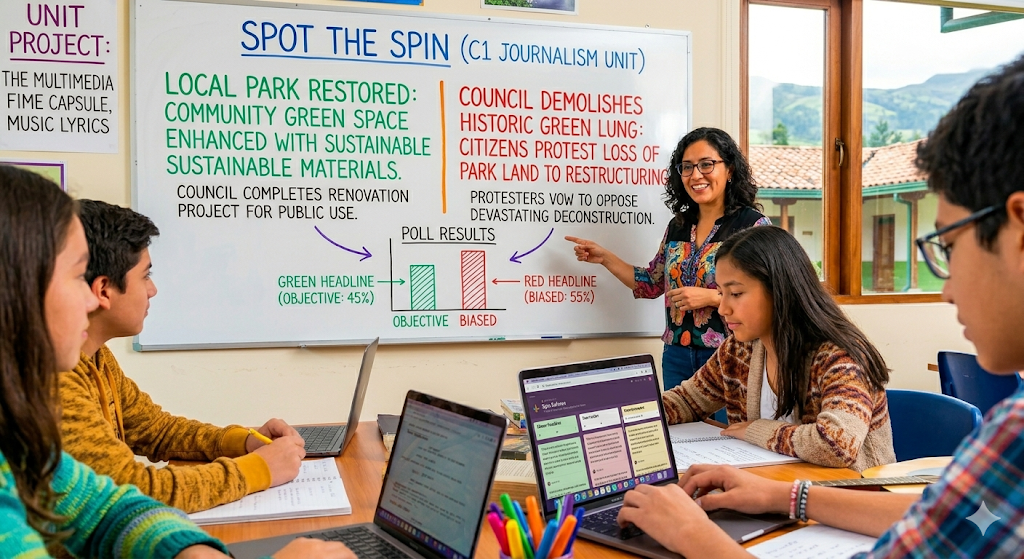
Anticipation Activity: “Spot the Spin”
- Instructions: Display two contrasting digital headlines of the same minor event (e.g., “Local Park Restructured for Modern Age” vs. “Historic Green Space Demolished by Council”).
- Task: Students use a digital polling tool (like Mentimeter or Padlet) to vote on which headline is objective and which is biased, briefly explaining their reasoning in the chat/board.
CONSTRUCTION
Part 2: Vocabulary Development (15 min)
The teacher explicitly introduces key vocabulary needed for the lesson, ensuring students clearly understand meaning and use. The phrases include:
Editorial Spin: Bias introduced by a writer to influence the reader’s opinion.
Sensationalism: The use of exciting or shocking stories at the expense of accuracy to provoke public interest.
Alleged: Asserted to be true but not yet proven (essential for legal protection).
To Verify: To make sure that something is true and accurate using reliable sources.
Inverted Pyramid: A metaphorical framework used by journalists to place the most important information at the top of an article.
Unsubstantiated: Not supported or proven by evidence.
Part 3: Grammar Review using Presentation (20 min)
Grammar Introduction: The Journalistic Passive & Hedging
- Theory: Focus on how journalists maintain objectivity by removing the agent (Passive Voice) and avoiding defamation lawsuits (Hedging Language).
- Structures:
- Passive: Object + to be + Past Participle —–>”The minister was questioned.”
- Hedging: It is alleged/reported/claimed that… —->”It is alleged that the funds were mishandled.”
- Digital Presentation: Show a quick comparison slider or side-by-side text demonstrating how “The police arrested the suspect” becomes the more objective, headline-ready “Suspect was arrested early Tuesday morning.”
Part 4: Guided Practice (25 min)
Grammar Practice Activity: “The Editor’s Desk”
- Instructions: Break students into groups and provide a shared document containing 5 highly sensationalized, active-voice social media rumors.
- Task: Students must rewrite these rumors into objective, formal, passive-voice news leads using hedging verbs.
- Deliverable: A collaborative Google Slide featuring their polished, neutral headlines.
SESSION 2: CONSTRUCTION – REINFORCEMENT (40 min)

“The Live Press Conference” (40 Mins)
- Instructions: The teacher or a selected student acts as a public figure handling a fictional, non-sensitive crisis (e.g., a tech company’s new video game app accidentally crashed global servers).
- Task:
- First 15 mins: The class acts as investigative reporters, conducting a live interview/press conference and taking dynamic notes.
- Remaining 25 mins: Students work individually to write a 150-word breaking news flash. They must include at least two passive voice structures, two vocabulary words from Day 1, and use advanced reported speech (“The CEO conceded that…”, “Spokespersons refuted claims…”).
SESSION 3: CONSOLIDATION (80 min)
Part 1 – ( 2 x 40min)
The Project: “The Digital Front Page”
Students work in editorial teams of 3 to produce a digital, single-page newspaper layout covering a major school or mock community event.
- Period 1: The Newsroom & Drafting (40 Mins)
- Groups collaborate on a design tool (like Canva).
- They must write one Hard News Article (focusing on objective passive voice) and one Editorial/Opinion Piece (focusing on identifying and applying stance).
- They must embed all 6 unit vocabulary words across the page.
- Period 2: The Editorial Pitch (40 Mins)
- Each group has 3 minutes to present their front page to the class.
- They must justify their headline choices and explain how they minimized or strategically used bias to appeal to their target audience.
- Peer assessment via a digital rubric evaluating: C1 Linguistic Precision, Accurate Passive/Hedging structures, and Visual Layout Authenticity.
NEE – Agregar el tipo de adaptaciones curriculares
Principio II: Pautas 6.1 – 6.3 – 6.4
Principio III: Pautas 7.1 – 8.1 – 9.1
ALUMNO 1: Constante monitoreo. Dar tiempo adicional para el desarrollo de la actividad y se reduce el número de ejercicios o se modifican los ejercicios con un nivel de dificultad reducido, de acuerdo con sus necesidades académicas.
ALUMNO 2: Constante monitoreo, Dar tiempo adicional para el desarrollo de la actividad y se reduce el número de ejercicios o se modifican los ejercicios con un nivel de dificultad reducido, de acuerdo con sus necesidades académicas.
ALUMNO 3: Constante monitoreo. Corroborar que el contenido entregado en clase haya sido comprendido por la estudiante mediante retroalimentación.