
K-LEARNING PROJECT
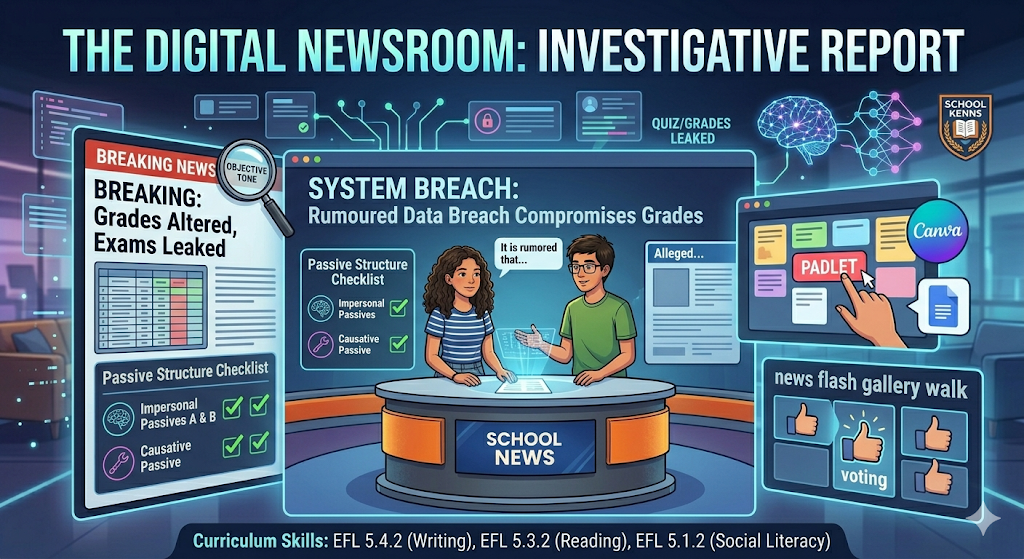
SKILLS
EFL 5.4.2 (Writing): Write a variety of digital text types (such as blogs, news reports, and columns) using appropriate vocabulary, idiomatic expressions, and advanced grammatical structures to relate a complete narrative or argue a point of view.
EFL 5.3.2 (Reading): Identify the intent, tone, and level of bias in extended texts (journalistic pieces/blogs) and understand how grammatical structures affect the objectivity of the message.
EFL 5.1.2 (Social Literacy / Communication): Demonstrate leadership and collaborative skills in digital team tasks, negotiating meaning and editing peers’ language to produce a cohesive, professional media artifact.
REAL-LIFE APPLICATION
In today’s digital era, youth are constantly bombarded by sensationalized headlines, clickbait, and unverified rumors on social media. This project mirrors the exact protocols used by real-world international journalists and media lawyers. In professional journalism, naming an unconvicted suspect or stating a rumor as an absolute fact can result in massive legal lawsuits for defamation.
By mastering advanced passive structures, students learn how to communicate critical, high-stakes information objectively, shield their sources, and maintain professional neutrality. Beyond writing, this activity directly trains their media literacy—giving them the analytical tools to spot biased reporting, evaluate how public information is framed in the news, and understand why certain language structures are chosen to shape public perception.
LEARNING ACTIVITIES
SESSION 1 (80 min)
Final Project
Period 1: Investigation & Drafting (40 Minutes)
Step 1: Brainstorming & Role Assignment (10 Mins)
Divide the class into editorial teams of 3. Introduce the breaking news scenario on the digital board.
- The Scenario: Last night, the school’s central digital database was breached. Grades were altered, and the upcoming exam questions were leaked.
- The Task: Teams must list 3 rumors circulating among students, 2 official statements from the tech department, and 1 action the principal took.
Step 2: Drafting the Report (30 Mins)
Students work together on a shared digital document to write a 120–150 word journalistic column.
Strict Grammatical Constraints (The Checklist): To get a top score, the article must include:
- [ ] 2 Impersonal Passives (Structure A: It is + PP + that): To report what the general public or authorities think without concrete evidence.
- [ ] 2 Impersonal Passives (Structure B: Subject + is + PP + to-infinitive): To focus the headline directly on key suspects or objects.
- [ ] 1 Causative Passive (Have/Get something done): To describe a security service or an unfortunate mishap experienced by the school.
- [ ] 3 Journalism/Media Vocabulary Words: (From your list: allege, presume, rumor, misleading, etc.).
Period 2: Editorial Review & Digital Publishing (40 Minutes)
Step 1: Peer-Review & Copy-Editing (15 Mins)
Teams swap digital documents with another group. Acting as “Senior Editors,” they use a digital comment tool to peer-review the draft based on two criteria:
- Journalistic Tone: Does it sound objective, or is it too gossipy/biased?
- Grammar Check: Did they correctly construct the advanced passive structures? (e.g., catching errors like “He is alleged to stole” instead of “He is alleged to have stolen”).
Step 2: Digital Layout & Publishing (20 Mins)
Groups copy-paste their finalized text into a creative template (like a Canva newspaper front page or a blogging format on Padlet). They must create:
- An eye-catching, objective passive headline (e.g., “School Server Presumed To Be Compromised By Internal Hackers”).
- A relevant digital image or graphic.
Step 3: The News Flash Gallery Walk (5 Mins)
Display the final digital articles on the main screen. The teacher reads out the best headlines, and students vote digitally on which report sounds the most objective and professionally written.
https://docs.google.com/document/d/1VX18l6sayq6FZxTLjmTt3XnVC8fpEByWxeysumErJEc/edit?usp=sharing
NEE – Agregar el tipo de adaptaciones curriculares
Principio II: Pautas 6.1 – 6.3 – 6.4
Principio III: Pautas 7.1 – 8.1 – 9.1
ALUMNO 1: Constante monitoreo. Dar tiempo adicional para el desarrollo de la actividad y se reduce el número de ejercicios o se modifican los ejercicios con un nivel de dificultad reducido, de acuerdo con sus necesidades académicas.
ALUMNO 2: Constante monitoreo, Dar tiempo adicional para el desarrollo de la actividad y se reduce el número de ejercicios o se modifican los ejercicios con un nivel de dificultad reducido, de acuerdo con sus necesidades académicas.
ALUMNO 3: Constante monitoreo. Corroborar que el contenido entregado en clase haya sido comprendido por la estudiante mediante retroalimentación.