
Film Scripts

SKILLS
EFL 5.3.4: Respond to and interpret literary texts [and scripts] as a community of readers, using appropriate vocabulary and text-based evidence.
EFL 5.4.10: Evaluate and utilize a variety of reading strategies (e.g., inferring subtext in dialogue, analyzing structural pacing/beats) to understand the literal and implied meanings of complex literary and media texts.
REAL-LIFE APPLICATION
A film script is a blueprint for human behavior and visual media. Learning how to read and analyze screenplay formatting teaches students to observe how subtle cues—such as a character’s silence, physical actions, or subtextual lines—manipulate audience perception. This is a vital skill for anyone working in digital content creation, corporate public relations, or media criticism, where every line must be meticulously engineered for maximum emotional resonance.
LEARNING ACTIVITIES
SESSION 1 (80 min) ANTICIPATION
Part 1 ( 15- 20 min)
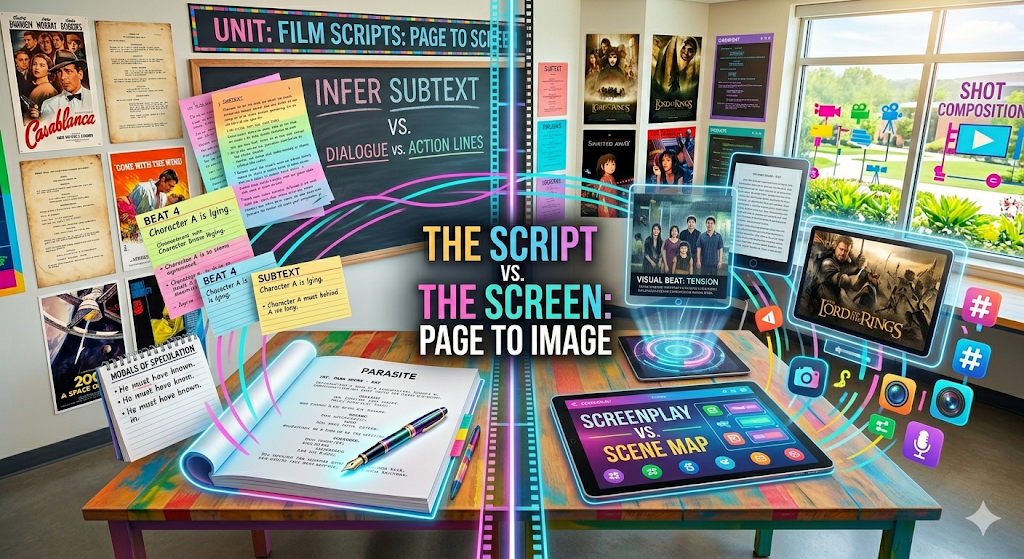
Anticipation Activity: “The Script vs. The Screen”
- Objective: Understand how screenplay formatting uses subtext and action lines to dictate meaning without outright stating it.
- Instructions:
- Distribute a half-page excerpt of a raw film script scene that features heavy subtext (e.g., two characters saying “I’m fine” while their actions imply extreme tension).
- Have two students read the dialogue flatly without acting.
- Ask the class to infer what the characters are actually feeling based purely on the action lines (parentheticals) and formatting.
- Briefly explain how screenwriting relies on the principle of “Show, Don’t Tell.”
CONSTRUCTION
Part 2: Vocabulary Development (15 min)
The teacher explicitly introduces key vocabulary needed for the lesson, ensuring students clearly understand meaning and use. The phrases include:
| Word/Phrase | Meaning | Context |
| Subtext | What a character really means, which is implied rather than explicitly stated in the dialogue. | Screenwriting |
| Action Lines | Descriptions of characters’ movements, settings, and sounds within a script scene. | Screenwriting |
| Beat | A structural pause or a dramatic shift in emotion, psychological direction, or power dynamic. | Script Analysis |
| Exposition | Background information about plot, characters, or setting explicitly dropped into dialogue (often criticized if poorly done). | Narrative Structure |
| Parenthetical | A brief note beneath a character’s name indicating their delivery or immediate action (e.g., [bitterly]). | Script Formatting |
| Voiceover (V.O.) | Dialogue spoken by an off-screen voice or a narrator tracking internal thoughts. | Screenwriting |
Part 3: Grammar Review using Presentation (20 min)
Grammar Introduction: Modals of Stance and Speculation (20 mins)
- Focus: Utilizing advanced modals (Modal + have + Past\ Participle or Modal + be + -ing) to evaluate a screenwriter’s intentions, subtext, or character motives.
- Theory: When analyzing a script, students cannot speak with 100% certainty about a character’s inner psyche unless stated in the action lines. They must use modals of speculation to construct high-level literary theories.
- Examples:
- High Certainty (Past): The protagonist must have realized her partner was lying, judging by her sudden hesitation in line 4.
- Possibility (Continuous): The screenwriter could be using the stormy weather in the scene description to mirror the crumbling marriage.
- Strong Expectation: An audience reading this subtext is bound to have inferred the betrayal long before the climax.
Part 4: Guided Practice (25 min)
Grammar Practice Activity (25 mins)
Task: “The Subtext Speculator”
Instructions:
- Distribute a short, 3-scene script outline where character motivations are left highly ambiguous.
- Working independently, students must write 5 analytical sentences evaluating why the characters acted the way they did. They must use a different modal of stance/speculation in every sentence.
- Example prompt statement: “Why did character A drop the glass?”
- Student rewrite: “Character A might well have been hiding his overwhelming shock, causing him to lose his grip on the glass.”
- Students swap with a partner to check for correct modal grammar and C1 vocabulary usage.
SESSION 2: CONSTRUCTION – REINFORCEMENT (40 min)
“The Dialogue De-Exposition Challenge” (40 mins)

- Objective: Reinforce script formatting, subtext extraction, and modal speculation.
- Instructions:
- Setup (10 mins): Provide a poorly written, highly conversational prose passage filled with heavy, unnatural exposition (e.g., “As you know, brother, since our father died three years ago and left us his printing business, I have always hated working with you.”).
- The Script Adaptation (20 mins): Students must rewrite this prose into a professional film script format. They must strip away the obvious exposition and replace it entirely with subtext, action lines, and parentheticals. They are required to use at least 3 vocabulary words from Day 1 in their formatting notes.
- The Peer Evaluation (10 mins): Students swap scripts. The peer writes 3 analytical notes using modals of stance to evaluate the rewrite (“Your use of the parenthetical [avoiding eye contact] must have been intended to highlight the sibling rivalry without saying it aloud.”).
SESSION 3: CONSOLIDATION (80 min)
Part 1 – ( 2 x 40min)
Reinforcement:
Period 1: The Script Breakdown & Textual Analysis Exam (40 mins)
- Format: Written Assessment.
- Task: Provide students with an unseen, 2-page dramatic script excerpt.
- Questions to answer:
- 3 Inference questions focused on identifying specific beats and tracking shifts in character power dynamics.
- 2 Sentence-transformation tasks turning plain, descriptive observations about the scene into advanced modal speculation sentences.
- A formatting critique where they point out how the writer used action lines to deliver thematic nuance.
Period 2: The Table Read & Creative Pitch (40 mins)
- Format: Speaking & Rhetorical Application Assessment.
- Task: “The Directorial Pitch.”
- Instructions:
- In pairs, students select a 1-minute scene they adapted on Day 2 and perform a dynamic “table read” for the class, emphasizing the subtext vocally.
- Following the reading, they have 1 minute to deliver a formal directorial defense to the class explaining their artistic choices.
- Rubric Criteria: They must naturally speak with a formal C1 tone, utilizing at least two different modals of stance to defend what the audience should infer from their performance, alongside 2 target vocabulary words from the unit.
NEE – Agregar el tipo de adaptaciones curriculares
Principio II: Pautas 6.1 – 6.3 – 6.4
Principio III: Pautas 7.1 – 8.1 – 9.1
ALUMNO 1: Constante monitoreo. Dar tiempo adicional para el desarrollo de la actividad y se reduce el número de ejercicios o se modifican los ejercicios con un nivel de dificultad reducido, de acuerdo con sus necesidades académicas.
ALUMNO 2: Constante monitoreo, Dar tiempo adicional para el desarrollo de la actividad y se reduce el número de ejercicios o se modifican los ejercicios con un nivel de dificultad reducido, de acuerdo con sus necesidades académicas.
ALUMNO 3: Constante monitoreo. Corroborar que el contenido entregado en clase haya sido comprendido por la estudiante mediante retroalimentación.