
Homographs,and Homonyms
SKILLS
(EFL 5.1.2) Communication and Cultural Awareness: Understand nuances in meaning and use language flexibly for social and professional purposes
(EFL 5.3.3). Reading: Evaluate and analyze the impact of word choice on the meaning of complex texts
(EFL 5.4.7).Writing: Use a wide range of vocabulary and grammatical structures with precision to produce clear, well-structured text
REAL-LIFE APPLICATION
In professional and academic settings, ambiguity is the enemy. Whether one is interpreting a legal contract, reading medical instructions, or writing a diplomatic email, failing to distinguish between a lead (the metal) and a lead (to guide) can result in costly errors. Precision ensures students’ intent aligns perfectly with the reader’s understanding.
LEARNING ACTIVITIES
SESSION 1 (80 min) ANTICIPATION
Part 1 (20 min)
“Puns and Puzzles” Warm-up
- Project three sentences with dual meanings: “The bandage was wound around the wound.” “The crane flew over the construction crane.”
- “The dump was so full, it had to refuse more refuse.”
- Task: In pairs, students must identify the two meanings of the repeated word.
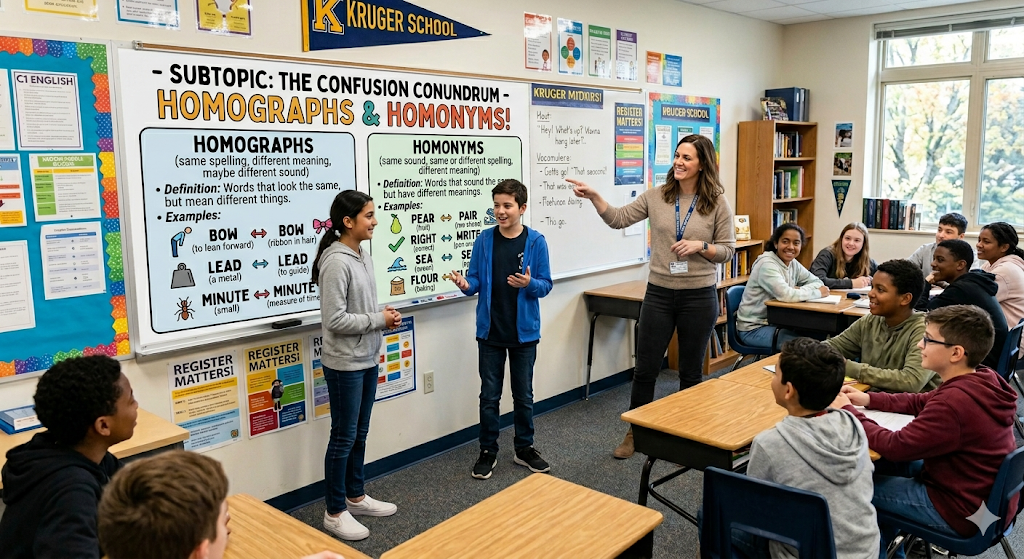
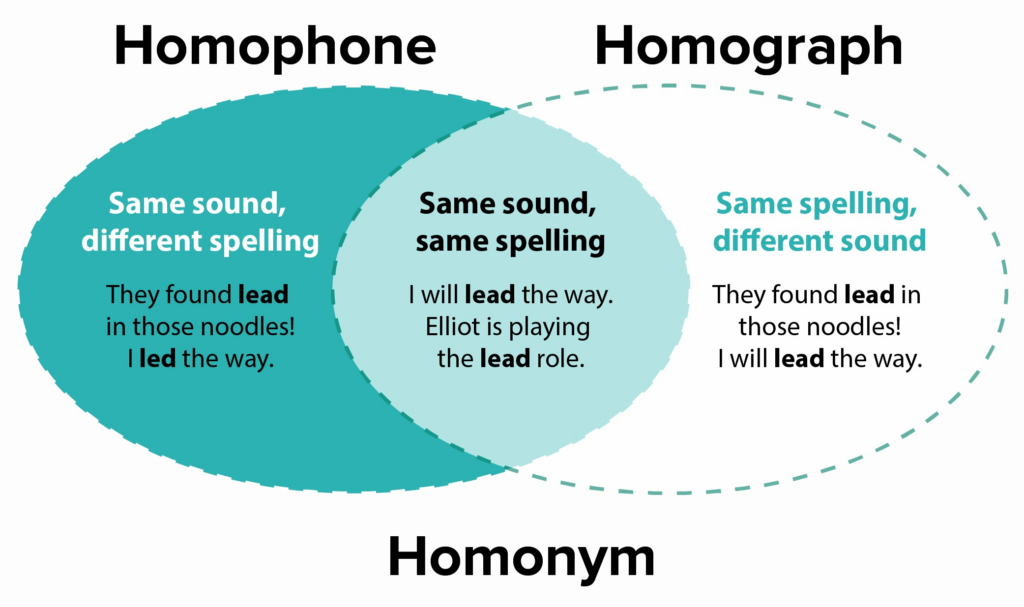
- Quick Theory: Briefly define Homonyms (same sound/spelling, different meaning) and Homographs (same spelling, different sound/meaning)
CONSTRUCTION
Part 2: Vocabulary Development (15 min)
The teacher explicitly introduces key vocabulary needed for the lesson, ensuring students clearly understand meaning and use. The words include:
Focus on high-level academic terms:
- Ambiguity,
- Context Clues
- Pronunciation
- Syllable
- Definition
- Homophone.
Quick game to go over the vocabulary: Bamboozle or Kahoot
Part 3: Grammar Introduction using Gamma Presentation (20 min)
The Logic of Context
- Homograph Mechanics: Focus on word stress shifts (e.g., CONtent vs. conTENT).
- Rule: Many nouns have stress on the first syllable; verbs on the second.
- Homonym Disambiguation: Explain how sentence structure (syntax) determines meaning.
- Example: “The bar is closed” (Noun) vs. “We bar the door” (Verb).
- Instruction: Students take notes on a T-chart separating words that change pronunciation from those that don’t.
Part 4: Guided Practice (25 min)
The Confusion Cure

Teacher Instructions
- Objective: Students use context clues and synonyms to eliminate ambiguity from a poorly written text message chain.
- Setup: Copy the “Confusing Chat” onto the board or a worksheet. Explain to students that two friends are having a terrible time meeting up because of double-meaning words.
- Grouping: Pairs or small groups.
Student Worksheet & Instructions
The Mission: The text conversation below is a total disaster. Because the characters used homonyms and homographs without enough context clues, they are completely misunderstanding each other. Act as the Confusion Cure Team and rewrite the chat so it is 100% clear. You cannot delete the ideas, but you must replace the confusing words with precise synonyms or add descriptive adjectives.
The Confusing Chat (To Give to Students)
- Alex: “Hey! Did you desert me? I am standing by the sign.”
- Blake: “No! I am trying to close the gate so the animals stay close. What sign? The billboard or your zodiac sign?”
- Alex: “The street sign! Hurry up, a huge fly is trying to fly into my soda. Also, I see a giant wave coming from the pool, so wave at me when you get here!”
The Solution (Example of an Ideal Student Rewrite)
- Alex: “Hey! Did you abandon me? I am standing right next to the street post.”
- Blake: “No! I am trying to shut the gate so the animals stay nearby. Which marker? The billboard or your zodiac symbol?”
- Alex: “The metal traffic sign! Hurry up, a annoying insect is trying to buzz into my soda. Also, I see a giant splash of water coming from the pool, so gesture with your hand at me when you get here!”
SESSION 2: CONSTRUCTION – REINFORCEMENT (40 min)
Part 1 – The Visual Double Entendre (20 min)
- Task: Students create a digital slide or meme that illustrates a “Homonym Fail.”
- Requirement: They must write two sentences: one using the word correctly in a formal context and one using it in an informal context.
Part 2 – Interactive Practice (20 min)
Students participate in a Kahoot or similar interactive activity designed to reinforce the concepts learned.
Kahoot
SESSION 3: CONSOLIDATION (80 min)

Part 1 – The Clarification Audit (20 min)
Task: Provide a short paragraph (3-4 sentences) that is intentionally “broken” because of homograph/homonym misuse.
- Example: “The object was to object to the project, but the project lead felt the lead was too heavy to carry.”
Student Requirement:
- Annotate: Underline the homographs/homonyms.
- Transcribe: Use basic IPA or bold the stressed syllable (e.g., OB-ject vs. ob-JECT) to show correct pronunciation.
- Rewrite: Produce a C1-level version using more precise synonyms (e.g., “The goal was to protest the proposal…”).
Part 2- Activity: The Comic Strip Makeover (40min)
Teacher Instructions
- Objective: Students identify homographs that change pronunciation based on meaning, highlight the correct voice stress, and visually demonstrate the literal confusion versus the intended meaning.
- Setup: Provide students with a 3-panel blank comic template.
- Grouping: Individual or pairs.
Student Worksheet & Instructions
The Mission: When we write homographs, people can’t hear our voice. If they read it with the wrong syllable stressed, the sentence makes no sense!
- Look at the broken sentence below.
- Capitalize the “voice punch” (the stressed syllable) so the reader knows how to say it aloud.
- Draw a 3-panel comic strip that tells the story of this funny mix-up.
The Broken Sentence
- “The principal’s object was to object to our science project, but the project lead felt the lead was too heavy to carry.”
Step 1 & 2: The Pronunciation & Synonym Guide (Example)
Before drawing, students fill out their guide to clear up the pronunciation:
| Confusing Word | Pronunciation Fix (Capitalize the Punch) | What it actually means here (Synonym) |
| object (1st) | OB-ject | The goal / The target |
| object (2nd) | ob-JECT | To protest / To disagree |
| project (1st) | PRO-ject | The assignment / The school task |
| project (2nd) | pro-JECT | Note: This is a trick! The sentence uses “project” twice as a noun, meaning the school task. |
| lead (1st) | LEED | The leader / The person in charge |
| lead (2nd) | LED | The heavy metal |
Step 3: The Comic Strip Panels (Example Description)
- Panel 1: Visual: A strict school principal standing at a podium with a speech bubble that says: “I protest this science assignment!” * Caption: The principal’s OB-ject was to ob-JECT to our PRO-ject…
- Panel 2: Visual: A student wearing a lab coat and safety goggles (the team leader) looking completely exhausted while trying to lift a giant, gray metal brick.
- Caption: …but the LEED team leader felt the heavy LED metal block…
- Panel 3: Visual: The student accidentally drops the heavy metal block on the floor with a loud “CRASH!”, breaking the science display table in half while the principal gasps.
- Caption: …was simply too heavy to carry to class!
Part 2 –Summative Assessment: Multiple Choice Quiz (20 min)
10 Multiple Choice questions.
https://gemini.google.com/share/2de294d90861
NEE – Agregar el tipo de adaptaciones curriculares
Principio II: Pautas 6.1 – 6.3 – 6.4
Principio III: Pautas 7.1 – 8.1 – 9.1
ALUMNO 1: Constante monitoreo. Dar tiempo adicional para el desarrollo de la actividad y se reduce el número de ejercicios o se modifican los ejercicios con un nivel de dificultad reducido, de acuerdo con sus necesidades académicas.
ALUMNO 2: Constante monitoreo, Dar tiempo adicional para el desarrollo de la actividad y se reduce el número de ejercicios o se modifican los ejercicios con un nivel de dificultad reducido, de acuerdo con sus necesidades académicas.
ALUMNO 3: Constante monitoreo. Corroborar que el contenido entregado en clase haya sido comprendido por la estudiante mediante retroalimentación.