
K-LEARNING PROJECT

SKILLS
(EFL 5.4.2): Identify and use appropriate register and style in diverse speaking contexts, such as formal and informal interviews, discussions, and presentations.
EFL 5.4.8): Produce well-structured, smoothly flowing, and cohesive utterances on a variety of topics, using a range of rhetorical devices to emphasize key points.
Cultural & Social Awareness (EFL 5.1.7): Interpret and demonstrate respect for different points of view by using language that is empathetic and professional, while expressing one’s own opinion clearly and politely (Hedging).
REAL-LIFE APPLICATION
In professional and academic spheres, the ability to calibrate one’s language is a defining characteristic of high-level fluency. Mastering these tools allows students to navigate complex stakeholder management, where hedging serves as a vital diplomatic shield to address risks or deliver difficult news without compromising their professional credibility. Conversely, using boosting and fronting enables them to project an executive presence, commanding attention during high-stakes pitches or presentations with absolute conviction. Furthermore, the integration of ellipsis and substitution removes linguistic “clutter,” allowing for the rapid, efficient, and native-like communication required in fast-paced boardroom environments or international summits. Ultimately, this unit transforms English from a subject of study into a sophisticated tool for power and diplomacy, mirroring the real-world communication strategies used by global leaders and executives.
LEARNING ACTIVITIES
SESSION 1 (80 min)
Final Project: Mission to Mars – The Red Planet Protocol
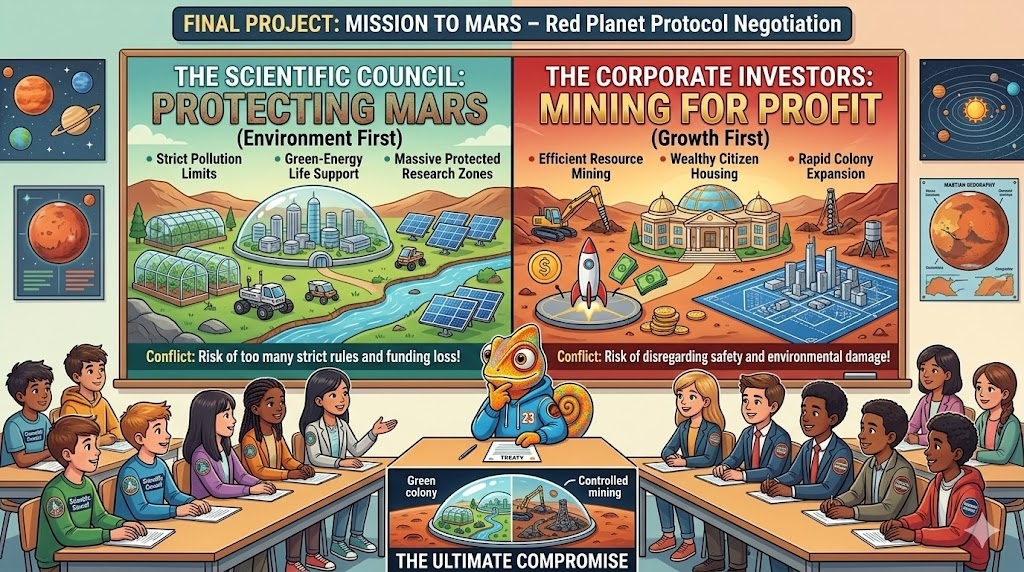
The Setup
The year is 2050. The first human colony on Mars is about to launch, but construction cannot begin until two powerful committees agree on the “Red Planet Protocol” (the laws of the colony).
Students will be divided into two competing factions. Each faction must present a 5-minute case outlining their top 3 demands, and then engage in a live, moderated negotiation to find a middle ground.
The Factions (Choose Your Side)
Faction 1: The Eco-Mars Scientific Council
- The Vibe: Passionate, protective, and strictly evidence-based.
- The Mission: To ensure humanity doesn’t ruin Mars like they did Earth. They want strict limits on pollution, massive zones protected for scientific research, and green-energy life support systems.
- Their Conflict: If they are too strict, the colony won’t make enough money to survive, and the investors will pull their funding.
Faction 2: The Ares Vanguard Corporate Investors
- The Vibe: Ambitious, highly confident, and business-savvy.
- The Mission: To make the colony financially self-sustaining and profitable. They want to mine Martian minerals, build luxury domed housing for wealthy citizens, and expand the colony as fast as possible.
- Their Conflict: If they ignore safety and environment rules, a single Martian dust storm or oxygen leak could ruin their entire investment.
The C1 Grading Checklist (What Students Must Include)
To get an “Advanced/C1” grade, each group’s presentation and negotiation must clearly demonstrate the target grammar from the unit:
- Hedging & Boosting: Use hedging when discussing risks (“A lack of green zones could potentially endanger public health”) and boosting when making demands (“We are undoubtedly the best choice to manage the energy grid”).
- Ellipsis & Substitution: Avoid clunky, repetitive arguments during the live debate. Use words like those, the former, doing so, or omit words entirely to keep the argument flowing smoothly.
- Diplomatic Language: Use the middle-ground phrases (“Can we meet halfway on…?”, “While we respect your perspective…”) to successfully sign the treaty.
The Presentation & Debate Structure
- Phase 1: The Pitch (5 mins per group): Each group presents their 3 core demands using a visual slide or poster. They must use inversion or fronting for dramatic emphasis (e.g., “Never before has humanity faced such a choice…”).
- Phase 2: The Direct Challenge (3 mins total): Each group gets 90 seconds to politely point out flaws in the other group’s plan using hedging to stay professional.
- Phase 3: The Grand Negotiation (10 mins): The groups sit face-to-face. The teacher (or a student moderator) calls out the main conflicts (e.g., Where do we build the mining facility?). The students must use their middle-ground vocabulary to co-write and sign the final treaty.
RUBRIC: https://docs.google.com/document/d/1R_wJcARKrPW0MtymgqVrxxoGcKZa6TJjhObzVxI2lPc/edit?usp=sharing
NEE – Agregar el tipo de adaptaciones curriculares
Principio II: Pautas 6.1 – 6.3 – 6.4
Principio III: Pautas 7.1 – 8.1 – 9.1
ALUMNO 1: Constante monitoreo. Dar tiempo adicional para el desarrollo de la actividad y se reduce el número de ejercicios o se modifican los ejercicios con un nivel de dificultad reducido, de acuerdo con sus necesidades académicas.
ALUMNO 2: Constante monitoreo, Dar tiempo adicional para el desarrollo de la actividad y se reduce el número de ejercicios o se modifican los ejercicios con un nivel de dificultad reducido, de acuerdo con sus necesidades académicas.
ALUMNO 3: Constante monitoreo. Corroborar que el contenido entregado en clase haya sido comprendido por la estudiante mediante retroalimentación.