
ADVANCED PASSIVE STRUCTURES
SKILLS
CE.EFL.5.11 (Reading): Identify and understand main points and specific details in extended texts… (EFL 5.3.2).
EFL.5.15 (Writing): Plan and produce well-structured, complex texts using advanced grammatical structures
CE.EFL.5.2 (Listening): Understand the main ideas and specific details of complex recorded or spoken material…
REAL-LIFE APPLICATION
In the real world, we use advanced passives (like causative passives or reporting verbs) to sound objective, professional, and sophisticated. It is the language of journalism, legal defense, and formal debates. For example, saying “It is rumored that the tournament was canceled” or “I had my computer hacked” shifts focus from who did it to what happened, which is essential for objective academic writing and media literacy..
LEARNING ACTIVITIES
SESSION 1 (80 min) ANTICIPATION
Part 1 ( 15- 20 min)
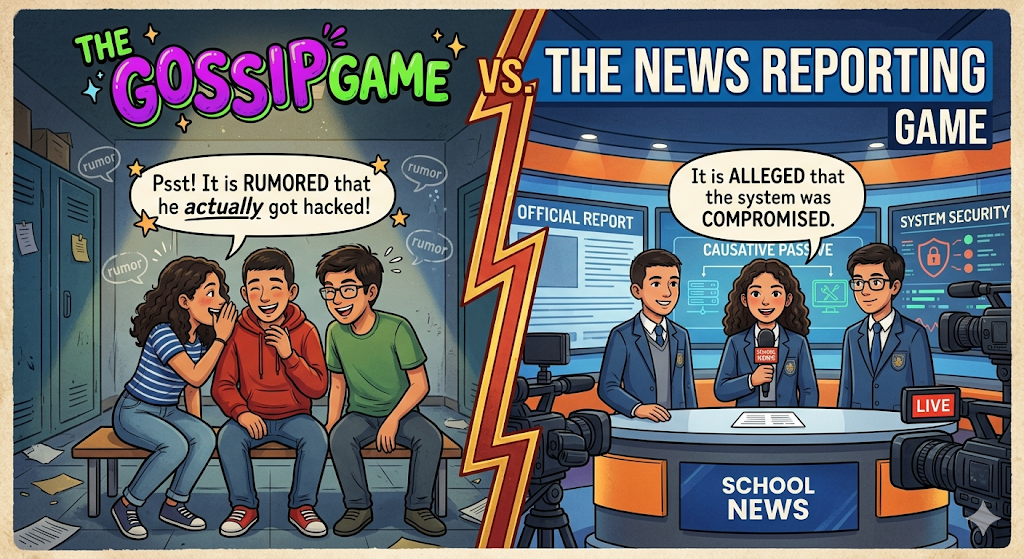
Activity: The Gossip vs. The News Reporting Game
- Instruction: Write a juicy, active-voice rumor on the digital board: “People say that the Principal stole the school mascot.”
- Task: Ask students how a professional news anchor would say this without getting sued for defamation. Guide them to transform it into: “It is alleged that the mascot was stolen.”
- Theory Intro: Briefly explain that advanced passives (It is said that… / Subject + is said to…) protect the speaker and focus purely on the event.
CONSTRUCTION
Part 2: Vocabulary Development (15 min)
The teacher explicitly introduces key vocabulary needed for the lesson, ensuring students clearly understand meaning and use. The phrases include:
To allege (e.g., It is alleged that…)
To presume (e.g., The artifact is presumed to be…)
To get around to (Phrasal verb often used in passive contexts)
To have/get something done (Causative passive structure)
To be rumored to (e.g., She is rumored to write a book)
Misleading (Adjective often used when evaluating passive news statements)
Part 3: Grammar Review using Presentation (20 min)
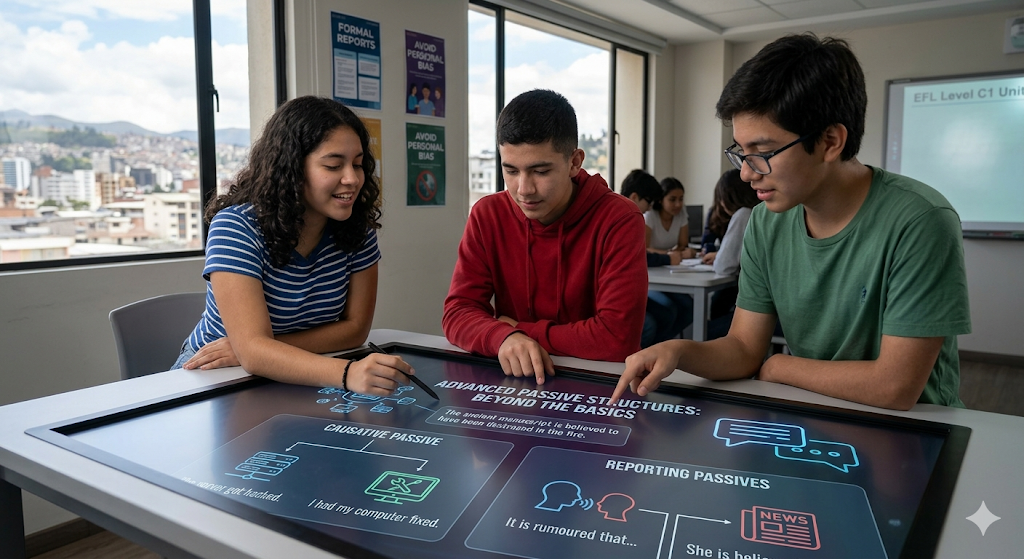
Focus on two advanced structures: Impersonal Passives and Causative Passives.
1. Impersonal Passive (Reporting Verbs)
Used for general beliefs or avoiding blame.
- Structure A: $It + be + Past\ Participle + that-clause$
- Example: It is believed that climate change is accelerating.
- Structure B: $Subject + be + Past\ Participle + to-infinitive$
- Example: Climate change is believed to be accelerating.
2. Causative Passive
Used when someone else does an action for you (often because of a mishap or service).
- Structure: $Subject + have/get + object + past\ participle$
- Example: I had my phone stolen. / We need to get the classroom painted.
Part 4: Guided Practice (25 min)
Activity: The “Fake News” Debunker
- Instruction: Provide a digital worksheet with 5 sensationalist active-voice headlines (e.g., “Aliens built the pyramids”).
- Task: Students must rewrite them into formal, objective passive sentences using both Impersonal Passive structures (Structures A and B above).
- Example Output: “It is claimed that the pyramids were built by aliens” AND “The pyramids are claimed to have been built by aliens.”
SESSION 2: CONSTRUCTION – REINFORCEMENT (40 min)

Day 2: Reinforcement & Creative Application
Activity: The Tech Startup Pitch (Creative & Digital)
- Instruction: Students work in pairs to design a fictional futuristic app or gadget.
- Task: They must write a 6-sentence digital advertisement pitch using at least three causative passives and two reporting passives.
- Example: “Our new app is rumored to double your brainpower. Get your memory upgraded today!”
- Delivery: Students post their pitches on a shared Padlet or digital board for classmates to comment on.
SESSION 3: CONSOLIDATION (80 min)
Part 1 – ( 2 x 40min)
Period 1: Objective & Transformation Test (40 Mins)
- Part A (Multiple Choice): 10 questions identifying correct passive forms vs. active forms in context.
- Part B (Sentence Transformation): 5 “Key Word Transformation” tasks (Cambridge C1 style).
- Prompt: People think the hacker is hiding in Quito. (THOUGHT)
- Answer: The hacker is thought to be hiding in Quito.
Period 2: The Investigative Journalist Report (40 Mins)
- Task: Students write a short, formal breaking-news report (120–150 words) about a fictional mystery or crime (e.g., a cyber-attack on the school’s server).
- Rubric Criteria: Must correctly implement at least 2 impersonal passives and 2 causative passives. Grading focuses on grammatical accuracy (C1 level), cohesion, and appropriate formal register.
https://docs.google.com/document/d/1e5qAp_C6hopEzfp8GQ5TYOB6vyi1l4joVWpkyaicX8g/edit?usp=sharing
NEE – Agregar el tipo de adaptaciones curriculares
Principio II: Pautas 6.1 – 6.3 – 6.4
Principio III: Pautas 7.1 – 8.1 – 9.1
ALUMNO 1: Constante monitoreo. Dar tiempo adicional para el desarrollo de la actividad y se reduce el número de ejercicios o se modifican los ejercicios con un nivel de dificultad reducido, de acuerdo con sus necesidades académicas.
ALUMNO 2: Constante monitoreo, Dar tiempo adicional para el desarrollo de la actividad y se reduce el número de ejercicios o se modifican los ejercicios con un nivel de dificultad reducido, de acuerdo con sus necesidades académicas.
ALUMNO 3: Constante monitoreo. Corroborar que el contenido entregado en clase haya sido comprendido por la estudiante mediante retroalimentación.