
Level Review
SKILLS
EFL 5.3.3 (Reading): Critically analyze nuances, idioms, and bias within media, literature, and journalism, distinguishing between subtle authorial stance and objective reporting.
EFL 5.4.4 (Writing): Apply precision in language and syntactic variation (inversion, cleft sentences) to manipulate flow, emphasis, and tone for specific rhetorical effects.
EFL 5.2.2 (Oral Communication): Express abstract concepts, decode idiomatic expressions, and present complex literary or media arguments with high linguistic control.
REAL-LIFE APPLICATION
Reaching a C1 level isn’t just about avoiding grammatical errors; it is about choosing the exact words to evoke a specific emotional response, manipulating sentence structures to highlight critical information, and looking past the literal text to see an author’s true intent. Whether analyzing a contemporary news headline, evaluating editorial bias, or interpreting subtext in classical literature, advanced language mastery allows students to step out of the role of passive consumers and into the role of analytical, eloquent global communicators.
LEARNING ACTIVITIES
TOPICS
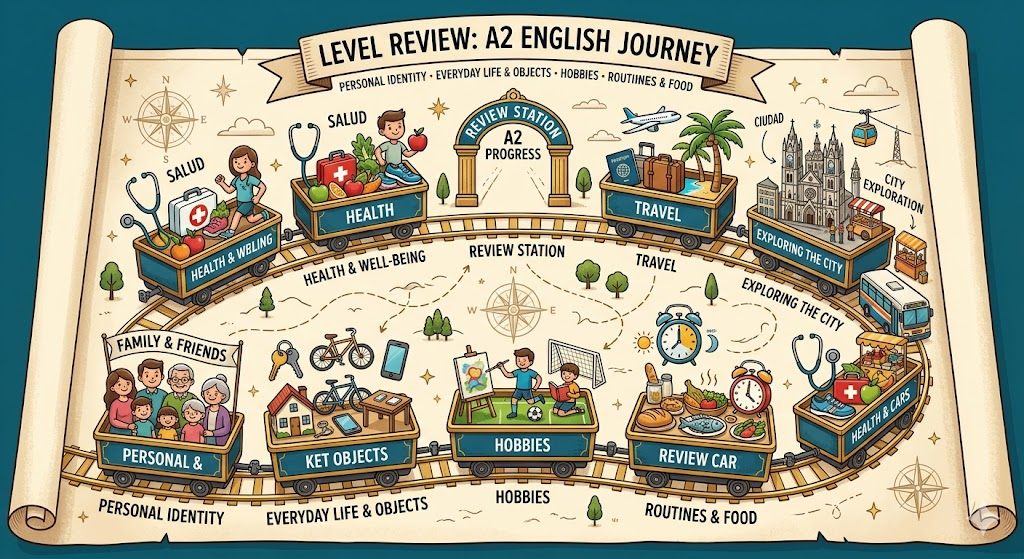
Assessment Sections
- Personal Identity (Family and Friends): This topic evaluates a student’s ability to describe people, establish relationships, and discuss social circles using basic adjectives and possessive pronouns.
- Everyday Life and Objects: This section tests the vocabulary related to common items found in a classroom, home, or office, and the ability to describe their use or location.
- Hobbies: This focuses on expressing personal interests and leisure activities, requiring the use of verbs like “like,” “enjoy,” and “love” followed by the gerund (-ing) form.
- Routines and Food: Students must demonstrate their grasp of the Present Simple tense to explain daily schedules and dietary habits, including vocabulary related to healthy and unhealthy food options.
- Exploring the City: This evaluates the ability to give and understand directions, identify urban landmarks (e.g., museums, parks, bus stations), and use prepositions of place.
- Travel and Health: This topic requires students to discuss past or future travel plans and express ideas about physical well-being, including basic advice or habits (e.g., “I should drink water”).
https://docs.google.com/document/d/13wvlr2n1C6CeunidZ4AfkQaa8RuiOXZ5ZgCPBFEDbhk/edit?usp=sharing
NEE – Agregar el tipo de adaptaciones curriculares
Principio II: Pautas 6.1 – 6.3 – 6.4
Principio III: Pautas 7.1 – 8.1 – 9.1
ALUMNO 1: Constante monitoreo. Dar tiempo adicional para el desarrollo de la actividad y se reduce el número de ejercicios o se modifican los ejercicios con un nivel de dificultad reducido, de acuerdo con sus necesidades académicas.
ALUMNO 2: Constante monitoreo, Dar tiempo adicional para el desarrollo de la actividad y se reduce el número de ejercicios o se modifican los ejercicios con un nivel de dificultad reducido, de acuerdo con sus necesidades académicas.
ALUMNO 3: Constante monitoreo. Corroborar que el contenido entregado en clase haya sido comprendido por la estudiante mediante retroalimentación.