
Precision in language:
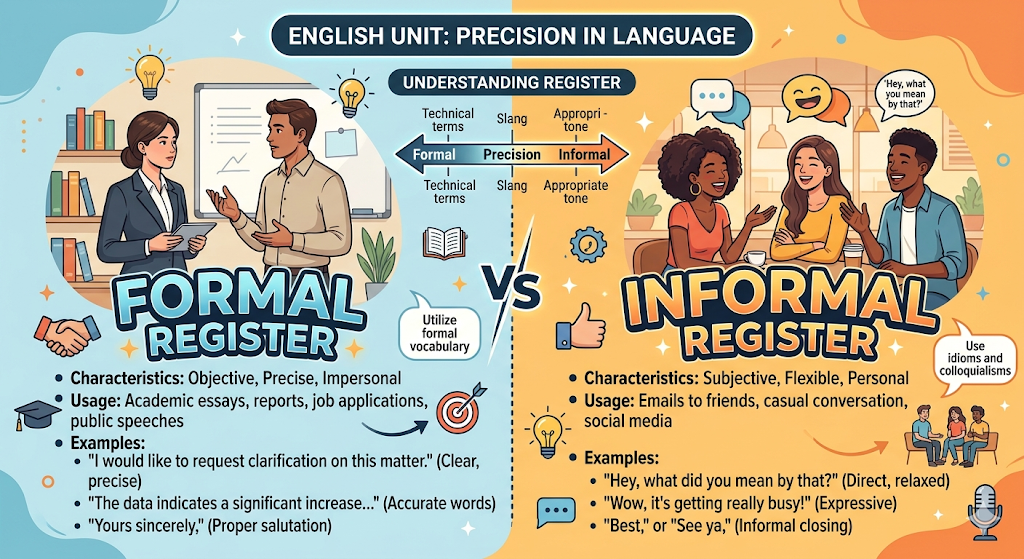
Formal AND INFORMAL REGISTER
SKILLS
EFL.5.1.10 Take initiative in a discussion in a positive way by being sensitive to peers’ responses
EEFL.5.2.1 Deduce the meanings of unfamiliar phrases and words from context
REAL-LIFE APPLICATION
Precision in language will allow students to navigate diverse social and professional landscapes. Mastering Homonyms, Cleft sentences, and Inversion ensures technical accuracy and rhetorical power, while adapting your Register—formal or informal—guarantees the message is always appropriate for the audience.
LEARNING ACTIVITIES
SESSION 1 (80 min) ANTICIPATION
Part 1 (10 -15min)
The teacher begins by projecting a split-screen image showing two contrasting scenarios: a casual group of friends at a café versus a formal job interview. Students are asked to observe carefully and respond to the guiding question: “How does the way you speak change the way people perceive your intelligence and authority?”
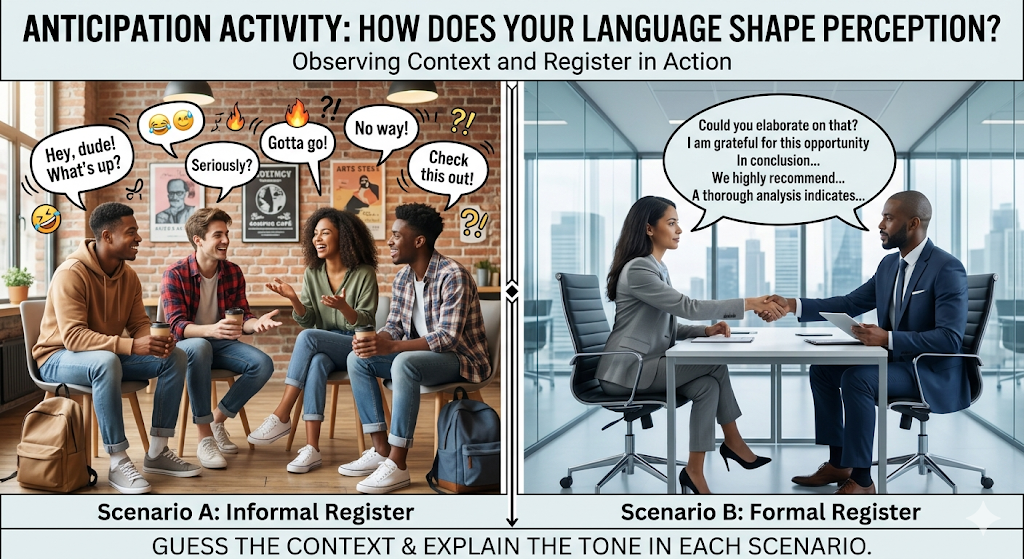
As anticipation, the class takes part in : “The Dial Turn,” a 10-minute activity where students “re-code” a blunt statement into three distinct registers.
Step 1: Small groups are created and are required to re-write (re-code) the original sentence into a different register. Level 1 is an informal, hyperbolic “viral tweet,” while Level 2 is a highly nuanced academic argument that utilizes hedging and abstraction to build credibility.
Step 2: Introduce sample sentences as examples.
Level 1 statement : “Working from home is the best because I can stay in my pajamas and skip the commute”
Level 2 statement: “The shift toward telecommuting may facilitate a significant improvement in work-life balance, provided that organizational structures adapt to maintain professional oversight.”
Step 3: Introduce a level one sentence both teams need to re-code.
Ex: “AI is going to steal everyone’s jobs”
becomes:
“While the integration of generative AI poses a potential disruption to labor markets, it is argued that the technology is more likely to augment human capabilities rather than result in widespread systemic unemployment.”
The activity concludes with a brief class reveal where students compare their versions to see how register functions as a tool for precision. This highlights that high-level English isn’t just about using “big words,” but about using sophisticated structures—such as moving from “I think” to “Evidence suggests”—to make an argument more defensible.
CONSTRUCTION
Part 2: Vocabulary Development (15-20 min)
The teacher explicitly introduces key vocabulary needed for the lesson, ensuring students clearly understand meaning and use. The words include:
- To a certain extent: Use this to partially agree while preparing to offer a counter-argument.
- With respect to / Regarding: A formal way to introduce a specific topic or pivot the conversation.
- It is widely asserted that: Useful for citing a general opinion or theory without taking personal “blame” for the claim.
- Notwithstanding: A sophisticated way to say “despite” or “in spite of” (e.g., “Notwithstanding the costs, the benefits are clear”).
- To advocate for: A stronger, more professional alternative to “to support” or “to be for” something.
- Implicit in this argument is…: Used to point out an underlying assumption in someone else’s point.
- To exacerbate: Use this instead of “make worse” when discussing problems or trends.
- In light of recent developments: A formal transition used to introduce new context or evidence.
- It would appear that: A classic hedging phrase to avoid making a blunt, possibly incorrect, factual claim.
- Conversely: A high-level transition used to introduce a contrasting idea, replacing the more casual “on the other hand.”
These phrases help students move away from the “I think/I feel” structure and toward the objective, evidence-based tone required for advanced argumentation.
Encourage students to create a sentence out loud with any of the vocab words.
Part 3: Role Play Prep (35 min)
Students are placed into groups and act out different formal / informal contexts using appropriate language and register as well as vocabulary.
Ex: 1. Job Interview
2. Interaction with a person with a high level of authority ( like the principle or a university recruiter)
3. Hanging out with friends ( required to research or apply everyday slang)
Each group will be assigned 3 or 4 words from the vocab that needs to be applied within their dialogue.
Roleplay Rubric:
| Criteria | 4 – Exceptional | 3 – Proficient | 2 – Developing | 1 – Beginning |
| Register & Tone | Consistently uses the correct formal or informal tone. Transitions between registers are seamless and appropriate for the audience. | Mostly uses the correct register. Only 1-2 minor slips in tone (e.g., using slang in a formal setting). | Struggles to maintain the correct register. Tone often feels inconsistent with the scenario. | Language is inappropriate for the context or shows no distinction between formal/informal. |
| Vocabulary Usage | Natural and accurate use of 5+ words from the vocab list. Words are used in the correct grammatical context. | Accurate use of 3-4 words from the vocab list. Meanings are clear, though maybe slightly forced. | Uses 1-2 words from the vocab list, or uses several words incorrectly/out of context. | No vocabulary from the list was used, or usage was entirely incorrect. |
| Communicative Fluency | Speech is fluid and natural. Interaction feels like a real conversation with appropriate responses to the partner. | Speech is mostly clear with minor hesitations. Able to maintain the conversation without much help. | Frequent pauses or “uhms” that break the flow. Relies heavily on notes or simple sentences. | Speech is fragmented and difficult to follow. Cannot sustain a conversation. |
| Non-Verbal Cues | Body language, eye contact, and gestures perfectly match the chosen register (e.g., professional posture for formal). | Uses good eye contact and gestures, though they may not always align with the specific register. | Limited use of gestures or eye contact. Body language is stiff or indifferent. | No attempt at non-verbal communication; student may be reading directly from a script. |
| Task Completion | Fully addresses the roleplay prompt and reaches a logical conclusion within the time limit. | Addresses the main points of the prompt, though the ending may feel slightly rushed. | Only partially addresses the prompt; key details of the scenario were missed. | Did not follow the prompt or the roleplay was too brief to evaluate. |
SESSION 3: CONSOLIDATION (80 min)
Part 1 – Role Play Presentations (30-40 min)
Students present their role plays to the class and then engage in a whole class discussion peer reviewing their use of language in their distinct contexts!
Part 2 – Feedback and Reflection (25-30 min)
After each performance, the teacher provides brief, constructive feedback, highlighting both strengths and areas for improvement. Peers are also encouraged to identify correct examples of the target structure. To close the session, students reflect by answering the question: What have you learned about change in register in different social contexts? How does use of formality influence in the way one is perceived? This reinforces both language and content understanding.
NEE – Agregar el tipo de adaptaciones curriculares
Principio II: Pautas 6.1 – 6.3 – 6.4
Principio III: Pautas 7.1 – 8.1 – 9.1
ALUMNO 1: Constante monitoreo. Dar tiempo adicional para el desarrollo de la actividad y se reduce el número de ejercicios o se modifican los ejercicios con un nivel de dificultad reducido, de acuerdo con sus necesidades académicas.
ALUMNO 2: Constante monitoreo, Dar tiempo adicional para el desarrollo de la actividad y se reduce el número de ejercicios o se modifican los ejercicios con un nivel de dificultad reducido, de acuerdo con sus necesidades académicas.
ALUMNO 3: Constante monitoreo. Corroborar que el contenido entregado en clase haya sido comprendido por la estudiante mediante retroalimentación.