
Advanced Idioms and Nuance
SKILLS
EFL 5.3.4: Use new words and expressions which occur in a variety of contexts and spoken texts on familiar and unfamiliar topics
EFL 5.4.1: Select and justify a personal interpretation of a text, using language subtly and with nuance.
EFL 5.5.4: Write a variety of text types using advanced grammatical structures (e.g., past perfect continuous) to express precise meaning.
REAL-LIFE APPLICATION
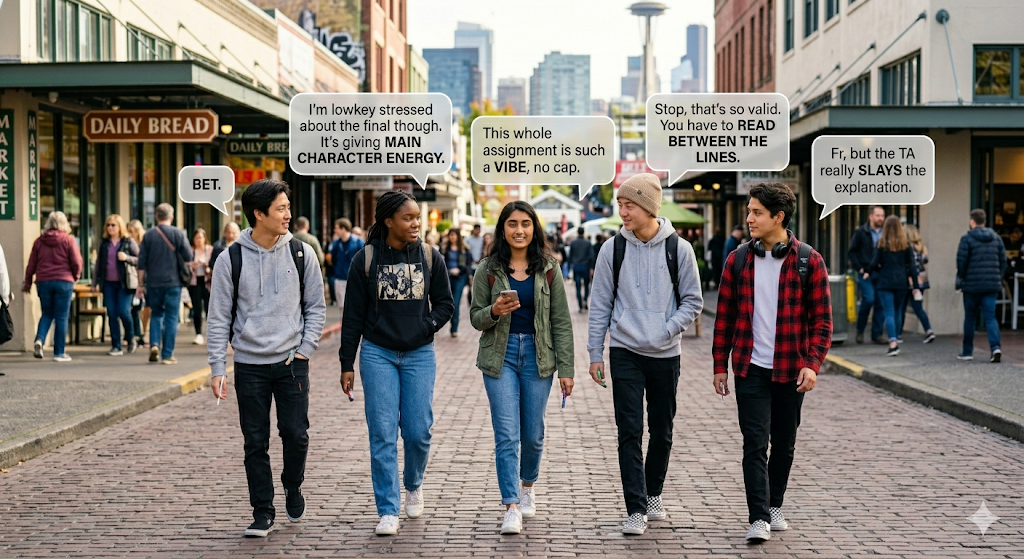
In the digital age, understanding English isn’t just about literal translations; it’s about reading between the lines. Mastering nuance, slang, and narrative tenses allows students to understand internet culture, stream global content without missing the subtext, and express their own complex stories authentically on digital platforms.
LEARNING ACTIVITIES
SESSION 1 (80 min) ANTICIPATION
Part 1 ( 15- 20 min)
Anticipation Activity:
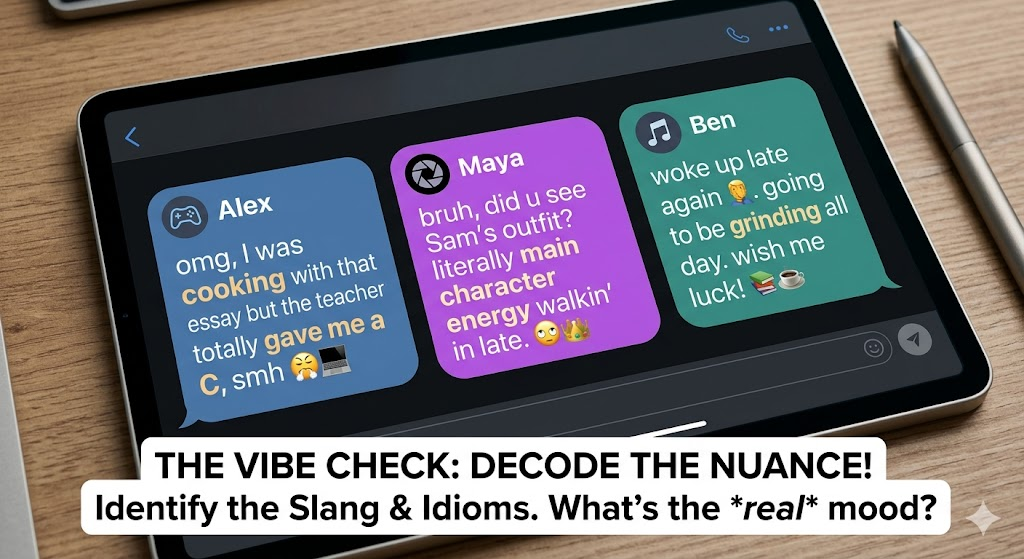
“The Vibe Check” (15 min)
- Objective: Introduce nuance and modern idioms.
- Instructions: Display three tweets or text messages that use modern slang/idioms (e.g., “I was cooking with that essay but the teacher gave me a C, smh”). Have students work in pairs to decode the literal meaning vs. the actual “vibe” (nuance). Briefly explain that language isn’t always literal.
CONSTRUCTION
Part 2: Vocabulary Development (15 min)
The teacher explicitly introduces key vocabulary needed for the lesson, ensuring students clearly understand meaning and use. The words include:
| Expression | Meaning | Example |
| To read the room | To understand the emotional context or mood of a situation. | He kept talking even though everyone was bored; he really couldn’t read the room. |
| To lock in | To intensely focus on a task. | Exams are next week, it’s time to lock in. |
| Side-eye | A facial expression expressing disapproval, skepticism, or suspicion. | She gave him major side-eye when he claimed he finished the project alone. |
| Main character energy | Behaving like the deliberate protagonist of one’s life, often with confidence. | Walking into the room with that outfit was pure main character energy. |
| To miss the mark | To fail to achieve a result or be inadequate. | The new school policy totally missed the mark on student dynamic. |
| To cook (slang) | To let someone do what they are good at; to concoct a great idea/plan. | Wait, let him cook, his idea for the video project is actually genius. |
Part 3: Grammar Introduction using Presentation (20 min)
Grammar Introduction: Past Perfect Continuous
Theory:
- Objective: Review the tense for background actions interrupted by another past event.
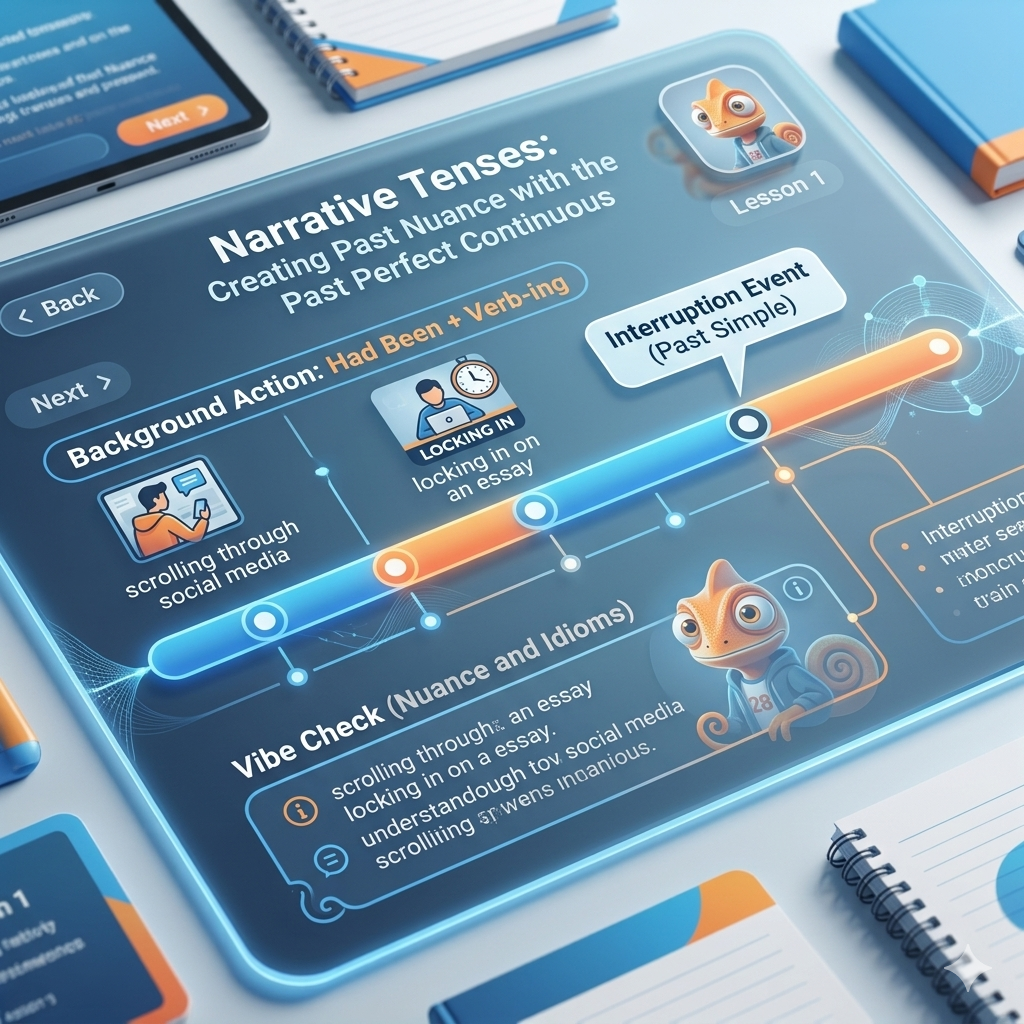
- Form: Subject + had + been + Verb\ing
- Instructions: Present a digital timeline. Contrast Past Perfect (“I had finished my homework when she called”) with Past Perfect Continuous (“I had been scrolling TikTok for an hour when my phone died”). Emphasize that the continuous tense shows an ongoing, immersive background action that creates nuance in storytelling.
Part 4: Guided Practice (25 min)
Grammar Practice: Before the Glitch
- Instructions: Provide students with a digital worksheet containing 5 “cliffhanger” sentences ending in a sudden interruption. Students must complete the background story using the past perfect continuous and at least one vocabulary word.
- Example Prompt: “Suddenly, the Wi-Fi cut out. Before that happened, I…”
- Expected Output: “…I had been locking in on my essay for two hours.”
SESSION 2: CONSTRUCTION – REINFORCEMENT (40 min)
Digital Storyboarding
- Objective: Apply grammar and vocabulary creatively.
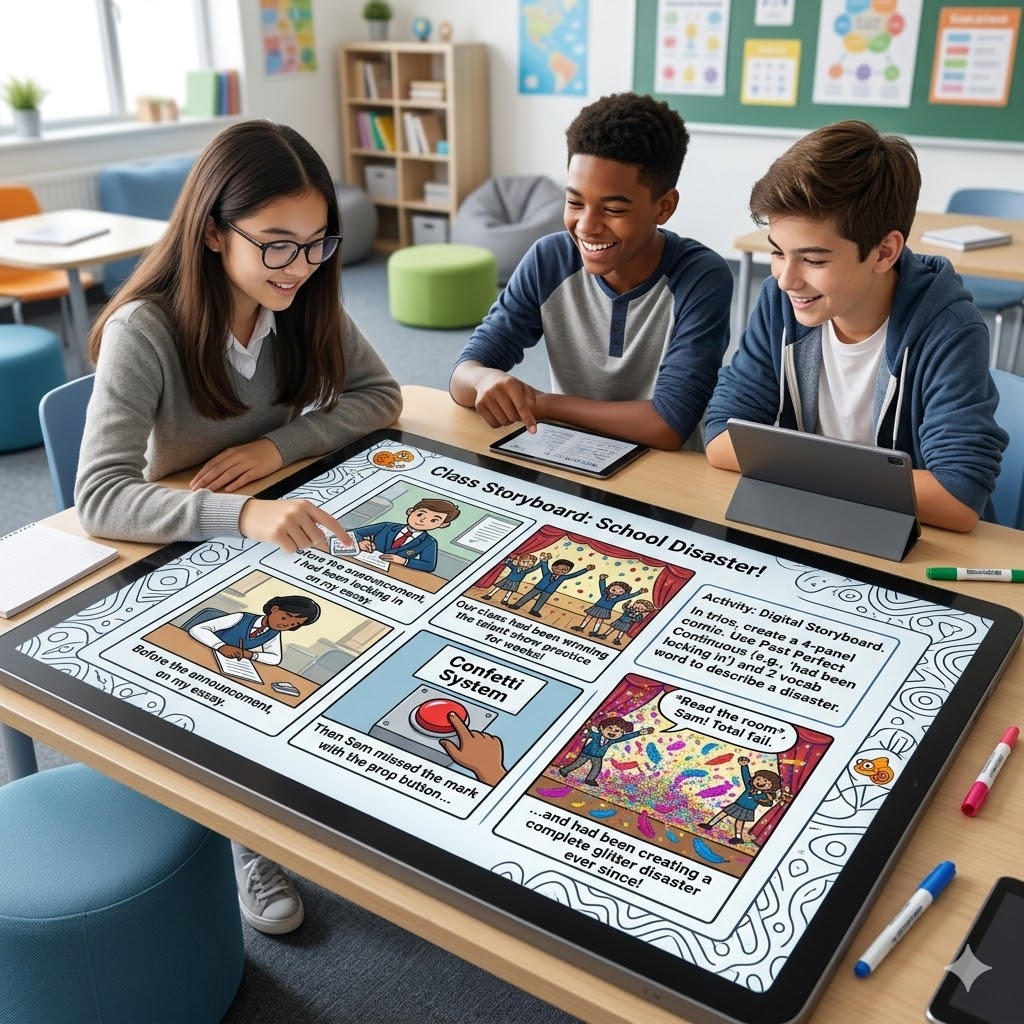
- Instructions: In trios, students use a digital tool (Canva, Google Slides) to create a 4-panel comic strip or storyboard.
- The Task: They must tell a short story about a “disaster” or “plot twist” at a school event.
- Requirements: The captions must include at least two uses of the past perfect continuous to set the scene, and two vocabulary words from Day 1 to describe the characters’ reactions.
- Submission: Upload to the class Padlet/LMS for a quick peer-review gallery walk in the final 10 minutes.
SESSION 3: CONSOLIDATION (80 min)
Part 1 – ( 2 x 40min)
Reinforcement:
Period 1: The Digital Narrative Draft (40 min)
- Task: Individual writing assessment.
- Prompt: Write a short narrative essay or blog post (180–220 words) about a time a misunderstanding occurred because someone didn’t “read the room” or “missed the mark.”
- Criteria: Must naturally incorporate 3 vocabulary words and at least 2 correct uses of the past perfect continuous to establish background actions.
Period 2: Peer-Editing & Final Polish (40 min)
- 0–20 min: Nuance Audit. Students swap digital drafts with a partner. Using the “Suggesting” mode, peers must highlight the idioms and narrative tenses, evaluating if the nuance is correct or if it sounds forced.
- 20–40 min: Final revisions based on feedback and submission to the teacher for final grading.
NEE – Agregar el tipo de adaptaciones curriculares
Principio II: Pautas 6.1 – 6.3 – 6.4
Principio III: Pautas 7.1 – 8.1 – 9.1
ALUMNO 1: Constante monitoreo. Dar tiempo adicional para el desarrollo de la actividad y se reduce el número de ejercicios o se modifican los ejercicios con un nivel de dificultad reducido, de acuerdo con sus necesidades académicas.
ALUMNO 2: Constante monitoreo, Dar tiempo adicional para el desarrollo de la actividad y se reduce el número de ejercicios o se modifican los ejercicios con un nivel de dificultad reducido, de acuerdo con sus necesidades académicas.
ALUMNO 3: Constante monitoreo. Corroborar que el contenido entregado en clase haya sido comprendido por la estudiante mediante retroalimentación.
SKILLS
EFL 5.3.4: Use new words and expressions which occur in a variety of contexts and spoken texts on familiar and unfamiliar topics
EFL 5.4.1: Select and justify a personal interpretation of a text, using language subtly and with nuance.
EFL 5.5.4: Write a variety of text types using advanced grammatical structures (e.g., past perfect continuous) to express precise meaning.
REAL-LIFE APPLICATION
In the digital age, understanding English isn’t just about literal translations; it’s about reading between the lines. Mastering nuance, slang, and narrative tenses allows students to understand internet culture, stream global content without missing the subtext, and express their own complex stories authentically on digital platforms.
LEARNING ACTIVITIES
SESSION 1 (80 min) ANTICIPATION
Part 1 ( 15- 20 min)
Anticipation Activity:
“The Vibe Check” (15 min)
- Objective: Introduce nuance and modern idioms.
- Instructions: Display three tweets or text messages that use modern slang/idioms (e.g., “I was cooking with that essay but the teacher gave me a C, smh”). Have students work in pairs to decode the literal meaning vs. the actual “vibe” (nuance). Briefly explain that language isn’t always literal.
CONSTRUCTION
Part 2: Vocabulary Development (15 min)
The teacher explicitly introduces key vocabulary needed for the lesson, ensuring students clearly understand meaning and use. The words include:
| Expression | Meaning | Example |
| To read the room | To understand the emotional context or mood of a situation. | He kept talking even though everyone was bored; he really couldn’t read the room. |
| To lock in | To intensely focus on a task. | Exams are next week, it’s time to lock in. |
| Side-eye | A facial expression expressing disapproval, skepticism, or suspicion. | She gave him major side-eye when he claimed he finished the project alone. |
| Main character energy | Behaving like the deliberate protagonist of one’s life, often with confidence. | Walking into the room with that outfit was pure main character energy. |
| To miss the mark | To fail to achieve a result or be inadequate. | The new school policy totally missed the mark on student dynamic. |
| To cook (slang) | To let someone do what they are good at; to concoct a great idea/plan. | Wait, let him cook, his idea for the video project is actually genius. |
Part 3: Grammar Introduction using Presentation (20 min)
Grammar Introduction: Past Perfect Continuous
Theory:
- Objective: Review the tense for background actions interrupted by another past event.
- Form: Subject + had + been + Verb\ing
- Instructions: Present a digital timeline. Contrast Past Perfect (“I had finished my homework when she called”) with Past Perfect Continuous (“I had been scrolling TikTok for an hour when my phone died”). Emphasize that the continuous tense shows an ongoing, immersive background action that creates nuance in storytelling.
Part 4: Guided Practice (25 min)
Grammar Practice: Before the Glitch
- Instructions: Provide students with a digital worksheet containing 5 “cliffhanger” sentences ending in a sudden interruption. Students must complete the background story using the past perfect continuous and at least one vocabulary word.
- Example Prompt: “Suddenly, the Wi-Fi cut out. Before that happened, I…”
- Expected Output: “…I had been locking in on my essay for two hours.”
SESSION 2: CONSTRUCTION – REINFORCEMENT (40 min)
Digital Storyboarding
- Objective: Apply grammar and vocabulary creatively.
- Instructions: In trios, students use a digital tool (Canva, Google Slides) to create a 4-panel comic strip or storyboard.
- The Task: They must tell a short story about a “disaster” or “plot twist” at a school event.
- Requirements: The captions must include at least two uses of the past perfect continuous to set the scene, and two vocabulary words from Day 1 to describe the characters’ reactions.
- Submission: Upload to the class Padlet/LMS for a quick peer-review gallery walk in the final 10 minutes.
SESSION 3: CONSOLIDATION (80 min)
Part 1 – ( 2 x 40min)
Reinforcement:
Period 1: The Digital Narrative Draft (40 min)
- Task: Individual writing assessment.
- Prompt: Write a short narrative essay or blog post (180–220 words) about a time a misunderstanding occurred because someone didn’t “read the room” or “missed the mark.”
- Criteria: Must naturally incorporate 3 vocabulary words and at least 2 correct uses of the past perfect continuous to establish background actions.
Period 2: Peer-Editing & Final Polish (40 min)
- 0–20 min: Nuance Audit. Students swap digital drafts with a partner. Using the “Suggesting” mode, peers must highlight the idioms and narrative tenses, evaluating if the nuance is correct or if it sounds forced.
- 20–40 min: Final revisions based on feedback and submission to the teacher for final grading.
NEE – Agregar el tipo de adaptaciones curriculares
Principio II: Pautas 6.1 – 6.3 – 6.4
Principio III: Pautas 7.1 – 8.1 – 9.1
ALUMNO 1: Constante monitoreo. Dar tiempo adicional para el desarrollo de la actividad y se reduce el número de ejercicios o se modifican los ejercicios con un nivel de dificultad reducido, de acuerdo con sus necesidades académicas.
ALUMNO 2: Constante monitoreo, Dar tiempo adicional para el desarrollo de la actividad y se reduce el número de ejercicios o se modifican los ejercicios con un nivel de dificultad reducido, de acuerdo con sus necesidades académicas.
ALUMNO 3: Constante monitoreo. Corroborar que el contenido entregado en clase haya sido comprendido por la estudiante mediante retroalimentación.