
K-LEARNING PROJECT
SKILLS
EFL.5.1.10 Take initiative in a discussion in a positive way by being sensitive to peers’ responses
EEFL.5.2.1 Deduce the meanings of unfamiliar phrases and words from context
REAL-LIFE APPLICATION
This project empowers students with strategic communication skills by teaching them to navigate the nuances of high-stakes environments. By mastering register, students learn to “code-switch” effectively between professional and social settings, while using inversion and cleft sentences allows them to speak with the rhetorical authority and clarity required in leadership or public speaking. Furthermore, focusing on homonyms and homographs cultivates a high level of linguistic precision, ensuring they can avoid costly misunderstandings in complex professional fields like law, business, or technology. Ultimately, this unit transforms grammar from a set of rules into a powerful tool for influence and risk mitigation in the real world.
LEARNING ACTIVITIES
SESSION 1 (80 min)
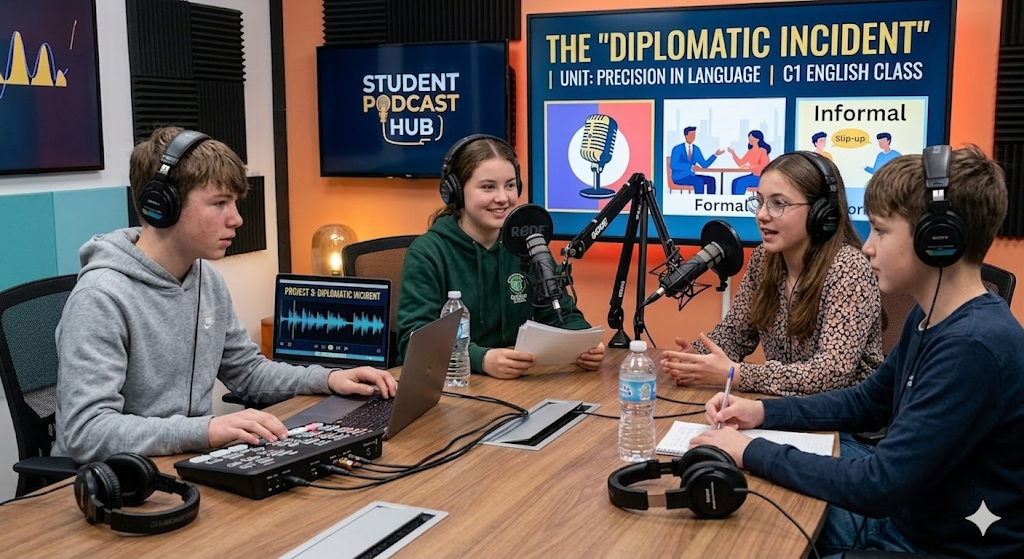
Students record a 5-minute podcast episode or mock news report about a social “faux pas.”
- The Task: A fictional politician or celebrity accidentally uses a very Informal Register in a highly Formal setting (or vice versa).
- Requirements:
- The student reports on the event using Inversion to add a dramatic, journalistic tone (“Under no circumstances should the Ambassador have used such slang…”).
- They must explain the confusion using Homonyms to show how the meaning was lost in translation.
- Edit the video with special effects
Phase 1: The Hook & The “Heinous” Slip-up (10 Mins)
The Intro: Present a “Breaking News” scenario. A world leader at a gala meant to say, “I am honored to be present,” but instead said, “I’m just here for the free booze.” * The Concept: Briefly review how Inversion creates a “serious/journalistic” tone and how Register can make or break a career.
Phase 2: Planning & Scripting (25 Mins)
Divide students into groups of 3–4 (Host, Investigative Reporter, and “Linguistic Expert”).
The Brainstorm: Groups choose their “Incident.” - Example: A CEO using slang during a court hearing, or a scientist using a homograph incorrectly (e.g., “The results were gross” meaning disgusting vs. total amount).
The Scripting Requirement: They must include: - 2 Inversions: “Rarely has the public seen such a blunder…”
- 2 Cleft Sentences: “It was the choice of words that caused the riot…”
- 1 Homonym/Homograph: A play on words that led to the confusion.
Phase 3: “Rehearsal & Polish” (15 Mins)Groups practice their delivery.
Peer Check: Have two groups “swap” scripts for 5 minutes. The other group must highlight the Inversions and Cleft sentences. If they can’t find them, the script isn’t “precise” enough yet!
Phase 4: The “Live” Broadcast (25 Mins)
Each group performs their 3-minute segment.
The “Live” Factor: If you have a microphone or even a fake “On Air” sign, use it!
Audience Task: While listening, the rest of the class must write down the Homonym or Homograph they heard and identify the Inversion.
Phase 5: Debrief & Wrap-up (5 Mins)
- Quick discussion: Which register was the most difficult to maintain?
- Collect the scripts as the formal “End of Unit” evidence.
NEE – Agregar el tipo de adaptaciones curriculares
Principio II: Pautas 6.1 – 6.3 – 6.4
Principio III: Pautas 7.1 – 8.1 – 9.1
ALUMNO 1: Constante monitoreo. Dar tiempo adicional para el desarrollo de la actividad y se reduce el número de ejercicios o se modifican los ejercicios con un nivel de dificultad reducido, de acuerdo con sus necesidades académicas.
ALUMNO 2: Constante monitoreo, Dar tiempo adicional para el desarrollo de la actividad y se reduce el número de ejercicios o se modifican los ejercicios con un nivel de dificultad reducido, de acuerdo con sus necesidades académicas.
ALUMNO 3: Constante monitoreo. Corroborar que el contenido entregado en clase haya sido comprendido por la estudiante mediante retroalimentación.