
Slang
SKILLS
Communication and Cultural Awareness (CE.EFL.5.2): Demonstrate an ability to discuss culture, including popular culture and youth language, from an objective perspective.
Reading (EFL 5.3.3): Understand specific detail given in a text (such as a digital chat or narrative) containing advanced vocabulary and structures.
Writing (EFL 5.4.2): Write a variety of text types (e.g., short narratives) using advanced grammatical structures like the past perfect continuous.
REAL-LIFE APPLICATION
Understanding contemporary slang and narrative tenses allows students to navigate native-level digital spaces (TikTok, YouTube, Discord) and international social circles authentically. Mastering the past perfect continuous ensures they can tell compelling, nuanced stories or gossip about why something happened, bridging the gap between textbook English and real-world fluency.
LEARNING ACTIVITIES
SESSION 1 (80 min) ANTICIPATION
Part 1 ( 15- 20 min)
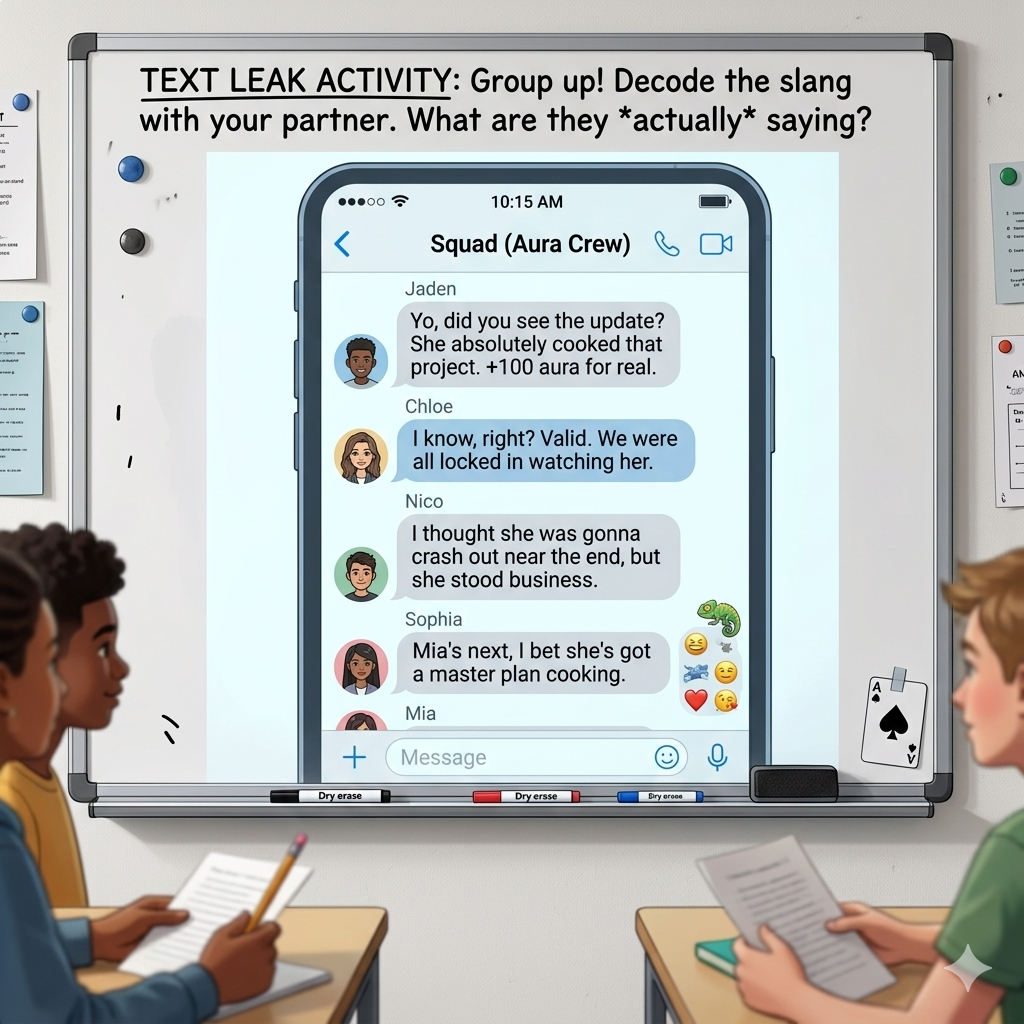
Anticipation Activity: “The Text Leak” (15 Mins)
- Objective: Introduce modern slang contextually.
- Instruction: Project a simulated text message thread full of modern slang. Ask students to decode it in pairs.
- Theory: Briefly explain that slang evolves rapidly and defines youth culture, while narrative tenses give context to the stories behind the slang.
CONSTRUCTION
Part 2: Vocabulary Development (15 min)
The teacher explicitly introduces key vocabulary needed for the lesson, ensuring students clearly understand meaning and use. The words include:
To cook (verb): To let someone do what they are good at; to perform well or concoct a masterplan. (e.g., “Let him cook.”)
Locked in (adjective/phrase): Deeply focused, committed, or in the zone.
To crash out (verb): To lose one’s temper completely and act recklessly due to frustration.
Stand on business (phrase): To take care of your responsibilities or defend your reputation.
Aura (noun): The specific vibe, charisma, or cool energy someone radiates. (e.g., “+100 aura”)
Valid (adjective): Acceptable, reasonable, or genuinely good.
Part 3: Grammar Introduction using Presentation (20 min)
Grammar Introduction: Past Perfect Continuous
Grammar Introduction: Past Perfect Continuous (20 Mins)
- Formula:{Subject} + {had been} + text{verb-ing}
- Concept: Used to show an action that started in the past and continued up until another point in the past, often emphasizing the duration or cause of a situation.
- Slang Integration Examples:
- “He had been cooking for hours before the teacher finally noticed his genius.”
- “She had been locking in for the exam all week, so getting an A was valid.”
- “They had been losing points all game, which is why he finally crashed out.”
Part 4: Guided Practice (25 min)
The Backstory” (25 Mins)
- Instruction: Give students 5 “consequence” sentences using slang (e.g., “Juan had zero aura today.”).
- Task: In pairs, students must write the cause using the past perfect continuous (e.g., “Juan had zero aura today because he had been tripping over his backpack all morning.”). Digital submission via Mentimeter or Padlet.
SESSION 2: CONSTRUCTION – REINFORCEMENT (40 min)
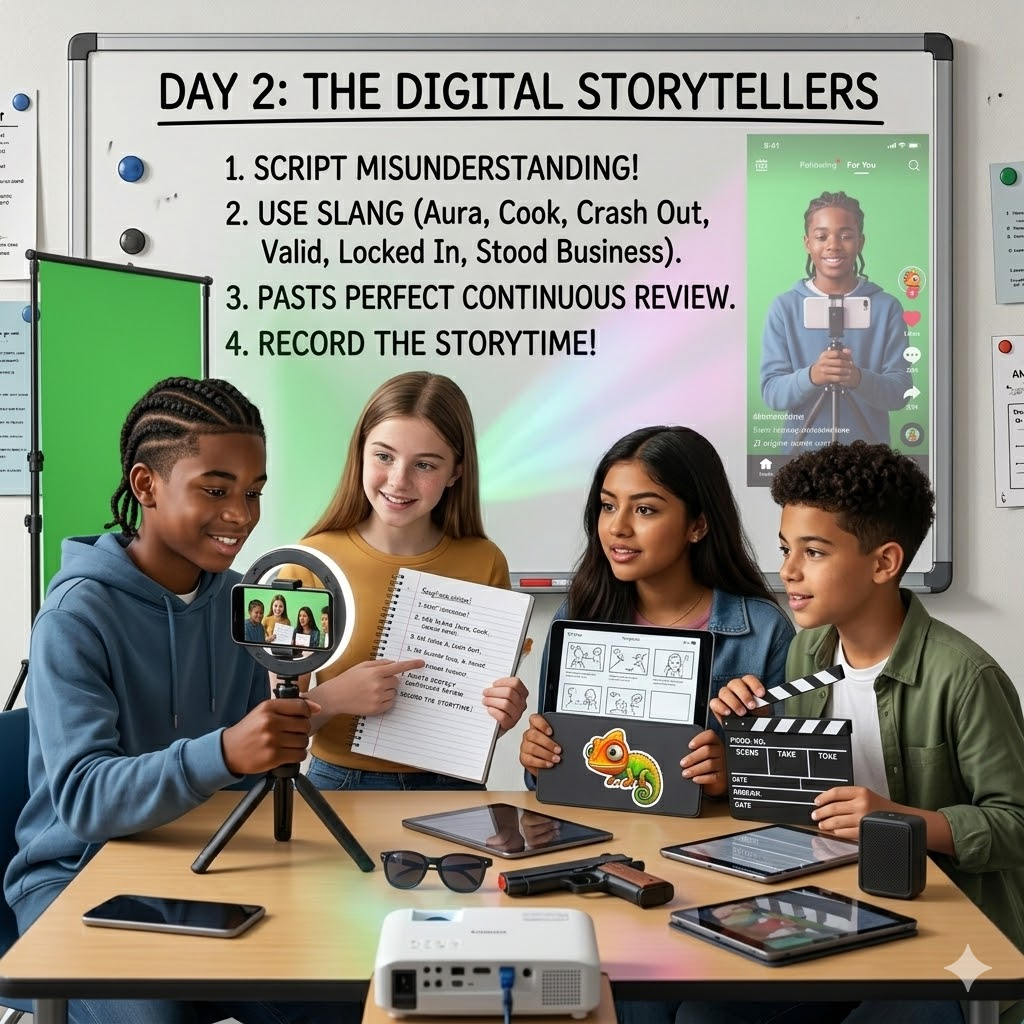
“The Digital Storytellers”
- Instruction: Students work in groups of three to write a script for a mock 1-minute TikTok/Reel storytime.
- Task: The story must detail a funny misunderstanding or dramatic event.
- Requirements: Must include at least 3 of the target slang words and 3 correct uses of the Past Perfect Continuous.
- Digital Twist: Students record the audio/video using Flip (Flipgrid) or just write it out on a shared Canva template.
SESSION 3: CONSOLIDATION (80 min)
Part 1 – ( 2 x 40min)
Reinforcement:
Period 1: The Writing Draft & Digital Peer Review (40 Mins)
- Task: Individual digital writing assessment. Students write a short, cohesive narrative essay or blog post (150–200 words) titled: “The Day Everything Crashed Out.”
- Criteria: Must naturally weave together a narrative using Past Perfect Continuous to establish background actions, contrasting them with Past Simple for the main actions, alongside the new vocabulary.
Period 2: Final Polish & Interactive Quiz (40 Mins)
- Part 1 (20 Mins): Final edits of the writing task based on teacher/peer feedback for digital submission.
- Part 2 (20 Mins): A high-stakes, competitive Gamified Quiz (Kahoot or Blooket) testing both the definition of the modern slang words and the structural mechanics of the past perfect continuous.
NEE – Agregar el tipo de adaptaciones curriculares
Principio II: Pautas 6.1 – 6.3 – 6.4
Principio III: Pautas 7.1 – 8.1 – 9.1
ALUMNO 1: Constante monitoreo. Dar tiempo adicional para el desarrollo de la actividad y se reduce el número de ejercicios o se modifican los ejercicios con un nivel de dificultad reducido, de acuerdo con sus necesidades académicas.
ALUMNO 2: Constante monitoreo, Dar tiempo adicional para el desarrollo de la actividad y se reduce el número de ejercicios o se modifican los ejercicios con un nivel de dificultad reducido, de acuerdo con sus necesidades académicas.
ALUMNO 3: Constante monitoreo. Corroborar que el contenido entregado en clase haya sido comprendido por la estudiante mediante retroalimentación.