
SPECULATING ABOUT PAST AND PRESENT
SKILLS
EFL 5.2.3): Follow main points of argumentation and interact with some flexibility on a range of abstract and concrete topics.
EFL 5.3.6): Display a range of reading strategies to understand complex, authentic texts, identifying explicit and implicit information.
(EFL 5.4.2): Write coherent texts using a wide range of advanced vocabulary and grammatical structures to express viewpoints and hypotheses
REAL-LIFE APPLICATION
Speculating about the past and present is a foundational skill in investigative journalism, historical analysis, and everyday problem-solving. In real life, professionals—from lawyers analyzing crime scenes to media critics evaluating unverified news—rely on these structures to pitch hypotheses, weigh evidence, and express degrees of certainty without stating unproven facts as absolute truths.
LEARNING ACTIVITIES
SESSION 1 (80 min) ANTICIPATION
Part 1 ( 15- 20 min)

Anticipation Learning Activity (10–15 mins)
- Activity: “The Unexplained Photo”
- Instructions: Display a highly unusual, real-world historical photo or a current unresolved media image on the digital board (e.g., the Mary Celeste ghost ship, an unexplained archaeological find, or a cryptic celebrity social media post).
- Task: Give students 3 minutes in breakout rooms to look at the image and brainstorm explanations. Bring them back and ask: How certain are you? How do we change our language when we are 90% sure versus 30% sure? Collect their initial ideas on the board.
CONSTRUCTION
Part 2: Vocabulary Development (15 min)
The teacher explicitly introduces key vocabulary needed for the lesson, ensuring students clearly understand meaning and use. The phrases include:
Feasible explanation: A theory or idea that is likely, probable, and easy to believe.
Far-fetched: Extremely unlikely to be true or impractical.
Conclusive evidence: Proof that leaves no doubt and completely clears up uncertainty.
Mere speculation: An idea or guess formed without any solid evidence.
To deduce: To reach a logical conclusion by utilizing the information or evidence available.
Highly improbable: Something that has a very low chance of actually happening or having happened.
Part 3: Grammar Review using Presentation (20 min)
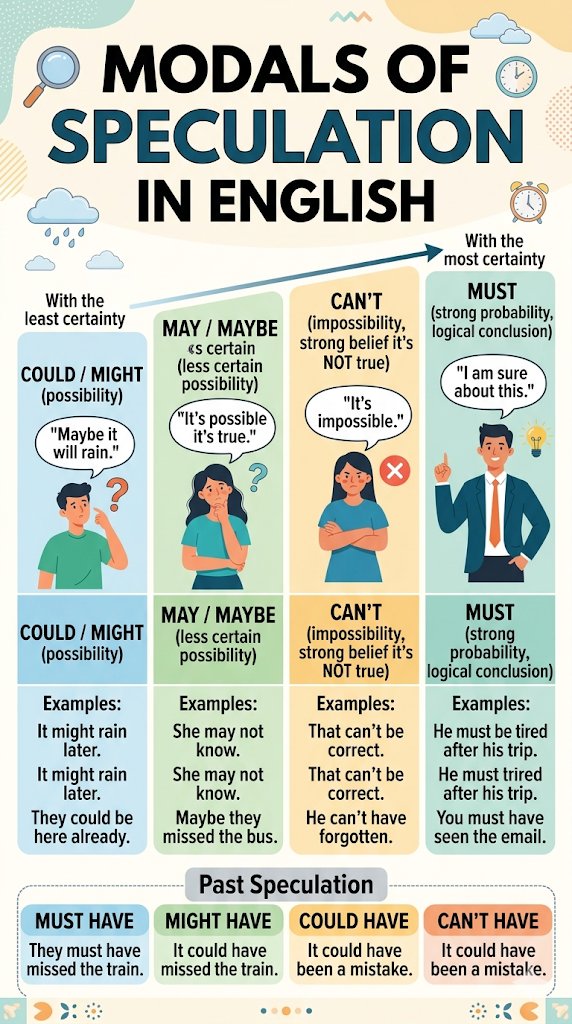
Grammar Review: Modals of Speculation Structure and Use (20 mins)
- Concept: Reviewing how we use modal verbs to express different degrees of certainty about the present and the past. Ask students to share the modals they have learned and say an example out loud.
- Formulas:
- Present Speculation: Subject+Modal+Verb (infinitive)
- Past Speculation: Subject+Modal+have+Past Participle
- Structure Guide:
- High Certainty (Positive): Must / Must have (e.g., “They must be exhausted.” / “She must have missed the flight.”)
- High Certainty (Negative): Can’t, Couldn’t / Can’t have, Couldn’t have (e.g., “That can’t be true.” / “He couldn’t have stolen it, he was with me.”)
- Possibility/Uncertainty: Might, May, Could / Might have, May have, Could have (e.g., “It might rain later.” / “They could have forgotten the date.”)
Grammar Practice Activity (25 mins)
- Activity: “The Celebrity/Historical Blind Item”
- Instructions: Provide students with 4 brief, anonymized, real-life scenarios (e.g., a famous artist who suddenly went missing for 11 days, or a modern tech company’s sudden stock market crash).
- Task: Working in trios, students must write exactly three present speculations and three past speculations for each mystery based on clues you give them.
- Constraint: They must use a different modal verb for each sentence to show varying degrees of certainty (e.g., “The company’s server must have been hacked, which means the data might be compromised right now.”). They submit their sentences to the class text channel for instant feedback.
SESSION 2: CONSTRUCTION – REINFORCEMENT (40 min)
Activity: “The Cold Case Journalists” (Roleplay & Writing)
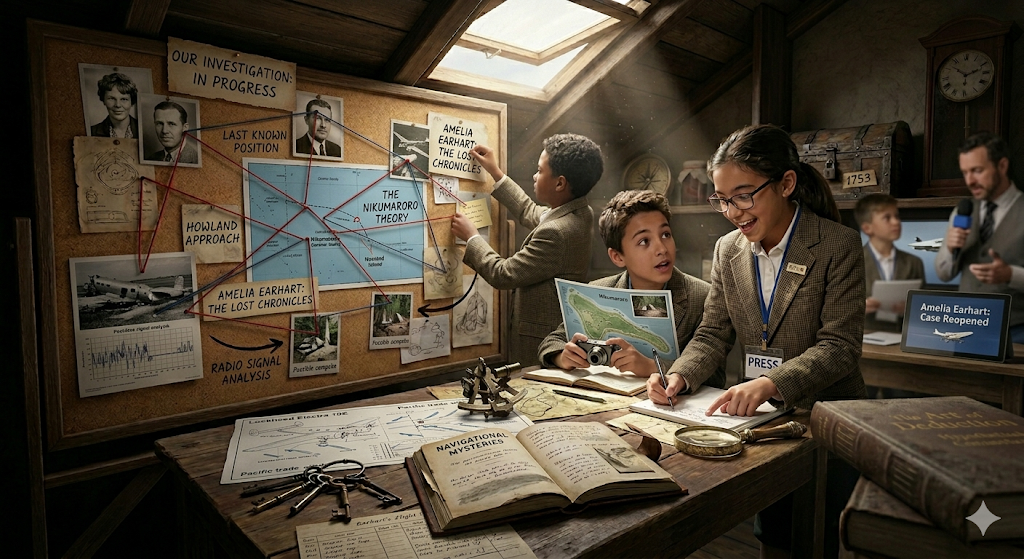
Instructions: Tell students they are investigative journalists looking into a famous real-life mystery (e.g., the disappearance of Amelia Earhart or the construction purpose of Stonehenge).
Task: Students select one mystery and create a video essay on the topic.
Criteria: The pitch must explicitly outline:
- One feasible explanation and one far-fetched theory using the vocabulary.
- At least 3 past modals of speculation to analyze what happened.
- At least 3 present modal of speculation to analyze the current state of the mystery.
Submission: Students upload their video or audio to a shared digital drive. Classmates must listen to/read two entries and comment on whether the level of modal certainty matches the evidence provided.
SESSION 3: CONSOLIDATION (80 min)
Part 1 – ( 2 x 40min)
Assessment Class (2 Periods × 40 mins)
- Format: Live Press Conference Simulation
- Period 1 (40 mins) – Incident Briefing & Strategy: The teacher acts as a government official or corporate spokesperson and drops a fictional, complex crisis scenario on a digital document (e.g., “A prototype AI drone vanished from a secure lab last night, and encrypted files were leaked online this morning.”). Students act as rival news agencies. They spend the period analyzing the evidence dossier, building their hypotheses, and preparing sharp, investigative questions packed with past/present speculation structures.
- Period 2 (40 mins) – The Press Conference: The live simulation begins. Each student group gets to grill the spokesperson with their speculative questions (e.g., “Given the digital footprints, could an insider have leaked the files? It can’t have been an external hack, right?”). Students are graded on their spontaneous use of C1 speculation vocabulary, grammatical accuracy of past/present modals under pressure, and the logical strength of their arguments.
NEE – Agregar el tipo de adaptaciones curriculares
Principio II: Pautas 6.1 – 6.3 – 6.4
Principio III: Pautas 7.1 – 8.1 – 9.1
ALUMNO 1: Constante monitoreo. Dar tiempo adicional para el desarrollo de la actividad y se reduce el número de ejercicios o se modifican los ejercicios con un nivel de dificultad reducido, de acuerdo con sus necesidades académicas.
ALUMNO 2: Constante monitoreo, Dar tiempo adicional para el desarrollo de la actividad y se reduce el número de ejercicios o se modifican los ejercicios con un nivel de dificultad reducido, de acuerdo con sus necesidades académicas.
ALUMNO 3: Constante monitoreo. Corroborar que el contenido entregado en clase haya sido comprendido por la estudiante mediante retroalimentación.