
Inversion with negative adverbials
SKILLS
CE.EFL.5.12: Demonstrate an ability to use a variety of complex sentences and language structures.
CE.EFL.5.15: Produce well-constructed, academic texts using appropriate cohesive devices and advanced grammar.
REAL-LIFE APPLICATION
Inversion isn’t just for textbooks; it’s the language of persuasion and emphasis. Students will learn to use it in formal speeches, hard-hitting journalism, and dramatic storytelling to grab the listener’s attention. Think of it as the “theatrical” side of English—it moves the most important negative element to the front to create an immediate impact.
LEARNING ACTIVITIES
SESSION 1 (80 min) ANTICIPATION
Part 1-The Drama Shift (15 min)
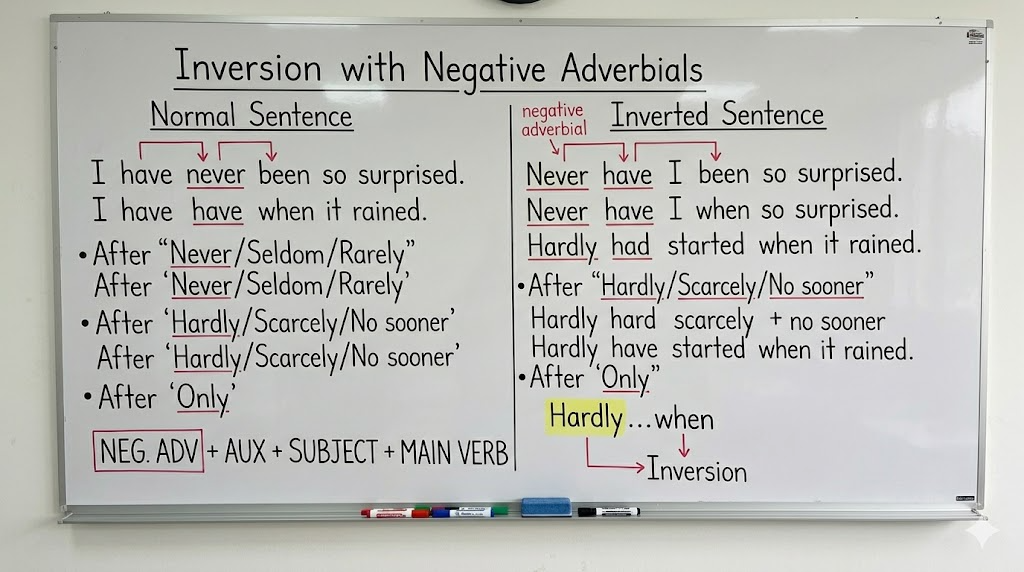
The teacher begins by projecting the image below. Then proceeds to display two sentences:
A: “I have never seen such a beautiful sunrise.”
B: “Never have I seen such a beautiful sunrise.”

Instruction: Ask students in pairs to discuss: *Which sounds more dramatic? What changed in the word order of Sentence B?*
Task: Give students three “normal” sentences (e.g., “She had hardly started…”) and challenge them to move the negative word to the start and “fix” the rest of the sentence.
1. The concert had hardly begun when the power went out.
2. She has never heard such a beautiful voice.
3. They realized the truth only when they saw the evidence.
CONSTRUCTION
Part 2: Vocabulary Development (15 min)
The teacher explicitly introduces key vocabulary needed for the lesson, ensuring students clearly understand meaning and use. The words include:
- 1. Seldom: Rarely or almost never.
- 2. Hardly / Scarcely: Only just; almost not.
- 3. Under no circumstances: Not for any reason (very formal).
- 4. On no account: Used to say something must not be done.
- 5. Not only… but also: Used to introduce two related points.
- 6. Little did they know: Used to say someone was unaware of what was about to happen.
To practice, ask students to volunteer and try changing these boring sentences using the negative adverbials provided. - Boring: They didn’t know that a surprise party was waiting for them.
- Boring: You must not open this door for any reason.
- Boring: It rarely rains in the desert.
Part 3: Grammar Introduction using Presentation (20 min)
The teacher presents the slides,
When we place a negative adverbial at the beginning of a sentence for emphasis, the word order changes from Subject + Verb to Auxiliary Verb + Subject + Main Verb (like a question).
The Formula:
Negative Adverbial + Auxiliary (do/have/be/can) + Subject + Main Verb
Examples:
Normal: I have seldom eaten such a spicy meal.
Inverted: Seldom have Ieaten such a spicy meal.
Normal: You should not open the door under any circumstances.
Inverted: Under no circumstances should you open the door.
Part 4: Guided Practice- The News Anchor (25 min)
Students begin applying the structure through practice.
Instruction: Students work in trios. They are given a list of “boring” facts about a fictional scandal.
Task: Rewrite 5 boring facts using inversion to make them sound like “Breaking News” headlines.
Example: “The mayor didn’t know the police were watching him ——> Little did the mayor know that the police were watching him.”
Presentation: Groups “broadcast” their headlines to the class with maximum dramatic flair.
SESSION 2: CONSTRUCTION – REINFORCEMENT (40 min)
The Regret Wall (40 min)
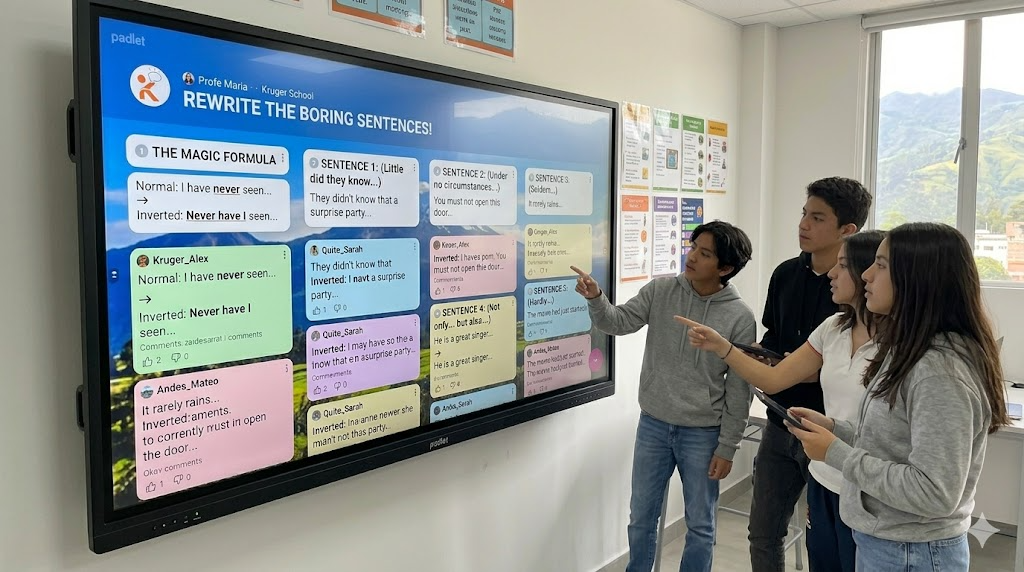
Creative Task: Students write a “Flash Fiction” story (100 words) about a character who made a huge mistake.
Requirement: They must use at least three different inverted structures (e.g., Never had he felt…, Not only did he lose…).
Format: Students Post these on a digital padlet or a physical wall. Students vote on the most “dramatic” story.
PRESENT PERFECT CONTINUOUS KAHOOT
SESSION 3: CONSOLIDATION (80 min)
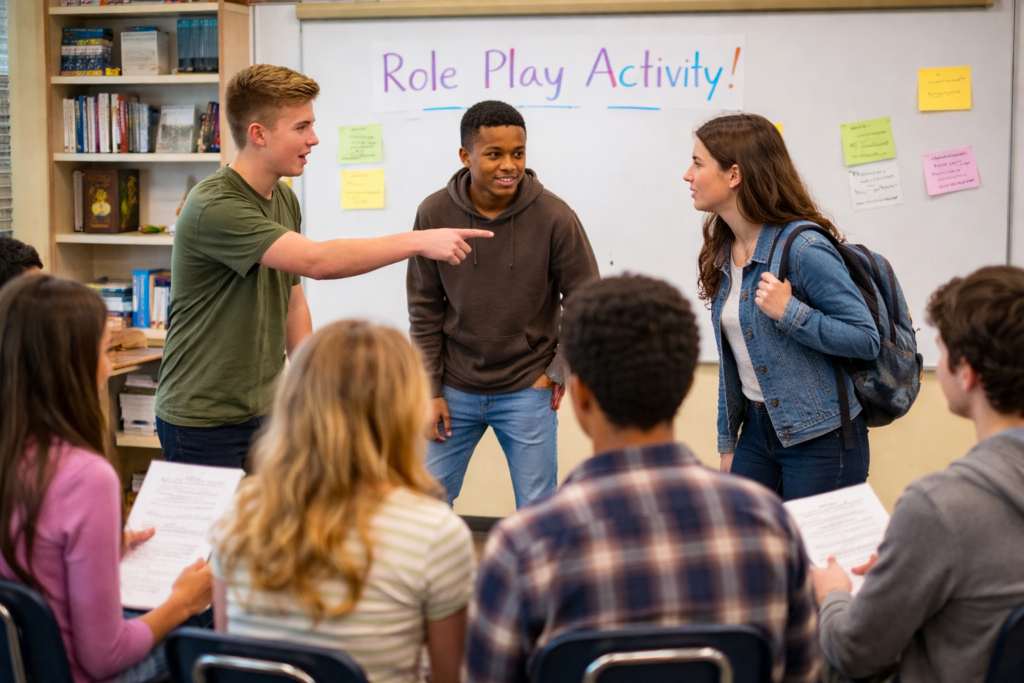
Part 1 – The “Movie Trailer” Pitch (40 min)

- Part 1:
- Students work in small groups to write a script for a movie trailer.
- Rule: Every single sentence must use an inverted negative adverbial to make it sound as epic and dramatic as possible.
- Example: “Little did the world know… Not only did the aliens arrive, but they also brought snacks.”
- Students quickly film their trailer and edit.
Part 2 – Trailer Presentations (40 min)
Part 2:Each group presents their trailer on the screen and at the end the class votes for the best trailer .
RUBRIC:
Trailer Rubric
| Category | High Performance (2 pts) | Satisfactory (1.5 pts) | Needs Improvement (0.5 – 1 pt) | Score |
| Grammar: The Magic Formula | All 5+ inverted sentences follow the correct $[Neg. Adv + Aux + Subj + Verb]$ structure perfectly. | 3–4 sentences are correctly inverted, or there are minor auxiliary verb errors. | Fewer than 3 sentences are inverted, or word order is consistently incorrect. | /2 |
| Vocabulary Usage | Effectively uses at least 4 different adverbials from the list (e.g., Little did they know, Seldom). | Uses 2–3 adverbials from the list correctly. | Uses only 1 adverbial or uses them in a way that doesn’t make sense. | /2 |
| Dramatic Impact | The inversion is used to create genuine suspense or excitement. It feels like a real movie trailer! | The sentences are dramatic, but the flow is a bit repetitive or stiff. | The sentences feel like a grammar exercise rather than a story or trailer. | /2 |
| Creativity & Story | The plot of the “trailer” is clear, original, and engaging for the audience. | The plot is understandable but cliché or slightly disorganized. | No clear plot; just a list of disconnected sentences. | /2 |
| Delivery & Pronunciation | Clear voiceover with “movie trailer” intonation. Pronunciation is accurate and easy to follow. | Generally clear, though some words may be mumbled or the tone is a bit flat. | Hard to understand; lacks the energy or pacing required for a trailer. | /2 |
| TOTAL SCORE | /10 |
NEE – Agregar el tipo de adaptaciones curriculares
Principio II: Pautas 6.1 – 6.3 – 6.4
Principio III: Pautas 7.1 – 8.1 – 9.1
ALUMNO 1: Constante monitoreo. Dar tiempo adicional para el desarrollo de la actividad y se reduce el número de ejercicios o se modifican los ejercicios con un nivel de dificultad reducido, de acuerdo con sus necesidades académicas.
ALUMNO 2: Constante monitoreo, Dar tiempo adicional para el desarrollo de la actividad y se reduce el número de ejercicios o se modifican los ejercicios con un nivel de dificultad reducido, de acuerdo con sus necesidades académicas.
ALUMNO 3: Constante monitoreo. Corroborar que el contenido entregado en clase haya sido comprendido por la estudiante mediante retroalimentación.