
CLEFT SENTENCES
SKILLS
(EFL 5.1.7). Communication and Cultural Awareness: Use a wide range of language to express thoughts precisely, emphasizing specific aspects of an idea
(EFL 5.3.5).Reading: Identify and analyze stylistic devices used to create emphasis in complex academic and literary texts
(EFL 5.4.8).Writing: Apply advanced grammatical structures (cleft sentences) to provide focus and clarity in formal essays
REAL-LIFE APPLICATION
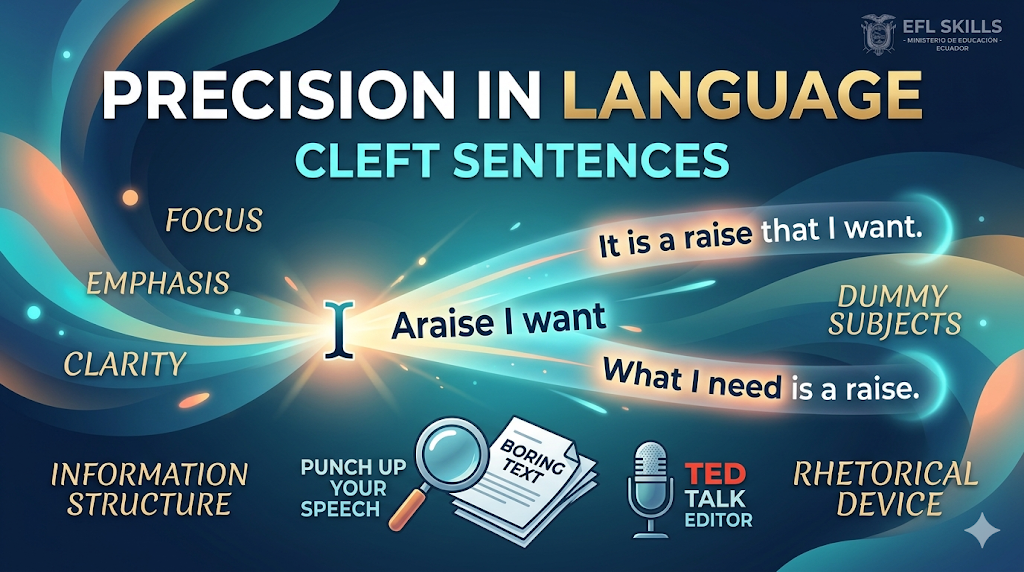
Cleft sentences are the “highlighter” of the English language. In journalism, public speaking, or high-stakes negotiations, they are used to correct a misunderstanding or to ensure the listener doesn’t miss the core point. Instead of saying “I want a raise,” saying “What I really need is a raise” shifts the focus from the person to the necessity of the request..
LEARNING ACTIVITIES
SESSION 1 (80 min) ANTICIPATION
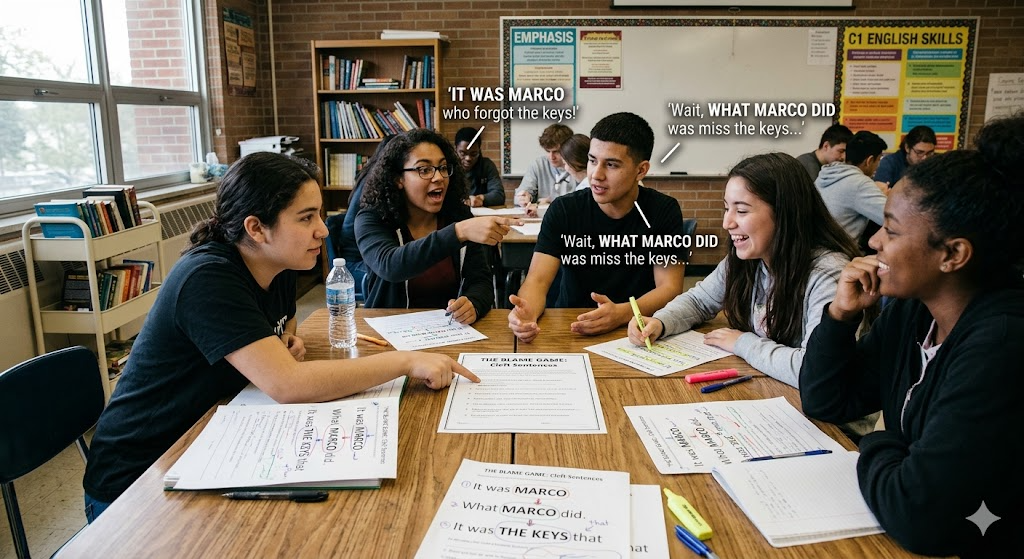
Part 1 – “The Blame Game” (20 min)
- Scenario: Present a chaotic situation (e.g., a broken vase or a missed deadline).
- Task: Students are given a basic sentence: “Marco forgot the keys.” 3. The Shift: Ask students to rewrite the sentence four different ways to blame:
- Marco specifically. (It was Marco who…)
- The object. (It was the keys that…)
- The action. (What Marco did was…)
- Goal: Students realize that word order changes the “emotional weight” of a sentence.
CONSTRUCTION
Part 2: Grammar Introduction (20 min)
The Anatomy of Clefting
- It-Clefts: Focuses on a noun or pronoun.
- Formula: It + is/was + [Focused Part] + that/who…
- Example: “It was the CEO who made the final decision.”
- Wh-Clefts (Pseudo-clefts): Focuses on a verb or the whole clause.
- Formula: What + [Clause] + is/was + [Focused Part]
- Example: “What I find fascinating is the lack of evidence.”
- Instruction: Emphasize that cleft sentences “split” a single clause into two to create a focal point.
Part 4: Guided Practice (25 min)
“The TED Talk Editor”
The Task: Provide a boring, flat speech transcript full of simple Subject-Verb-Object sentences.
Instructions: Students must “punch up” the speech by converting at least five key sentences into It-clefts or Wh-clefts.
Presentation: Students read their “Before” and “After” versions aloud. The class votes on which version sounds more persuasive and “C1-level.”
SESSION 2: CONSTRUCTION – REINFORCEMENT (40 min)
Part 1 – “The Drama Reformulated” (20 min)
Materials: Slips of paper/digital cards with “boring” sentences.
1. The Hook: The “No, Actually…” Warm-up (5 mins)
Start with a bit of roleplay. Make a blatantly false claim about something the students like (e.g., “I heard you guys all love doing 4 hours of homework on Fridays”).
Encourage them to correct you using a cleft sentence:
- Student: “No, what we actually want is a weekend with no homework!”
- Student: “It’s the extra sleep that we really need.”
Part 2 – Interactive Practice (20 min)
The Mechanics: The “Cleft-It” Challenge
Students are given 5 “flat” sentences. In pairs, they must rewrite each one in three different ways using cleft structures.
Example Sentence: Lana Del Rey released a new album yesterday.
- It cleft: It was Lana Del Rey who released a new album yesterday.
- What cleft: What Lana Del Rey did yesterday was release a new album.
- The thing/time cleft: The time (when) Lana Del Rey released a new album was yesterday.
SESSION 3: CONSOLIDATION (80 min)
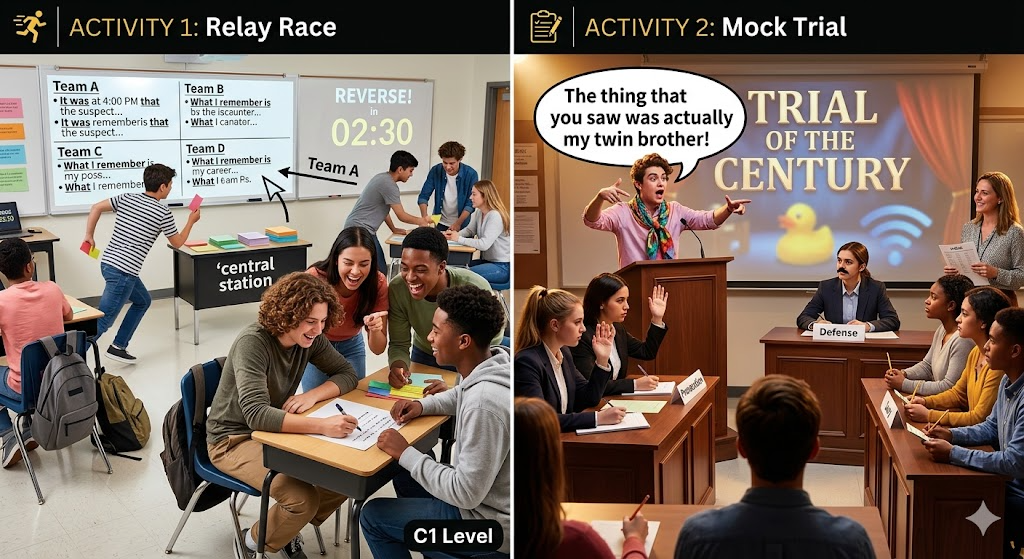
Part 1 – The “Cleft-It” Relay Race (35 Minutes)
Part 1:
This focuses on speed and structural accuracy.
Setup
- The class is divided into 3 or 4 teams.
- Place a stack of “Boring Sentences” on a desk at the front of the room (one stack per team).
- The Goal: Be the first team to correctly “upcycle” all sentences into specific cleft structures.
The Gameplay
- The Sprint: One student from each team runs to the front, grabs a sentence (e.g., “The chef burnt the soufflé because the timer broke”), and brings it back to the group.
- The Transformation: The group must rewrite that sentence using two different types of clefts (e.g., one It-cleft and one Pseudo-cleft).
- The Verification: A “runner” takes the rewritten version to you (the Judge).
- Correct? They get a point and the next runner goes.
- Incorrect? You send them back to “fix the focus.”
- The Twist: Every 10 minutes, shout “REVERSE!” The teams must now take a complex cleft sentence you provide and simplify it back into a “boring” standard sentence.
Part 2 – The “Trial of the Century” (40 min)
The Scenario
A high-profile “crime” has occurred (e.g., The school’s Wi-Fi password was changed to “I-Love-Grammar,” and the principal’s office was filled with 5,000 rubber ducks). There are three main suspects.
The Roles
- The Prosecution: Must use cleft sentences to emphasize guilt and evidence.
- The Defense: Must use cleft sentences to emphasize alibis and alternative culprits.
- The Witnesses: Must use cleft sentences to provide “dramatic” testimony.
- The Jury: Responsible for note-taking and deciding the winner based on who used the most effective (and correct) clefts.
The Procedure
- Preparation (15 mins): Groups prepare their opening statements and cross-examinations. They must include at least 10 cleft sentences in their script (mix of All, What, It, The reason why, etc.).
- The Trial (25 mins): Conduct the trial.
- Prosecutor: “It was at 4:00 PM that the suspect was seen near the ducks!”
- Suspect: “No! The thing that you saw was actually my twin brother!”
- Witness: “What I clearly remember is the smell of rubber and mischief.”
- The Verdict (5 mins): The Jury delivers the verdict, highlighting the “most persuasive cleft sentence” they heard.
RUBRIC:
https://docs.google.com/document/d/1aVlfDiNNTQevHAsu6rvDiZ_o4mMc1g5egqIK4gQ8tnQ/edit?usp=sharing
NEE – Agregar el tipo de adaptaciones curriculares
Principio II: Pautas 6.1 – 6.3 – 6.4
Principio III: Pautas 7.1 – 8.1 – 9.1
ALUMNO 1: Constante monitoreo. Dar tiempo adicional para el desarrollo de la actividad y se reduce el número de ejercicios o se modifican los ejercicios con un nivel de dificultad reducido, de acuerdo con sus necesidades académicas.
ALUMNO 2: Constante monitoreo, Dar tiempo adicional para el desarrollo de la actividad y se reduce el número de ejercicios o se modifican los ejercicios con un nivel de dificultad reducido, de acuerdo con sus necesidades académicas.
ALUMNO 3: Constante monitoreo. Corroborar que el contenido entregado en clase haya sido comprendido por la estudiante mediante retroalimentación.