
advanced Ellipsis and SUbstitution
SKILLS
(EFL 5.1.2) Communication and Cultural Awareness: Understand nuances in meaning and use language flexibly for social and professional purposes
(EFL 5.3.3). Reading: Evaluate and analyze the impact of word choice on the meaning of complex texts
(EFL 5.4.7).Writing: Use a wide range of vocabulary and grammatical structures with precision to produce clear, well-structured text
REAL-LIFE APPLICATION
In high-level academic writing and professional debates, repeating the same nouns or phrases makes students sound robotic. Ellipsis (dropping words) and Substitution (replacing words with “do,” “so,” or “one”) allow them to maintain “flow.” It’s the difference between a repetitive speech and one that sounds charismatic and native-like.
LEARNING ACTIVITIES
SESSION 1 (80 min) ANTICIPATION
Part 1 – “The Echo Chamber” ( 15- 20 min)
- Instruction: Give students a short, 5-line dialogue where every noun and verb is repeated (e.g., “Do you want coffee? Yes, I want coffee. I think coffee is good.”).
- Task: In pairs, students must “slash” every word they think is unnecessary without losing the meaning.
- Theory: Introduce the term Economy of Language: Good writers say more with less.
CONSTRUCTION
Part 2: Vocabulary Development (15 min)
The teacher explicitly introduces key vocabulary needed for the lesson, ensuring students clearly understand meaning and use. The words include:
- Redundancy: The state of being no longer useful or needed.
- Omission: Leaving something out.
- Anaphoric: Referring back to something previously mentioned.
- Succinct: Briefly and clearly expressed.
- Cohesive: Formed into a united whole.
- Synonymous: Having the same or similar meaning.
Part 3: Grammar Introduction using Presentation (20 min)
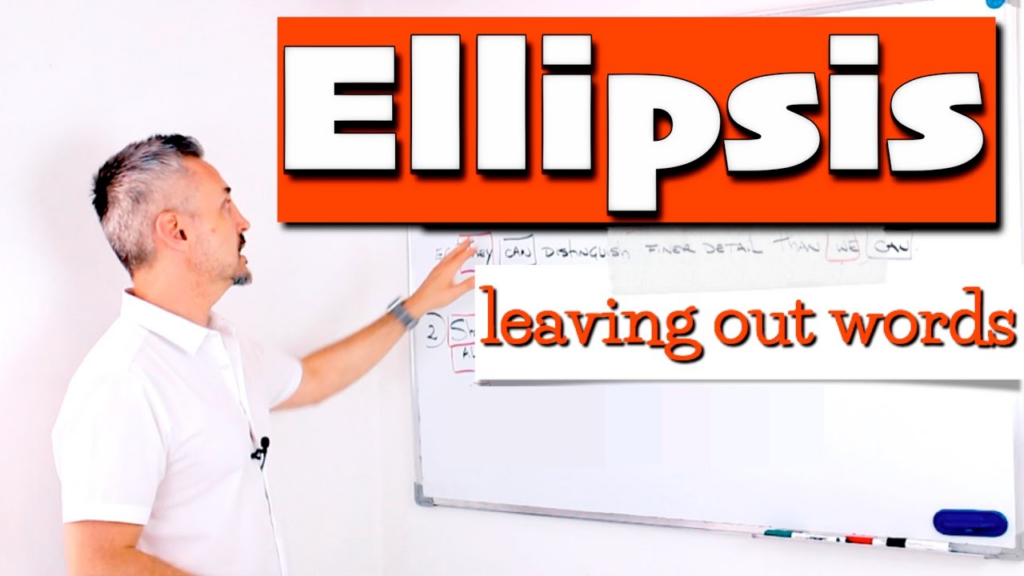
Grammar Introduction: Ellipsis and Substitution
Theory:
- Ellipsis: Removing words that are understood from context.
- Example: “I’ve been to Rome, but she hasn’t [been to Rome].”
- Substitution: Using words like do/does, so/not, one/ones.
- Example: “I don’t like the red shirt; I prefer the blue one.”
- Example: “Will it rain? I hope not.” (Replaces “I hope it doesn’t rain”).
Part 4: Guided Practice (25 min)
Grammar Practice: “The Minimalist Challenge” (25 min)*
- Instruction: Provide a 200-word academic paragraph that is intentionally repetitive.
- Task: Students must rewrite it using at least 5 instances of ellipsis and 5 substitutions.
- Check: Peer-review in groups of three to see who achieved the “cleanest” flow.
SESSION 2: CONSTRUCTION – REINFORCEMENT (40 min)
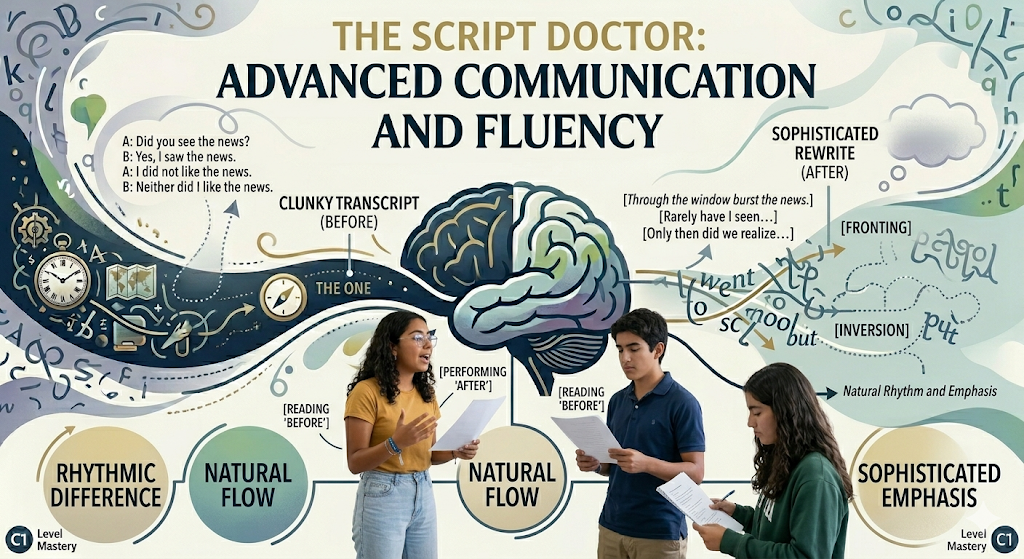
“The Script Doctor” (40 min)
Activity: “The Script Doctor”
- Instruction: Provide a transcript of a clunky, repetitive movie scene or political interview.
- Task: Students act as “editors,” rewriting the dialogue to sound more natural and sophisticated using the target grammar.
- Output: Students perform their “before” and “after” versions to hear the rhythmic difference.
SESSION 3: CONSOLIDATION (80 min)
Part 1 – ( 2 x 40min)
Reinforcement:
- Period 1 (40 min) – Creative Production: *The Chain Story: In groups, students write a collaborative story. Student A writes a sentence; Student B must write the next sentence using ellipsis or substitution to link them.
- Goal: Create a 15-sentence story that flows perfectly.
- Period 2 (40 min) – Assessment:
- The “Spot the Gaps” Quiz: A 10-question digital quiz (Forms/Kahoot).
- Part A: Identify where words were omitted.
- Part B: Choose the correct substitute (e.g., “so” vs “not”, “do” vs “does”).
- Part C: Rewrite 3 sentences for maximum emphasis.
NEE – Agregar el tipo de adaptaciones curriculares
Principio II: Pautas 6.1 – 6.3 – 6.4
Principio III: Pautas 7.1 – 8.1 – 9.1
ALUMNO 1: Constante monitoreo. Dar tiempo adicional para el desarrollo de la actividad y se reduce el número de ejercicios o se modifican los ejercicios con un nivel de dificultad reducido, de acuerdo con sus necesidades académicas.
ALUMNO 2: Constante monitoreo, Dar tiempo adicional para el desarrollo de la actividad y se reduce el número de ejercicios o se modifican los ejercicios con un nivel de dificultad reducido, de acuerdo con sus necesidades académicas.
ALUMNO 3: Constante monitoreo. Corroborar que el contenido entregado en clase haya sido comprendido por la estudiante mediante retroalimentación.