
Homographs,and Homonyms

SKILLS
(EFL 5.1.2) Communication and Cultural Awareness: Understand nuances in meaning and use language flexibly for social and professional purposes
(EFL 5.3.3). Reading: Evaluate and analyze the impact of word choice on the meaning of complex texts
(EFL 5.4.7).Writing: Use a wide range of vocabulary and grammatical structures with precision to produce clear, well-structured text
REAL-LIFE APPLICATION
In professional and academic settings, ambiguity is the enemy. Whether one is interpreting a legal contract, reading medical instructions, or writing a diplomatic email, failing to distinguish between a lead (the metal) and a lead (to guide) can result in costly errors. Precision ensures students’ intent aligns perfectly with the reader’s understanding.
LEARNING ACTIVITIES
SESSION 1 (80 min) ANTICIPATION
Part 1 (20 min)
“Puns and Puzzles” Warm-up
- Project three sentences with dual meanings: * “The bandage was wound around the wound.” * “The crane flew over the construction crane.”
- “The dump was so full, it had to refuse more refuse.”
- Task: In pairs, students must identify the two meanings of the repeated word.
- Quick Theory: Briefly define Homonyms (same sound/spelling, different meaning) and Homographs (same spelling, different sound/meaning)
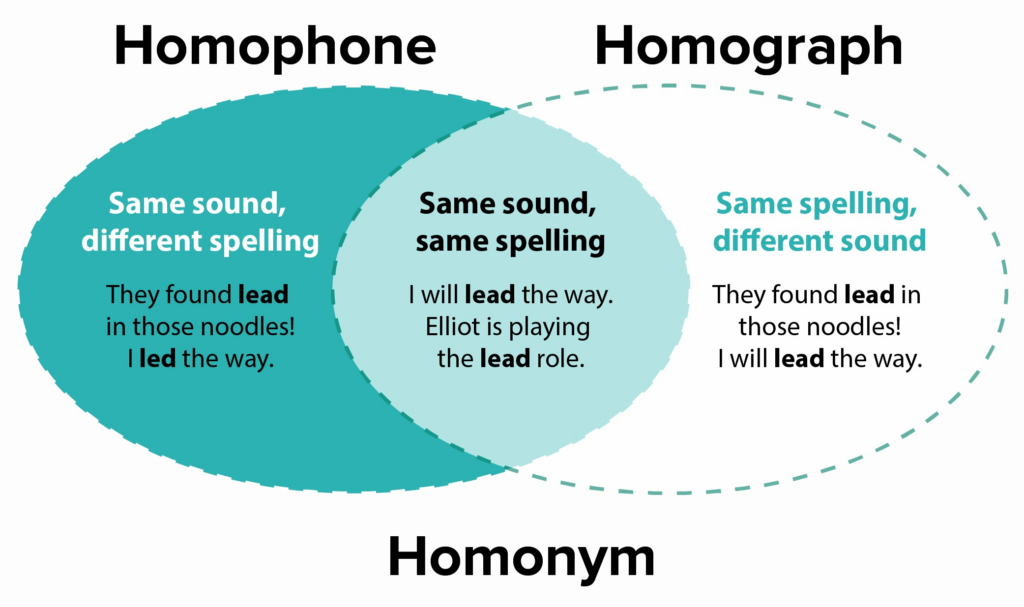
CONSTRUCTION
Part 2: Vocabulary Development (15 min)
The teacher explicitly introduces key vocabulary needed for the lesson, ensuring students clearly understand meaning and use. The words include:
Focus on high-level academic/professional terms:
- Ambiguity: Uncertainty or inexactness of meaning.
- Context Clues: Hints found within a sentence to help define a word.
- Nuance: A subtle difference in shade of meaning or expression.
- Lexical: Relating to the words or vocabulary of a language.
- Polysemy: The coexistence of many possible meanings for a word.
- Syntactic: Relating to the arrangement of words to create well-formed sentences.
Quick game to go over the vocabulary: Bamboozle or Kahoot
Part 3: Grammar Introduction using Gamma Presentation (20 min)
The Logic of Context
- Homograph Mechanics: Focus on word stress shifts (e.g., CONtent vs. conTENT).
- Rule: Many nouns have stress on the first syllable; verbs on the second.
- Homonym Disambiguation: Explain how sentence structure (syntax) determines meaning.
- Example: “The bar is closed” (Noun) vs. “We bar the door” (Verb).
- Instruction: Students take notes on a T-chart separating words that change pronunciation from those that don’t.
Part 4: Guided Practice (25 min)
“The Script Doctor”
The Task: Provide a short, intentionally confusing paragraph where homonyms/homographs are used without enough context.
- Instructions: Students must rewrite the paragraph to be “crystal clear” for a C1 audience by using synonyms, adding descriptive adjectives, or restructuring the sentence.
- Peer Review: Swap with a partner to see if the “corrected” version is truly unambiguous.
SESSION 2: CONSTRUCTION – REINFORCEMENT (40 min)
Part 1 – The Visual Double Entendre (20 min)
- Task: Students create a digital slide or meme that illustrates a “Homonym Fail.”
- Requirement: They must write two sentences: one using the word correctly in a formal context and one using it in an informal context.
Part 2 – Interactive Practice (20 min)
Students participate in a Kahoot or similar interactive activity designed to reinforce the concepts learned.
Kahoot
SESSION 3: CONSOLIDATION (80 min)

Part 1 – The Clarification Audit (15 min)
Task: Provide a short paragraph (3-4 sentences) that is intentionally “broken” because of homograph/homonym misuse.
- Example: “The object was to object to the project, but the project lead felt the lead was too heavy to carry.”
Student Requirement:
- Annotate: Underline the homographs/homonyms.
- Transcribe: Use basic IPA or bold the stressed syllable (e.g., OB-ject vs. ob-JECT) to show correct pronunciation.
- Rewrite: Produce a C1-level version using more precise synonyms (e.g., “The goal was to protest the proposal…”).
Part 2 –Summative Assessment: Multiple Choice Quiz (25 min)
10 Multiple Choice questions.
https://gemini.google.com/share/2de294d90861
NEE – Agregar el tipo de adaptaciones curriculares
Principio II: Pautas 6.1 – 6.3 – 6.4
Principio III: Pautas 7.1 – 8.1 – 9.1
ALUMNO 1: Constante monitoreo. Dar tiempo adicional para el desarrollo de la actividad y se reduce el número de ejercicios o se modifican los ejercicios con un nivel de dificultad reducido, de acuerdo con sus necesidades académicas.
ALUMNO 2: Constante monitoreo, Dar tiempo adicional para el desarrollo de la actividad y se reduce el número de ejercicios o se modifican los ejercicios con un nivel de dificultad reducido, de acuerdo con sus necesidades académicas.
ALUMNO 3: Constante monitoreo. Corroborar que el contenido entregado en clase haya sido comprendido por la estudiante mediante retroalimentación.