
FLOW AND EMPHASIS
SKILLS
CE.EFL.5.12: Produce clear, smoothly flowing, well-structured speech, showing controlled use of organizational patterns, connectors, and cohesive devices.
CE.EFL.5.15: Demonstrate an ability to use a variety of complex sentences and language structures to analyze and respond to different types of texts.
CE.EFL.5.16: Produce well-constructed, academic texts using appropriate cohesive devices and advanced grammar to present a clear, persuasive argument.
REAL-LIFE APPLICATION
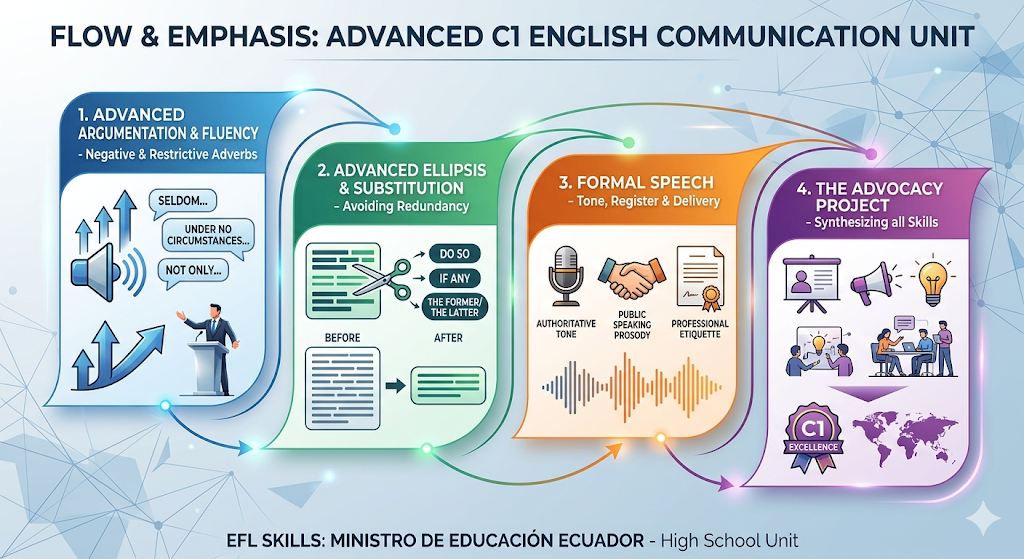
Throughout this module, we will move beyond basic sentence structures to master the art of sophisticated communication. We will begin by exploring Advanced Argumentation and Fluency, focusing on how negative and restrictive adverbs (inversion) can add rhetorical power to your claims. From there, we will dive into Advanced Ellipsis and Substitution to strip away redundancy and make your writing more “lean” and professional. Finally, we will refine these tools for Formal Speech, ensuring your delivery is both authoritative and smooth. In the “real world,” these aren’t just grammar rules—they are the tools of leadership. Whether you are delivering a keynote speech, negotiating a high-level contract, or writing a persuasive editorial, the ability to control emphasis and flow determines whether your audience is simply listening or truly convinced.
LEARNING ACTIVITIES
TOPICS:
Module 1: Advanced Argumentation & Fluency
Focus: Negative and Restrictive Adverbs (e.g., “Seldom have I seen…”).
Module 2: Advanced Ellipsis & Substitution
Focus: Avoiding repetition to achieve C1-level conciseness (e.g., using “do so,” “if any,” or omitting words entirely).
Module 3: Formal Speech
Focus: Tone, register, and the prosody of emphasis in spoken English.
Final Assessment: The Advocacy Project
- Focus: A capstone project combining all three modules into a persuasive campaign or speech.
NEE – Agregar el tipo de adaptaciones curriculares
Principio II: Pautas 6.1 – 6.3 – 6.4
Principio III: Pautas 7.1 – 8.1 – 9.1
ALUMNO 1: Constante monitoreo. Dar tiempo adicional para el desarrollo de la actividad y se reduce el número de ejercicios o se modifican los ejercicios con un nivel de dificultad reducido, de acuerdo con sus necesidades académicas.
ALUMNO 2: Constante monitoreo, Dar tiempo adicional para el desarrollo de la actividad y se reduce el número de ejercicios o se modifican los ejercicios con un nivel de dificultad reducido, de acuerdo con sus necesidades académicas.
ALUMNO 3: Constante monitoreo. Corroborar que el contenido entregado en clase haya sido comprendido por la estudiante mediante retroalimentación.