
advanced argumentation and fluency
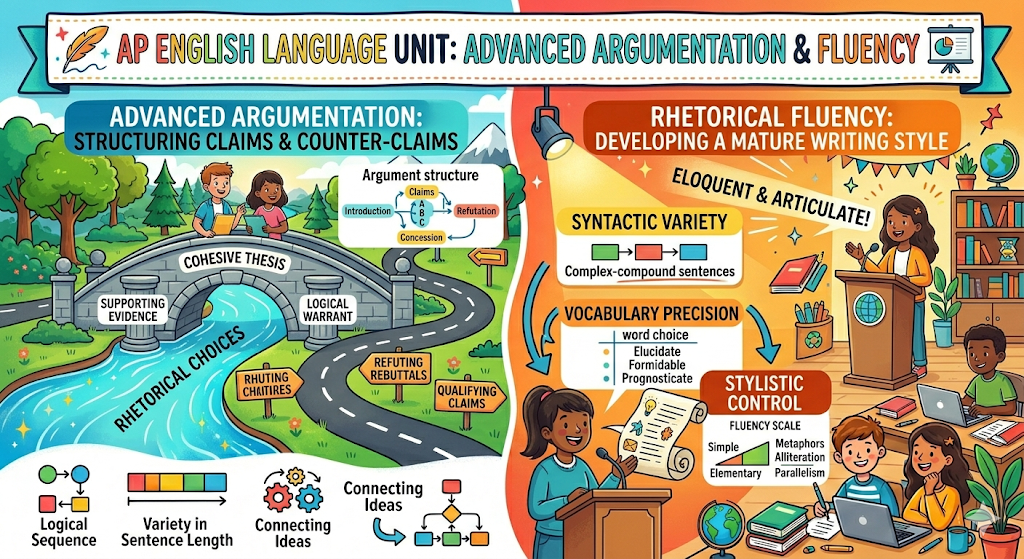
SKILLS
(EFL 5.1.2) Communication and Cultural Awareness: Understand nuances in meaning and use language flexibly for social and professional purposes
(EFL 5.3.3). Reading: Evaluate and analyze the impact of word choice on the meaning of complex texts
(EFL 5.4.7).Writing: Use a wide range of vocabulary and grammatical structures with precision to produce clear, well-structured text
REAL-LIFE APPLICATION
In professional and academic settings, how you say something is as important as what you say. Mastery of flow and emphasis allows students to ace university interviews, deliver persuasive presentations, and avoid sounding robotic during high-stakes negotiations by highlighting their most important ideas.
LEARNING ACTIVITIES
SESSION 1 (80 min) ANTICIPATION
Part 1 – “The Emphasis Shift”( 15- 20 min)
“The Emphasis Shift”
Instruction: Show three identical sentences on screen. Ask students to read them aloud, stressing only the bold word.
- I didn’t say she stole the money. (Someone else said it.)
- I didn’t say she stole the money. (I implied it/wrote it.)
- I didn’t say she stole the money. (She stole something else.)
- Discussion: How does moving the stress change the “flow” and meaning?
CONSTRUCTION
Part 2: Vocabulary Development (15 min)
The teacher explicitly introduces key vocabulary needed for the lesson, ensuring students clearly understand meaning and use. The words include:
Phrases to Agree
Instead of just saying “You’re right,” these phrases help students validate someone else’s point while keeping their own high-level voice.
- “You’ve hit the nail on the head with that point.” (Great for recognizing a perfect argument.)
- “I completely see where you’re coming from, and to add to that…” (Perfect for building on a classmate’s idea.)
- “That argument is incredibly convincing because…”
- “Your point about [X] is spot on.”
Phrases to Disagree (Politely but Firmly)
Middle school debates can get passionate! These phrases help students challenge an idea intellectually without making it personal.
- “I see your point, but have you considered…?” (The ultimate polite challenge.)
- “That’s a valid argument, but the evidence shows something else.”
- “I’m not entirely convinced that…” (A sophisticated way to express doubt.)
- “While I understand why you’d say that, I look at it a bit differently.”
- “I respect your perspective, but I have to disagree because…”
Phrases to Find a Middle Ground
- “Can we meet halfway and agree that…?” (Direct and collaborative.)
- “It sounds like we actually agree on the main goal, even if we disagree on the details.”
- “While we might not see eye-to-eye on everything, we can both agree that…”
- “Let’s look at the common ground between our two arguments.”
Quick game to go over the vocabulary: Bamboozle or Kahoot
Part 3: Grammar Introduction using Presentation (20 min)
Grammar Introduction: Fronting
Theory: Fronting involves moving an adverbial phrase or a prepositional phrase to the beginning of the sentence.
- Place/Position: In the middle of the valley stood an ancient oak tree.
- Direction/Movement: Into the room burst the angry manager.
- Manner/Adverbs: Slowly and silently, the thief opened the window. The “Flow” Rule: We often “front” information that was mentioned in the previous sentence to create a bridge (e.g., “I looked at the shelf. On that shelf was the key.”)
Part 4: Guided Practice (25 min)
Instruction: Give students a “flat” police report. They must rewrite it using Fronting to make it sound like a dramatic mystery novel.
- Flat: A bloodstained glove lay behind the sofa. —–>Behind the sofa lay a bloodstained glove.
- Flat: The suspect ran out of the back door. —–>Out of the back door ran the suspect.
- Flat: He spoke quietly but firmly. ——> Quietly but firmly, he spoke.
SESSION 2: CONSTRUCTION – REINFORCEMENT (40 min)
“The Great Debate Spotlight” (40 min)
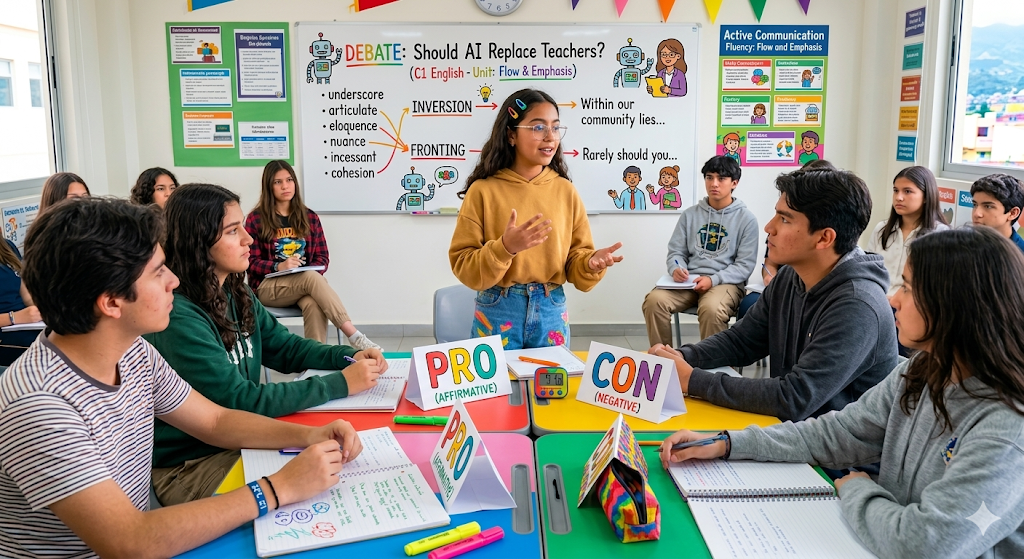
Activity: Persuasive Fronting “Battle”
- Step 1: The Topic (5 min): Assign a controversial but lighthearted topic (e.g., “Should AI replace teachers?” or “Is social media ruining our attention spans?”). Split the class into “Pro” and “Con.”
- Step 2: The Rhetorical Prep (15 min): Students must write 3 “power statements” using fronting for emphasis.
- Instead of: “Our future is at stake here.”
- Fronted: “At stake here is our very future.”
- Instead of: “The solution lies within our community.”
- Fronted: “Within our community lies the solution.”
- Step 3: The Mini-Debate (15 min): Students present their arguments. To earn a “Fluency Point,” they must transition smoothly from their partner’s point using a fronted adverbial (e.g., “Contrary to that point stands the fact that…”).
- Step 4: Reflection (5 min): Discuss which version sounded more “authoritative” or “eloquent” (using your unit vocabulary!)
SESSION 3: CONSOLIDATION (80 min)
Part 1 – “The Narrative Flow”( 2 x 40min)
Reinforcement:
Creative Task:
- Period 1 (The Descriptive Journey): Students write a “Travel Vlog” script or a “Gothic Horror” intro. They must use at least 5 examples of fronting and 4 vocabulary words.
- Period 2 (The Flow Circle): Students stand in a circle. One student starts a story with a fronted phrase (e.g., “Beyond the mountains lived a dragon…”). The next student must continue, fronting the next location or action (e.g., “Through the fire flew a bird…”). The goal is non-stop flow for 5 minutes.
NEE – Agregar el tipo de adaptaciones curriculares
Principio II: Pautas 6.1 – 6.3 – 6.4
Principio III: Pautas 7.1 – 8.1 – 9.1
ALUMNO 1: Constante monitoreo. Dar tiempo adicional para el desarrollo de la actividad y se reduce el número de ejercicios o se modifican los ejercicios con un nivel de dificultad reducido, de acuerdo con sus necesidades académicas.
ALUMNO 2: Constante monitoreo, Dar tiempo adicional para el desarrollo de la actividad y se reduce el número de ejercicios o se modifican los ejercicios con un nivel de dificultad reducido, de acuerdo con sus necesidades académicas.
ALUMNO 3: Constante monitoreo. Corroborar que el contenido entregado en clase haya sido comprendido por la estudiante mediante retroalimentación.