
FORMAL SPEECH
SKILLS
EFL 5.4.2: Identify and use appropriate register and style in diverse speaking contexts, such as formal and informal interviews, discussions, and presentations.
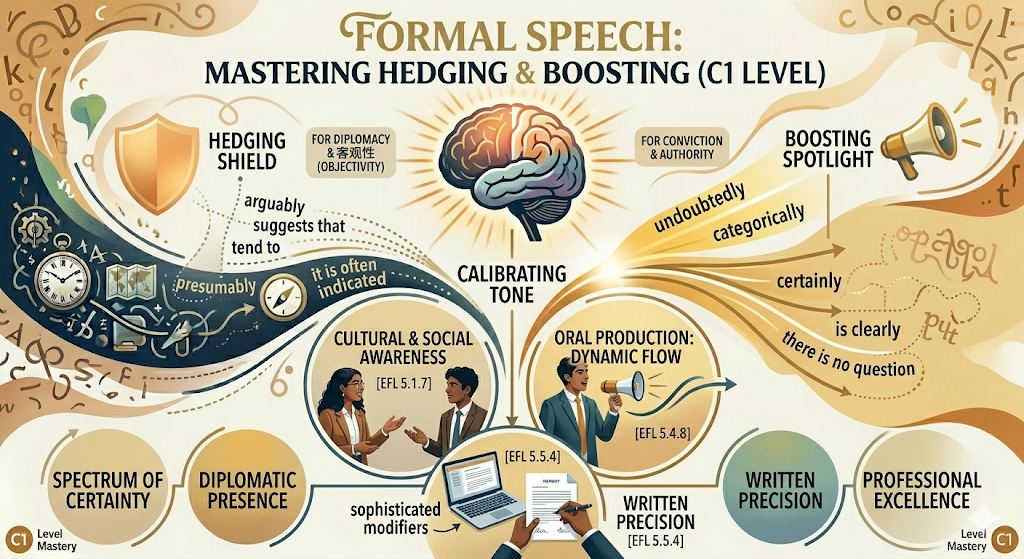
EFL 5.4.8: Produce well-structured, smoothly flowing, and cohesive utterances on a variety of topics, using a range of rhetorical devices to emphasize key points.
EFL 5.1.7: Interpret and demonstrate respect for different points of view by using language that is empathetic and professional, while expressing one’s own opinion clearly and politely.
REAL-LIFE APPLICATION
In university seminars, job interviews, or corporate boardrooms, absolute statements (e.g., “This will fail”) often sound unprofessional. Hedging (softening) allows for nuance and “room to be wrong,” while Boosting (strengthening) shows conviction. Mastering these ensures students sound credible rather than arrogant or unsure.
LEARNING ACTIVITIES
SESSION 1 (80 min) ANTICIPATION
Part 1 – The Verdict ( 15- 20 min)
Anticipation Activity:
Instruction: Show three statements on a slide. Ask students which one sounds most professional for a scientist:
- “The vaccine works.”
- “The vaccine clearly works.” (Boosting)
- “The data suggests that the vaccine is likely to work.” (Hedging)
- Discussion: Why is #3 often preferred in academia? Discuss the “safety” of hedging.
CONSTRUCTION
Part 2: Vocabulary Development (15 min)
The teacher explicitly introduces key vocabulary needed for the lesson, ensuring students clearly understand meaning and use. The words include:
Hedging (Softening the Claim)
- Arguably: Used to qualify a statement that may be open to debate.
- Presumably: Used to convey what is likely the case, though not 100% certain.
- Tentative: Describing an idea or proposal that is not yet fully worked out or certain.
- To suggest/indicate: Verbs used to present findings or opinions without claiming absolute truth.
Boosting (Strengthening the Claim)
- Undoubtedly: To emphasize that something is definitely true or exists.
- Categorically: To state something in a way that is unambiguous and leave no room for doubt.
- Compelling: Used to describe an argument or evidence that is very strong and convincing.
- Of paramount importance: A phrase used to show that something is more important than anything else.
Part 3: Grammar Introduction using Presentation (20 min)
Grammar Introduction: Ellipsis and Substitution
Theory:
1. Modal Verbs (The Foundation)
Students should move beyond simple “can/will” to more precise modals:
- Low Certainty (Hedge):might, may, could.
- “The policy might lead to unforeseen consequences.”
- High Certainty (Boost):must, will, shall.
- “This approach will undoubtedly revolutionize the industry.”
2. Adverbial Qualifiers
Adding an adverb allows you to “tune” the sentence:
- Hedging Adverbs: possibly, relatively, apparently, supposedly.
- Boosting Adverbs: clearly, strikingly, definitely, remarkably.
3. The “Distance” Strategy (Introductory Phrases)
One of the most effective C1 techniques is to create distance between the speaker and the statement to avoid sounding aggressive:
- Direct (Too blunt): “This plan is expensive.”
- Hedged (Professional): “It would appear that the plan is somewhat costly.”
- Boosted (Authoritative): “There is no question that the plan requires significant investment.”
4. Nouns of Probability
Using nouns instead of verbs adds a layer of academic “weight”:
- “There is a likelihood that…” (Hedge)
- “There is every indication that…” (Boost)
Part 4: Guided Practice (25 min)
Grammar Practice: The Dial (25 min)
Instruction: Give students 5 “Absolute” sentences (e.g., “Online school is better than face-to-face”).
- Task: They must rewrite each sentence twice: once “hedged” to the extreme (very cautious) and once “boosted” to the extreme (very confident).
- Peer Review: Partners read them aloud; the listener must guess the speaker’s “level of certainty” on a scale of 1–10.
SESSION 2: CONSTRUCTION – REINFORCEMENT (40 min)

Activity: “The Diplomat’s Rewrite”
Instruction: Provide a “clunky” email from a disgruntled employee who is being too direct.
- Original: “Your plan is bad. It won’t work. We will lose money.”
- Task: Students must rewrite this using hedging to sound professional and diplomatic.
- Example: “It would appear that the plan may face challenges. One could argue that it might lead to financial losses.”
- Discussion: Does the hedged version sound weaker or more sophisticated? (Hint: In C1 English, it’s usually more sophisticated).
SESSION 3: CONSOLIDATION (80 min)
Part 1 – ( 2 x 40min)
Reinforcement:
Period 1: Creative Activity: “The Shark Tank Pitch” (30 min)
Instruction: In pairs, students pitch a “ridiculous” product (e.g., a waterproof tea bag).
- Constraint: When talking about the product’s benefits, they must Boost. When talking about potential risks or competition, they must Hedge.
- Flow Check: They must use the “Argumentation” vocabulary from the previous unit (e.g., “While I concede that the market is small, I undoubtedly believe our product is unique.”)
Period 2: Assessment: “The Policy Proposal” (40 min)
Task: Students write a short (150-word) formal proposal regarding a school change (e.g., “Should the school day start at 10:00 AM?”). Rubric:
- Hedging (3 pts): Use of at least 3 hedging devices to discuss potential drawbacks.
- Boosting (3 pts): Use of at least 3 boosters to emphasize benefits.
- Vocabulary (2 pts): Use of unit words like substantiate, advocate, or compelling.
- Tone (2 pts): Maintaining a formal, C1-level register throughout.
NEE – Agregar el tipo de adaptaciones curriculares
Principio II: Pautas 6.1 – 6.3 – 6.4
Principio III: Pautas 7.1 – 8.1 – 9.1
ALUMNO 1: Constante monitoreo. Dar tiempo adicional para el desarrollo de la actividad y se reduce el número de ejercicios o se modifican los ejercicios con un nivel de dificultad reducido, de acuerdo con sus necesidades académicas.
ALUMNO 2: Constante monitoreo, Dar tiempo adicional para el desarrollo de la actividad y se reduce el número de ejercicios o se modifican los ejercicios con un nivel de dificultad reducido, de acuerdo con sus necesidades académicas.
ALUMNO 3: Constante monitoreo. Corroborar que el contenido entregado en clase haya sido comprendido por la estudiante mediante retroalimentación.