
Phrasal Verbs
SKILLS
EFL 5.3.4: Use new words and expressions (phrasal verbs) which occur in a variety of contexts and spoken texts.
EFL 5.4.2: Identify idioms, phrasal verbs, and colloquial expressions in digital media to extract specific meaning.
EFL 5.5.4: Write complex, coherent paragraphs using precise lexical choices to alter tone and narrative nuance.
REAL-LIFE APPLICATION
Phrasal verbs are the ultimate secret weapon for sounding fluent. Textbooks often teach formal verbs (“to tolerate”, “to invent”), but native speakers almost always use phrasal verbs (“to put up with”, “to make up”). Mastering these allows students to blend in seamlessly in international gaming lobbies, discord servers, and social media commentary.
LEARNING ACTIVITIES
SESSION 1 (80 min) ANTICIPATION
Part 1 ( 15- 20 min)
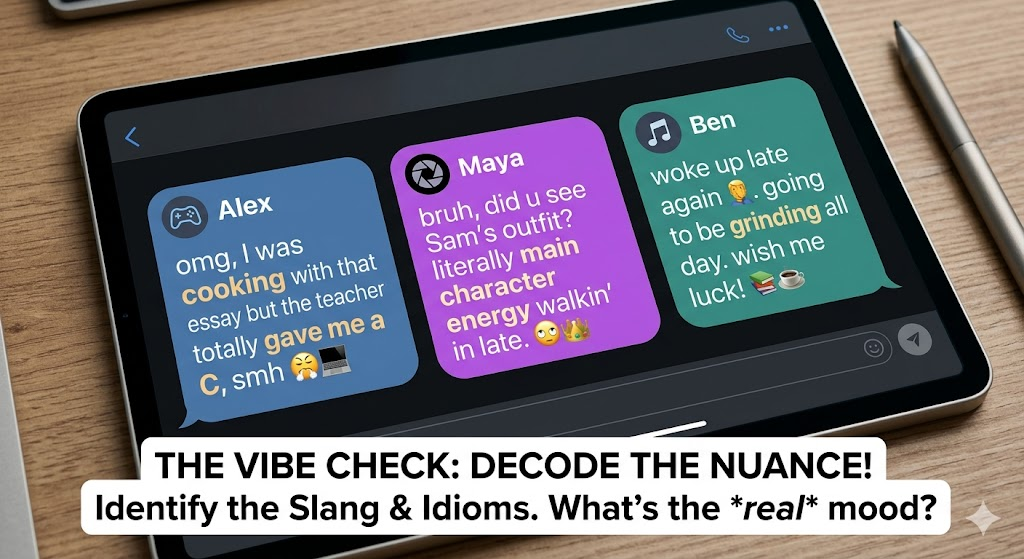
Anticipation Activity:
“The Upgrade Button” (15 min)
- Objective: Realize how phrasal verbs change a sentence from “robotic textbook” to “natural C1 English.”
- Instructions: Show a digital slide with a formal paragraph (e.g., “I cannot tolerate his attitude; we need to cancel the meeting”). Ask students to “upgrade” the verbs to sound like a normal teenager. Introduce the concept: A phrasal verb = Verb + Particle (preposition or adverb), which completely changes the original verb’s meaning.
CONSTRUCTION
Part 2: Vocabulary Development (15 min)
The teacher explicitly introduces key vocabulary needed for the lesson, ensuring students clearly understand meaning and use. The words include:
| Phrasal Verb | Meaning | Example |
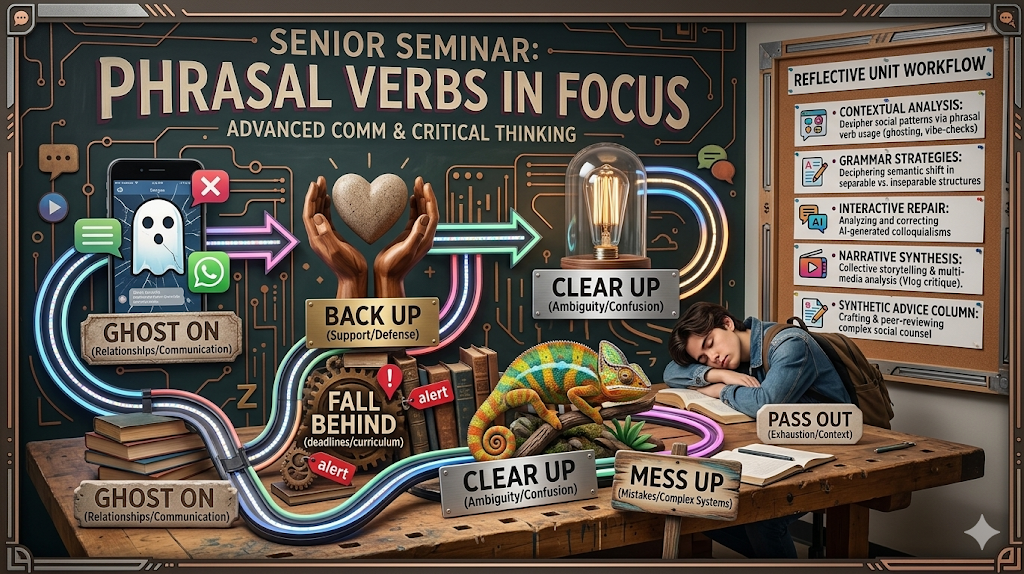
| To fall behind | To move slower than others; fail to maintain a pace. | If I miss one more day of class, I’m going to fall behind in math. |
| To ghost on (someone) | To suddenly cut off all digital communication without explanation. | We were supposed to study together, but he ghosted on me. |
| To clear up | To clarify a misunderstanding or solve a confusing situation. | Let’s have a quick call to clear up any confusion about the project. |
| To pass out | To lose consciousness / faint (or colloquially, to sleep from exhaustion). | After staying up all night gaming, he completely passed out on the desk. |
| To mess up | To make a mistake or ruin a situation. | I totally messed up the choreography during the talent show. |
| To back (someone) up | To support or defend someone. | Don’t worry about the presentation; if they ask hard questions, I’ll back you up. |
Part 3: Grammar Introduction using Presentation (20 min)
Grammar Introduction: Separable vs. Inseparable
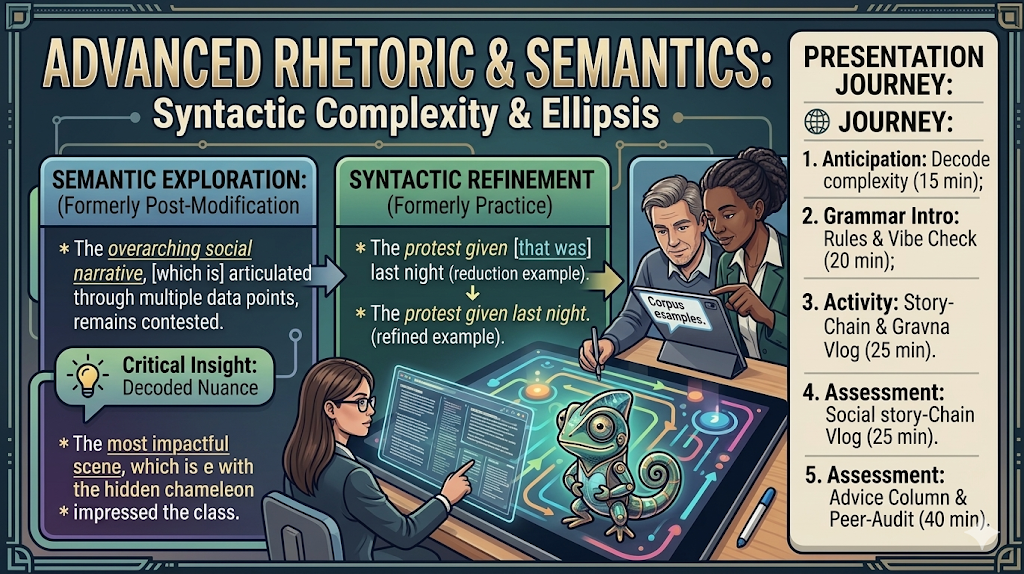
Separable vs. Inseparable (20 min)
- Objective: Understand the structural nuance of phrasal verbs.
- The Rules:
- Inseparable: The particle must stay next to the verb.
- Correct: I ghosted on my friend. / I ghosted on him.
- Separable: The object can go in the middle. Crucial Nuance: If the object is a pronoun (him, her, it, them), it must go in the middle.
- Correct: Clear up the mess. / Clear the mess up. / Clear it up.
- Incorrect: Clear up it.
- Inseparable: The particle must stay next to the verb.
Part 4: Guided Practice (25 min)
Grammar Practice Activity: “The Chat Filter”
- Instructions: Provide a digital worksheet simulating a buggy AI group chat. Students receive sentences where the pronoun is placed incorrectly (e.g., “I will back up her”). They must rewrite the chat logs correctly using the grammar rules, ensuring separable pronouns are placed in the middle.
SESSION 2: CONSTRUCTION – REINFORCEMENT (40 min)

The “Story-Chain” Vlog
- Objective: Practice oral fluency and structural accuracy using phrasal verbs.
- Instructions: In groups of 4, students create a continuous story using Flip (Flipgrid) or a shared audio note on their LMS.
- The Task: Student A starts a story using one phrasal verb (e.g., “Yesterday, I realized I was falling behind in science…”). Student B must listen, continue the story, and correctly use a second phrasal verb (e.g., “…so I asked my brother to back me up, but he ghosted on me!”).
- Goal: The chain must successfully include 4 distinct phrasal verbs with correct pronoun placement.
SESSION 3: CONSOLIDATION (80 min)
Part 1 – ( 2 x 40min)
Reinforcement:
Period 1: The “Advice Column” Draft (40 min)
- Task: Individual digital writing task.
- Prompt: Write a response to a fictional “Reddit/School Forum” post where a student is stressed about school drama and grades (150–200 words).
- Criteria: The advice text must naturally use at least 4 of the target phrasal verbs. At least two must demonstrate correct pronoun separation (e.g., “Don’t worry, you can clear it up”).
Period 2: The Grammar Quality Check (40 min)
- 0–20 min: The Code-Breaker Review. Partners swap documents. They must highlight all phrasal verbs and label them as [S] (Separable) or [I] (Inseparable), checking if any pronouns are illegally placed.
- 20–40 min: Final structural edits and digital submission for grading.
NEE – Agregar el tipo de adaptaciones curriculares
Principio II: Pautas 6.1 – 6.3 – 6.4
Principio III: Pautas 7.1 – 8.1 – 9.1
ALUMNO 1: Constante monitoreo. Dar tiempo adicional para el desarrollo de la actividad y se reduce el número de ejercicios o se modifican los ejercicios con un nivel de dificultad reducido, de acuerdo con sus necesidades académicas.
ALUMNO 2: Constante monitoreo, Dar tiempo adicional para el desarrollo de la actividad y se reduce el número de ejercicios o se modifican los ejercicios con un nivel de dificultad reducido, de acuerdo con sus necesidades académicas.
ALUMNO 3: Constante monitoreo. Corroborar que el contenido entregado en clase haya sido comprendido por la estudiante mediante retroalimentación.