
Professional mastery
SKILLS
EFL 5.3.3 (Reading): Identify hidden agendas, bias, and underlying cultural assumptions in complex information-rich texts, such as editorial opinion pieces, investigative reports, and digital media headlines.
EFL 5.4.4 (Writing): Produce clear, well-structured complex texts (news articles, editorials, press releases) that show controlled use of organizational patterns, connectors, and stylistic choices appropriate for the specific audience.
EFL 5.2.2 (Oral Communication): Advanced evaluation of informational audio and media, identifying nuances, speaker stance, implicit registers, and distinguishing between verifiable facts and speculation in live-recorded reports.
REAL-LIFE APPLICATION
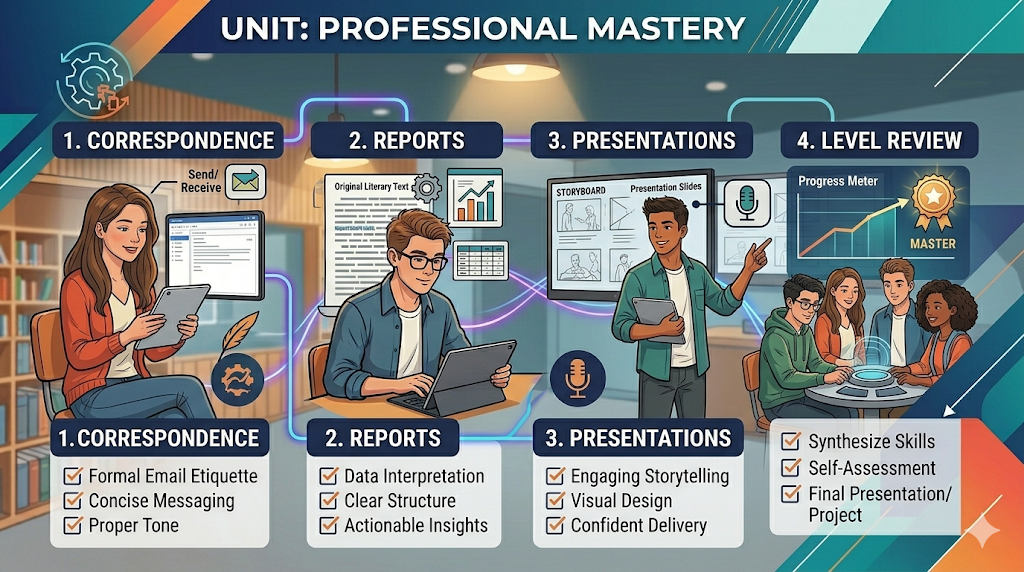
Mastering English at the C1 level is an essential skill in today’s globalized world. In professional environments, individuals are expected to communicate clearly, accurately, and persuasively through correspondence, reports, and presentations. Strong writing skills enable professionals to compose effective emails, formal letters, and business documents that convey ideas with precision and professionalism. The ability to write detailed reports allows them to analyze information, present evidence, and support recommendations in a logical manner. Additionally, confident presentation skills help individuals share ideas, influence audiences, and collaborate successfully in international settings. By developing advanced English proficiency, students prepare themselves to participate effectively in academic, professional, and global communities, where communication is often the key to success.
LEARNING ACTIVITIES
TOPICS
- Correspondence: Drafting formal email queries to sources, writing professional pitches to editors, and mastering the tone required for professional digital communication.
2. Reports: Compiling investigative data, writing structured news reports, synthesizing interviews, and differentiating objective reporting from op-eds.
3.Presentations: Delivering live pitch-meetings, defending an editorial stance, conducting mock press conferences, and effectively using spoken rhetoric to handle counter-arguments.
4. Level Review: A comprehensive review of advanced grammatical architecture necessary for this tier, specifically targeting complex discourse markers, hedging vocabulary, and Advanced Passive Structures used to shift narrative focus in media layout.
NEE – Agregar el tipo de adaptaciones curriculares
Principio II: Pautas 6.1 – 6.3 – 6.4
Principio III: Pautas 7.1 – 8.1 – 9.1
ALUMNO 1: Constante monitoreo. Dar tiempo adicional para el desarrollo de la actividad y se reduce el número de ejercicios o se modifican los ejercicios con un nivel de dificultad reducido, de acuerdo con sus necesidades académicas.
ALUMNO 2: Constante monitoreo, Dar tiempo adicional para el desarrollo de la actividad y se reduce el número de ejercicios o se modifican los ejercicios con un nivel de dificultad reducido, de acuerdo con sus necesidades académicas.
ALUMNO 3: Constante monitoreo. Corroborar que el contenido entregado en clase haya sido comprendido por la estudiante mediante retroalimentación.