
Correspondence
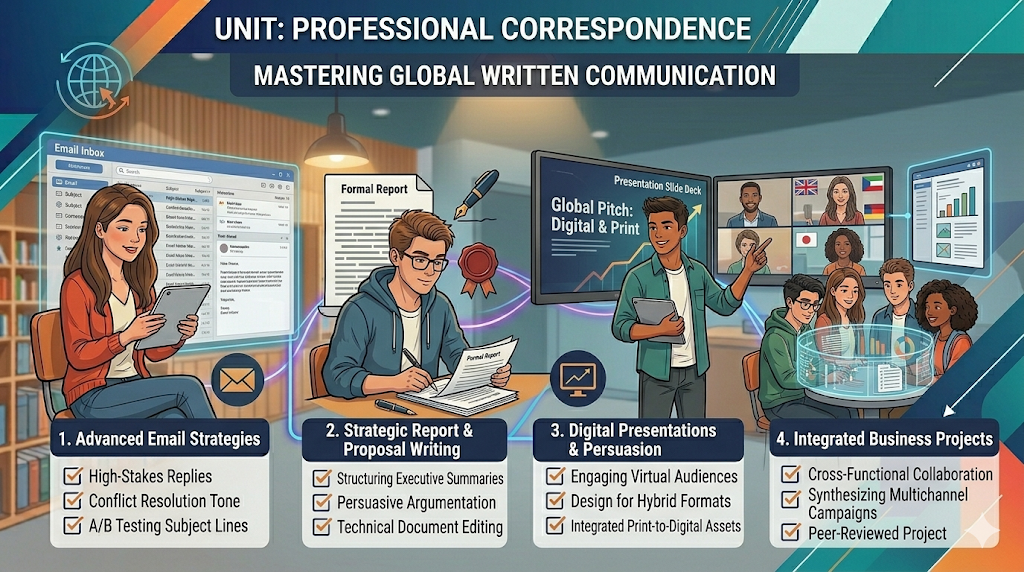
SKILLS
EFL 5.4.1 (Writing): Critically evaluate and utilize various digital forms of writing (emails, pitches, formal queries) to communicate effectively, maintaining appropriate style, professional tone, and organizational layout depending on the context and target reader.
EFL 5.3.6 (Reading): Analyze and interpret implicit meanings, stance, and level of formality in digital professional texts, identifying subtle shifts in register and language intention.
REAL-LIFE APPLICATION
In a globally connected digital environment, writing is often your first impression. Mastering professional correspondence changes how students are perceived by professionals, organizations, and academic institutions worldwide. Knowing how to change from colloquial text-speak to high-level professional English enables students to secure interviews with high-profile sources, pitch media layout concepts confidently, and resolve institutional disputes constructively. It turns writing into a tool for real-world influence.
LEARNING ACTIVITIES
SESSION 1 (80 min) ANTICIPATION
Part 1 ( 15- 20 min)
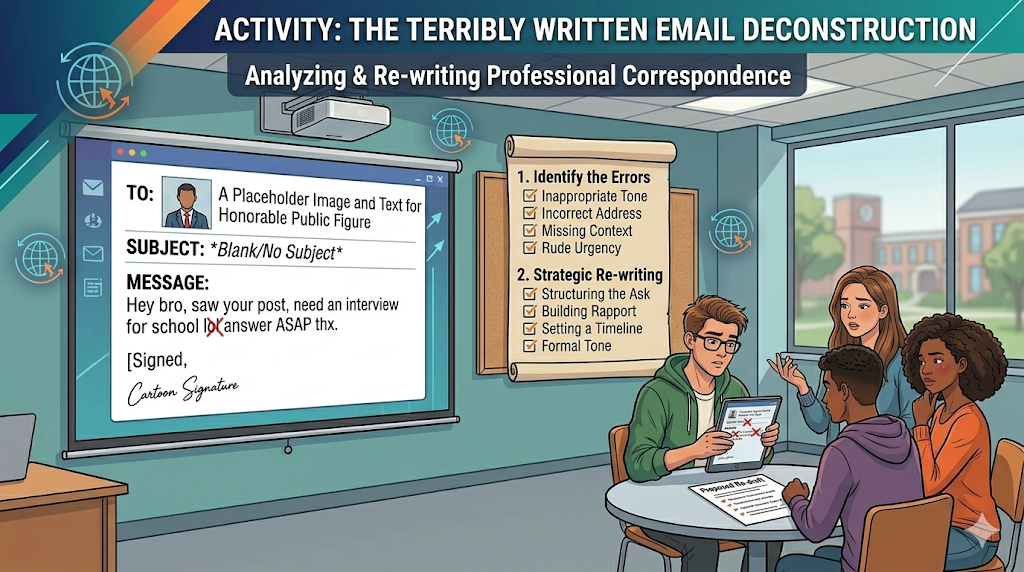
1. Anticipation Learning Activity (10-15 Minutes)
The “Fix the Fixer” Challenge:
- Activity: Project a terribly written email addressed to a prominent public figure on the board (e.g., “Hey bro, saw your post, need an interview for school lol answer ASAP thx”).
- Task: Students work in pairs for 5 minutes to list everything wrong with it (tone, spelling, mechanics).
- Theory Intro (5 mins): Introduce the concept of audience register and the structure of a standard professional digital pitch (Salutation —-> Context/Hook —-> Call to Action —-> Formal Sign-off).
CONSTRUCTION
Part 2: Vocabulary Development (15 min)
The teacher explicitly introduces key vocabulary needed for the lesson, ensuring students clearly understand meaning and use. The phrases include:
| Term / Phrase | Contextual Definition |
| 1. To lean on someone’s expertise | A sophisticated way to request information from a professional based on their skills. |
| 2. To follow up on [X] | A professional bridge statement used to continue a previous point or touch base. |
| 3. Mutual benefit / Mutually beneficial | An arrangement or pitch where both parties stand to gain equal value. |
| 4. High-profile source | A highly respected, specialized, or famous subject chosen for an interview. |
| 5. At your earliest convenience | A polite, C1-level substitute for writing “as soon as possible.” |
| 6. Pitch deck | A brief digital presentation or highly summarized message aimed at selling a concept or story. |
Part 3: Grammar Review using Presentation (20 min)
Grammar Introduction: Modal Verbs of Hedging & Conditional Softeners (20 Minutes)
- Objective: Move students away from demanding imperatives (“Give me your time”) toward diplomatic, cautious, and polite phrasing (“I would be deeply appreciative if…”).
- Direct Theory Instruction (10 mins):
- Show how conditional clauses soften messages to convey deep respect for a recipient’s schedule.
- Direct Command: “I want to ask you questions next Tuesday.”
- C1 Conditional Alternative: “I was wondering if you might have ten minutes to spare next Tuesday.”
- Formulating Formulaic Modals (10 mins): Review the formulaic structures used to construct professional alignment queries:{Polite Hook} = \text{Subject} + \text{would be highly grateful} + {if} + Subject} + {could} + (Infinitive Verb}
Part 4: Guided Practice (25 min)
Grammar Practice Activity (25 Minutes)
- The “Register Sliders” Matrix:
- Step 1 (10 mins): Provide students with a worksheet containing 5 blunt, direct demands typically found in basic communication.
- Step 2 (15 mins): Students rewrite these demands using the newly taught conditional expressions and softeners.
- Example Item: “Answer my questions by Friday.” ——> C1 Transformation: “If your schedule permits, I would be most grateful to receive your feedback by this coming Friday.”
SESSION 2: CONSTRUCTION – REINFORCEMENT (40 min)

Next-Day Reinforcement Activity: The Pitch War (40 Minutes)
- Creative Writing Challenge:
- Setup (5 mins): Assign students a choice of three hypothetical high-profile media clients (e.g., an investigative journalist, a technology CEO, or a sustainability director).
- Drafting Period (20 mins): Students draft a professional digital pitch attempting to convince this client to grant them an exclusive interview. They must integrate at least 4 vocabulary words and use conditional softeners.
- Peer-Review Evaluation (15 mins): Students swap devices or sheets and score their partner’s pitch using a quick checklist: Was it respectful? Was there a clear Call to Action? Was the tone consistently formal?
SESSION 3: CONSOLIDATION (80 min)
Part 1 – ( 2 x 40min)
Summative Assessment
Period 1: The Cold-Email Crisis Simulation (40 Minutes)
- Task: Students log into their digital learning platform. They receive a live “Crisis Briefing”: An investigative news reporting team needs an expert opinion on a breaking story regarding environmental policy, but the source is highly defensive and busy.
- Deliverable: Within the first period, students must individually write a formal query email requesting a 10-minute digital meeting. The email is evaluated on structure, formal registers, and accurate conditional grammar mechanics.
Period 2: Live Digital Edits & Defense (40 Minutes)
- Interactive Defense: The teacher selects elements of submitted pitches to display anonymously on the main board.
- On-the-Spot Adjustments: The class collaboratively adjusts sentences to maximize professional impact.
- Final Submission: Students make real-time modifications to their own files based on the review session and submit their finalized correspondence portfolio piece for grading.
NEE – Agregar el tipo de adaptaciones curriculares
Principio II: Pautas 6.1 – 6.3 – 6.4
Principio III: Pautas 7.1 – 8.1 – 9.1
ALUMNO 1: Constante monitoreo. Dar tiempo adicional para el desarrollo de la actividad y se reduce el número de ejercicios o se modifican los ejercicios con un nivel de dificultad reducido, de acuerdo con sus necesidades académicas.
ALUMNO 2: Constante monitoreo, Dar tiempo adicional para el desarrollo de la actividad y se reduce el número de ejercicios o se modifican los ejercicios con un nivel de dificultad reducido, de acuerdo con sus necesidades académicas.
ALUMNO 3: Constante monitoreo. Corroborar que el contenido entregado en clase haya sido comprendido por la estudiante mediante retroalimentación.