
REPORTS

SKILLS
EFL 5.3.4: Use new words and phrases which occur in an increased range of long and complex texts on both familiar and unfamiliar topics.
EFL 5.4.1: Critique and interpret a range of high-level texts by identifying bias, distinguishing fact from opinion, and evaluating reliability.
EFL 5.5.2: Write a variety of clear, well-structured texts (such as news reports and investigative summaries) using appropriate tone, cohesion, and registers.
REAL-LIFE APPLICATION
In a globally connected digital environment, writing is often your first impression. Mastering professional correspondence changes how students are perceived by professionals, organizations, and academic institutions worldwide. Knowing how to change from colloquial text-speak to high-level professional English enables students to secure interviews with high-profile sources, pitch media layout concepts confidently, and resolve institutional disputes constructively. It turns writing into a tool for real-world influence.
LEARNING ACTIVITIES
SESSION 1 (80 min) ANTICIPATION
Part 1 ( 15- 20 min)

Anticipation Learning Activity (10-15 Minutes)
Activity: “The Telephone vs. The Fact-Checker”
- Objective: Introduce the distortion of data and the need for objective reporting.
- Instructions:
- Display a highly sensationalized, biased headline on your digital board (e.g., “Local Park Ruined Forever by Greedy Soda Company!”).
- Give students 3 minutes in breakout rooms/groups to strip away the emotional language and list only the objective facts they can actually prove from that headline (Spoiler: almost none).
- Bring them back to co-create a definition of a “Report” versus an “Op-Ed.”
CONSTRUCTION
Part 2: Vocabulary Development (15 min)
The teacher explicitly introduces key vocabulary needed for the lesson, ensuring students clearly understand meaning and use. The phrases include:
Focus on high-level journalistic and analytical lexicon:
- To corroborate (v.): To confirm or give support to a statement or theory with evidence.
- Unbiased (adj.): Showing no prejudice for or against something; impartial.
- To synthesize (v.): To combine different pieces of information to form a connected whole.
- Editorializing (n.): The insertion of personal opinions into an objective news account.
- Primary source (n.): An immediate, first-hand account of a topic, from people who had a direct connection with it (e.g., interviews).
- Discrepancy (n.): A lack of compatibility or similarity between two or more facts.
Part 3: Grammar Review using Presentation (20 min)
Topic: Reported Speech with Advanced Reporting Verbs & Distancing Expressions
To write news reports, C1 students must move beyond “He said/She said” and use nuanced reporting verbs and passive structures for objectivity.
- The Structure:
- Subject + Advanced Reporting Verb + (that) clause ——> “Witnesses alleged that the suspect fled.”
- It + Passive Reporting Verb + that clause ———-> “It is widely rumored that the school board will resign.”
- Instructions:
- Present a slide contrasting: “The Mayor said the budget is gone” vs. “The Mayor acknowledged a deficit, while it is projected that budget cuts will follow.”
- Highlight how the second sentence sounds authoritative, distant, and professional. Briefly review backshifting rules (Present ——-> Past).
Part 4: Guided Practice (25 min)
Grammar Practice Activity (25 Minutes)
Activity: “The Press Room Rewrites”
- Objective: Practice advanced reporting verbs and objective distancing.
- Instructions:
- Provide a digital worksheet with 5 emotional, direct-speech quotes from an interview (e.g., “I swear I saw a UFO, it was huge and terrifying!” – Local Resident).
- Students work in pairs to rewrite these quotes into objective, formal sentences using verbs like claimed, disputed, maintained, or asserted (e.g., “A local resident asserted that they witnessed an unidentified flying object…”).
- Peer review: Pairs swap digital documents to check if any “emotional” words leaked through.
SESSION 2: CONSTRUCTION – REINFORCEMENT (40 min)
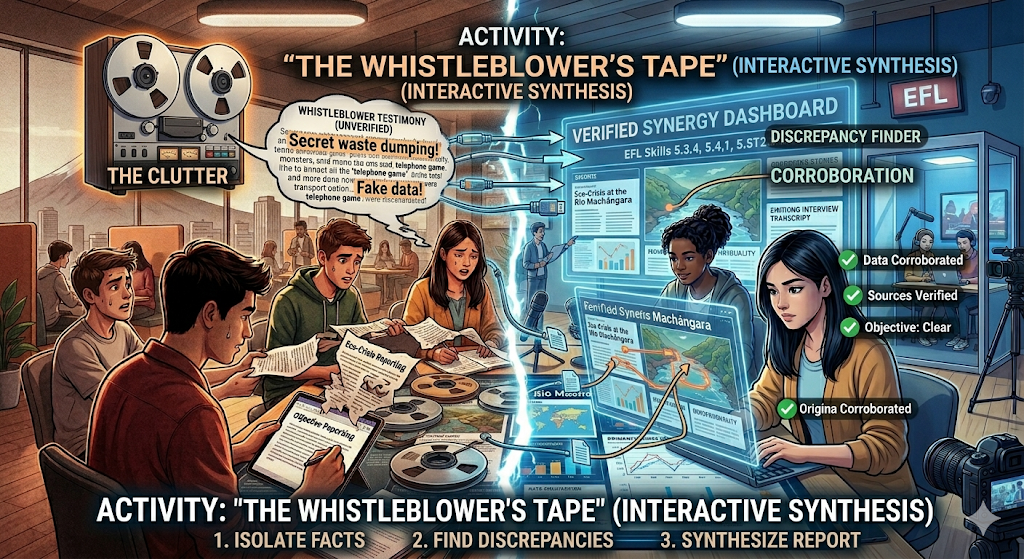
Activity: “The Whistleblower’s Tape” (Interactive Synthesis)
Objective: Synthesize raw interview data into a structured, objective summary.
Instructions:
- Setup (10 mins): Provide a short, chaotic 1-page transcript of two conflicting interviews regarding a fictional school event (e.g., the cancellation of the school prom due to a “missing” budget). One interview is an angry student; the other is a defensive principal.
- Analysis (15 mins): In groups of three, students use a shared digital graphic organizer to separate Fact from Opinion and find Discrepancies.
- Production (15 mins): Groups write a 100-word breaking “News Flash” summarizing the situation objectively, using at least 3 vocabulary words and 2 advanced reporting structures.
SESSION 3: CONSOLIDATION (80 min)
Part 1 – ( 2 x 40min)
Summative Assessment
Task: The Digital investigative Report Portfolio
- Format: Individual digital writing and synthesis task.
- The Scenario: Provide a digital dossier on a mock incident (e.g., a local eco-crisis like a sudden fish die-off in a nearby river). The dossier includes: a chart of water data, a fiery Op-Ed from an activist, and a formal statement from a local factory.
Period 1 (40 Mins): Data Compilation & Planning
- Students analyze the digital dossier.
- They fill out a synthesis matrix: cross-referencing the factory’s claims against the scientific data (corroborating or finding discrepancies).
- They outline a 3-paragraph news report (Lead paragraph, Body with synthesized interview data, Conclusion/Future outlook).
Period 2 (40 Mins): Drafting & Polishing
- Students write their formal 200–250 word News Report.
- Strict Criteria for Success:
- Zero personal pronouns or editorializing (total objectivity).
- Successful integration of both primary sources (interviews) via reported speech.
- Inclusion of at least 4 target vocabulary words.
- Submission is done digitally via your LMS for final grading against a C1 rubric (Focusing on Task Achievement, Coherence, Lexical Resource, and Grammatical Range).
| Criteria | Excellent (5 pts) | Good (4 pts) | Developing (3 pts) | Insufficient (1–2 pts) |
| Objectivity & Tone (EFL 5.4.1) | Completely objective and formal. Zero editorializing or personal pronouns. Distinctly separates fact from opinion. | Mostly objective. One or two instances of biased language or slip in formal register. | Noticeable personal bias or informal language. Struggles to maintain an journalistic tone. | Heavily biased or reads like an opinion piece/essay rather than a news report. |
| Data Synthesis & Structure (EFL 5.5.2) | Clear, logical structure (Lead, Body, Conclusion). Synthesizes data and interviews seamlessly into a cohesive narrative. | Proper structure followed. Includes most data, but the integration of interviews feels slightly disconnected. | Paragraph structure is weak. Mentions data and interviews but treats them as a list rather than synthesizing them. | Lacks a journalistic structure. Fails to incorporate or synthesize the provided dossier data. |
| Grammatical Accuracy (Reported Speech) | Masterful use of advanced reporting verbs (alleged, acknowledged) and passive distancing structures. No errors. | Good use of reporting verbs. Minor errors in backshifting or passive structures, but meaning is completely clear. | Attempts reporting verbs but frequently defaults to basic verbs (said, told). Several grammatical errors. | Serious grammatical errors that impede understanding. Fails to use reported speech structures. |
| Lexical Resource (Vocabulary) | Natural and accurate integration of 4+ target vocabulary words (e.g., corroborate, discrepancy). | Uses 3 target vocabulary words correctly. Meaning is clear, though word choice is occasionally forced. | Uses 1–2 target words, or uses them incorrectly. Vocabulary is repetitive or below C1 level. | Fails to use target vocabulary. Lexical range is severely limited or inappropriate for the task. |
NEE – Agregar el tipo de adaptaciones curriculares
Principio II: Pautas 6.1 – 6.3 – 6.4
Principio III: Pautas 7.1 – 8.1 – 9.1
ALUMNO 1: Constante monitoreo. Dar tiempo adicional para el desarrollo de la actividad y se reduce el número de ejercicios o se modifican los ejercicios con un nivel de dificultad reducido, de acuerdo con sus necesidades académicas.
ALUMNO 2: Constante monitoreo, Dar tiempo adicional para el desarrollo de la actividad y se reduce el número de ejercicios o se modifican los ejercicios con un nivel de dificultad reducido, de acuerdo con sus necesidades académicas.
ALUMNO 3: Constante monitoreo. Corroborar que el contenido entregado en clase haya sido comprendido por la estudiante mediante retroalimentación.