
Presentations
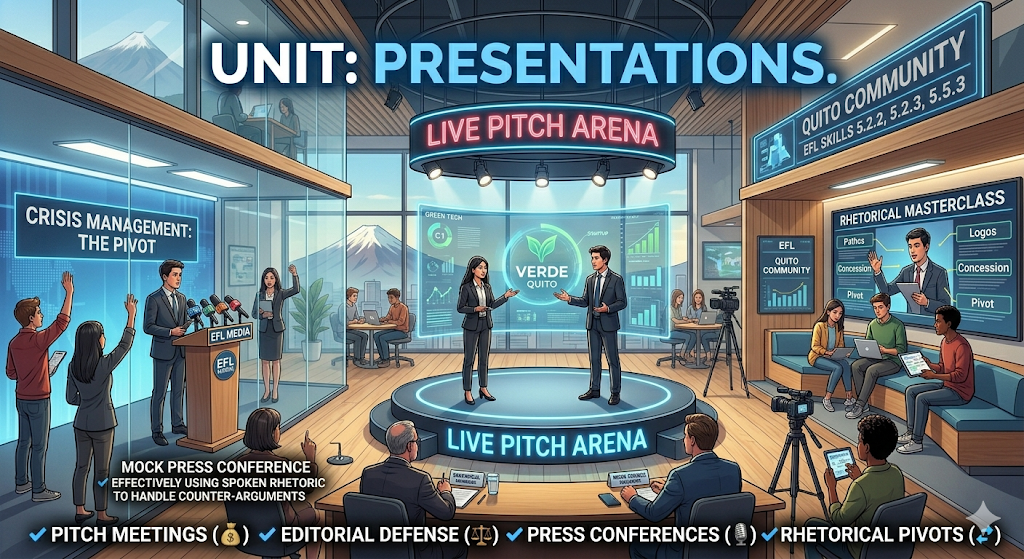
SKILLS
EFL 5.2.2: Adapt spoken language dynamically to a variety of formal and informal contexts, demonstrating command of complex rhetorical devices.
EFL 5.2.3: Respond to and defend a point of view in debates, interviews, and presentations on complex academic or global topics.
EFL 5.5.3: Produce clear, well-structured spoken presentations, using an appropriate range of advanced vocabulary and cohesive devices to highlight key points.
REAL-LIFE APPLICATION
Public speaking isn’t just about reading slides; it’s about shifting perspectives. Whether pitching a startup idea to investors, defending a company’s ethics at a press conference, or standing up for an editorial stance, mastering spoken rhetoric allows students to command a room, handle hostility with grace, and control the narrative in their future careers.
LEARNING ACTIVITIES
SESSION 1 (80 min) ANTICIPATION
Part 1 ( 15- 20 min)
Anticipation Learning Activity (10-15 Minutes)
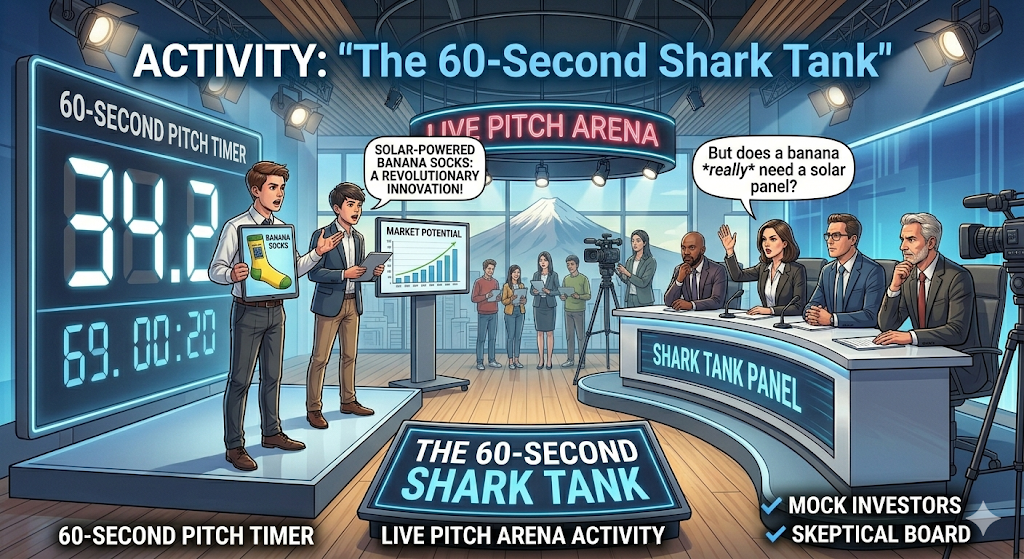
Activity: “The 60-Second Shark Tank”
- Objective: Introduce the power of persuasive hooks and handling immediate skepticism.
- Instructions:
- Display an absurd or useless invention on the screen (e.g., “Solar-powered flashlights” or “Socks for bananas”).
- Give students 3 minutes in pairs to prepare a live 60-second “pitch” to convince the class to buy it, focusing purely on emotional appeal (pathos) or logic (logos).
- Call on two pairs to present. Immediately throw a tough counter-argument at them (e.g., “Why would I buy a flashlight that only works in the sun?”).
- Use their natural reactions to define Rhetoric and Defensive Stance.
CONSTRUCTION
Part 2: Vocabulary Development (15 min)
The teacher explicitly introduces key vocabulary needed for the lesson, ensuring students clearly understand meaning and use. The phrases include:
Focus on high-level journalistic and analytical lexicon:
- To Pivot (v.): A strategy used in public speaking to shift a question from a dangerous or negative topic to a safer, more positive one.
- Concession (n.): A rhetorical device where one acknowledges the validity of an opponent’s point before counter-arguing.
- To Substantiate (v.): To provide evidence to support or prove the truth of an editorial stance or claim.
- Rhetorical Deflection (n.): The act of redirecting an aggressive question or criticism away from oneself or one’s organization.
- Rebuttal (n.): A contradiction or counter-argument designed to falsify or dismantle an opposing viewpoint.
- Persuasive Hook (n.): An opening statement (statistic, anecdote, or paradox) designed to capture an audience’s undivided attention instantly.
Part 3: Grammar Review using Presentation (20 min)
Topic: Reported Speech with Advanced Reporting Verbs & Distancing Expressions
Topic: Concessive Clauses & Conditional Structures for Counter-Arguments
To handle counter-arguments smoothly at a C1 level, students need diplomatic language to acknowledge an opposing view before shutting it down.
- The Structure:
- Subordinating Concessions: Although / Even though / While + Clause 1, Main Clause (Counter-argument).
- Adversative Concessions: Granted, [Opposing view], however / nevertheless + [Your point].
- Hypothetical Conditionals for Defense: If we were to [do what you suggest], the outcome would be [negative consequence].
- Instructions:
- Contrast a weak defense with a C1 rhetorical defense:
- Weak: “You say our product is expensive, but it’s really good.”
- C1 Rhetoric: “While I acknowledge the initial costs are high, nevertheless, the long-term return on investment is unmatched.”
- Model how While, Granted, and Nevertheless act as linguistic shields during a live meeting.
- Contrast a weak defense with a C1 rhetorical defense:
Part 4: Guided Practice (25 min)
Grammar Practice Activity (25 Mins)
Activity: “The Diplomatic Heckler”
- Objective: Practice concessive clauses and rhetorical pivots dynamically.
- Instructions:
- Divide students into pairs: The Speaker and The Heckler.
- Provide a list of controversial editorial stances (e.g., “Artificial Intelligence should replace all school textbooks.”).
- The Heckler fires a blunt objection (e.g., “But AI makes students lazy!”).
- The Speaker has 30 seconds to formulate a response starting strictly with a concessive frame (“Granted… however…” or “While it may seem that… nevertheless…”) to pivot the argument.
- Swap roles after 3 rounds.
SESSION 2: CONSTRUCTION – REINFORCEMENT (40 min)

Next-Day Reinforcement Activity (40 Mins)
Activity: “The Hot Seat” (Mock Press Conference)
- Objective: Conduct a live, high-stakes press conference utilizing spoken rhetoric and handling counter-arguments.
- Instructions:
- Setup (10 mins): Split the class into groups of 4. Two students are the PR Spokespersons for a tech company whose new app just crashed globally. The other two are Aggressive Journalists.
- Preparation (15 mins):
- The Spokespersons prep their opening statement using a Persuasive Hook and brainstorm defensive Pivots.
- The Journalists write down 3 biting, difficult questions to dismantle the company’s stance.
- The Simulation (15 mins): Run a live 5-minute mock press conference per group. Journalists fire questions; Spokespersons must use at least 2 concessive structures and 2 target vocabulary words to maintain control.
SESSION 3: CONSOLIDATION (80 min)
Part 1 – ( 2 x 40min)
Summative Assessment
Task: The Live Pitch & Editorial Defense Panel
- Format: Small group (3 students) live oral assessment.
- The Scenario: Groups act as editorial boards or startup innovators pitching a high-stakes proposal (e.g., Pitching a green energy initiative to a skeptical city council or Defending a controversial editorial stance on data privacy to a board of directors).
Period 1 (40 Mins): The Pitch Delivery
- Groups deliver a live 4-minute pitch/presentation to the class.
- The presentation must feature a clear rhetorical structure: an engaging hook, a substantiated editorial stance, and a concluding call to action.
- All students must speak equally, demonstrating C1 register and fluency.
Period 2 (40 Mins): The Cross-Examination (Q&A Defense)
- Immediately following their pitch, the group faces a 4-minute live Q&A panel driven by the teacher and peers (acting as the council/board).
- Strict Criteria for Success:
- Students cannot look at notes during the Q&A.
- They must successfully employ pivoting and concessive grammar to handle at least two hostile counter-arguments.
- The defense must remain entirely professional, calm, and rhetorically accurate.
NEE – Agregar el tipo de adaptaciones curriculares
Principio II: Pautas 6.1 – 6.3 – 6.4
Principio III: Pautas 7.1 – 8.1 – 9.1
ALUMNO 1: Constante monitoreo. Dar tiempo adicional para el desarrollo de la actividad y se reduce el número de ejercicios o se modifican los ejercicios con un nivel de dificultad reducido, de acuerdo con sus necesidades académicas.
ALUMNO 2: Constante monitoreo, Dar tiempo adicional para el desarrollo de la actividad y se reduce el número de ejercicios o se modifican los ejercicios con un nivel de dificultad reducido, de acuerdo con sus necesidades académicas.
ALUMNO 3: Constante monitoreo. Corroborar que el contenido entregado en clase haya sido comprendido por la estudiante mediante retroalimentación.