
Personal identity
SKILLS
Communication & Cultural Awareness (EFL 4.1.1): Compare and contrast aspects of self and family.
Oral Communication (EFL 4.2.2): Use simple phrases and sentences to describe family members and their relationships.
Reading (EFL 4.3.4): Understand the main points in short, simple texts on familiar topics
REAL-LIFE APPLICATION
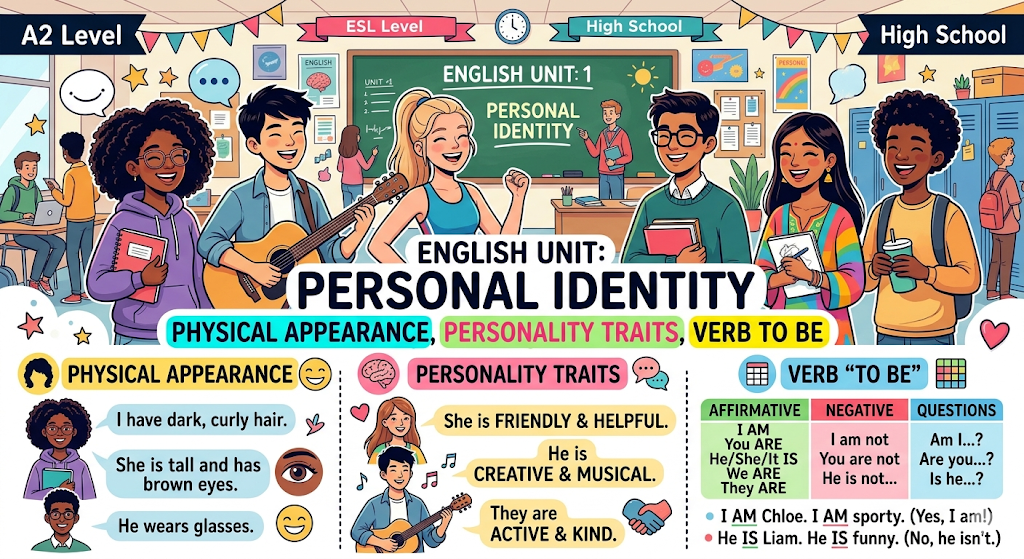
The integration of family, physical appearance, and personality traits using the verb to be is fundamental because it provides students with the linguistic tools to define their world. By mastering the verb to be as a “linking” tool, students transition from identifying objects to describing human complexity—moving beyond “This is my mother” to “My mother is tall and she is very patient.” This unit is vital as it bridges the gap between basic vocabulary and functional communication; it allows learners to express their unique identity and recognize the diversity in others, fostering empathy and social-emotional growth through English.
LEARNING ACTIVITIES
TOPICS
- Family
- Physical Appearance
- Personality Traits
- Verb to be
- K-Learning Project
NEE – Agregar el tipo de adaptaciones curriculares
Principio II: Pautas 6.1 – 6.3 – 6.4
Principio III: Pautas 7.1 – 8.1 – 9.1
ALUMNO 1: Constante monitoreo. Dar tiempo adicional para el desarrollo de la actividad y se reduce el número de ejercicios o se modifican los ejercicios con un nivel de dificultad reducido, de acuerdo con sus necesidades académicas.
ALUMNO 2: Constante monitoreo, Dar tiempo adicional para el desarrollo de la actividad y se reduce el número de ejercicios o se modifican los ejercicios con un nivel de dificultad reducido, de acuerdo con sus necesidades académicas.
ALUMNO 3: Constante monitoreo. Corroborar que el contenido entregado en clase haya sido comprendido por la estudiante mediante retroalimentación.