
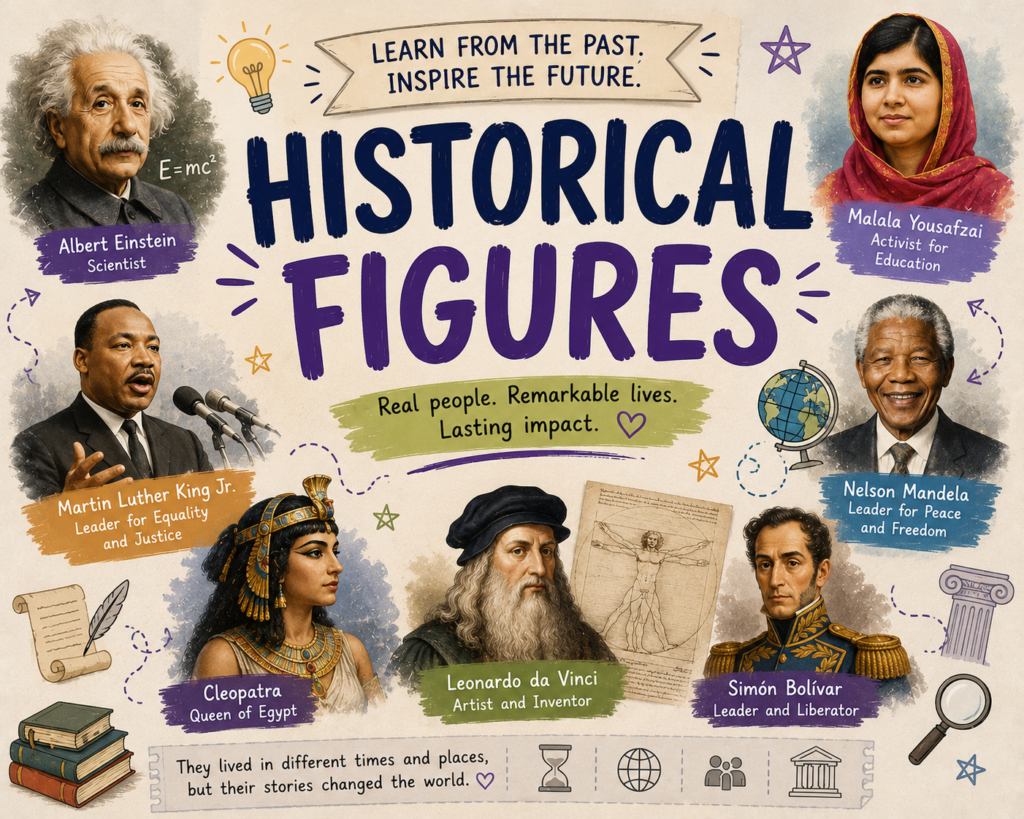
Historical Figures
SKILLS
EFL 4.2.1: Understand main ideas and some details in short simple texts.
EFL 4.2.1: Understand main ideas and some details in short simple texts.
EFL 4.3.1: Write simple sentences to describe people and past events.
EFL 4.5.2: Use creative thinking skills to learn and communicate in English.
REAL-LIFE APPLICATION
Understanding historical figures bridges the gap between the past and present. By analyzing how leaders, scientists, or artists changed their world, students develop critical thinking and learn to articulate their own values, preparing them to participate in global conversations about leadership, innovation, and social change.
LEARNING ACTIVITIES
SESSION 1 (80 min) ANTICIPATION
Part 1 – ( 10-15 minutes)
Anticipation Activity (10–15 minutes)
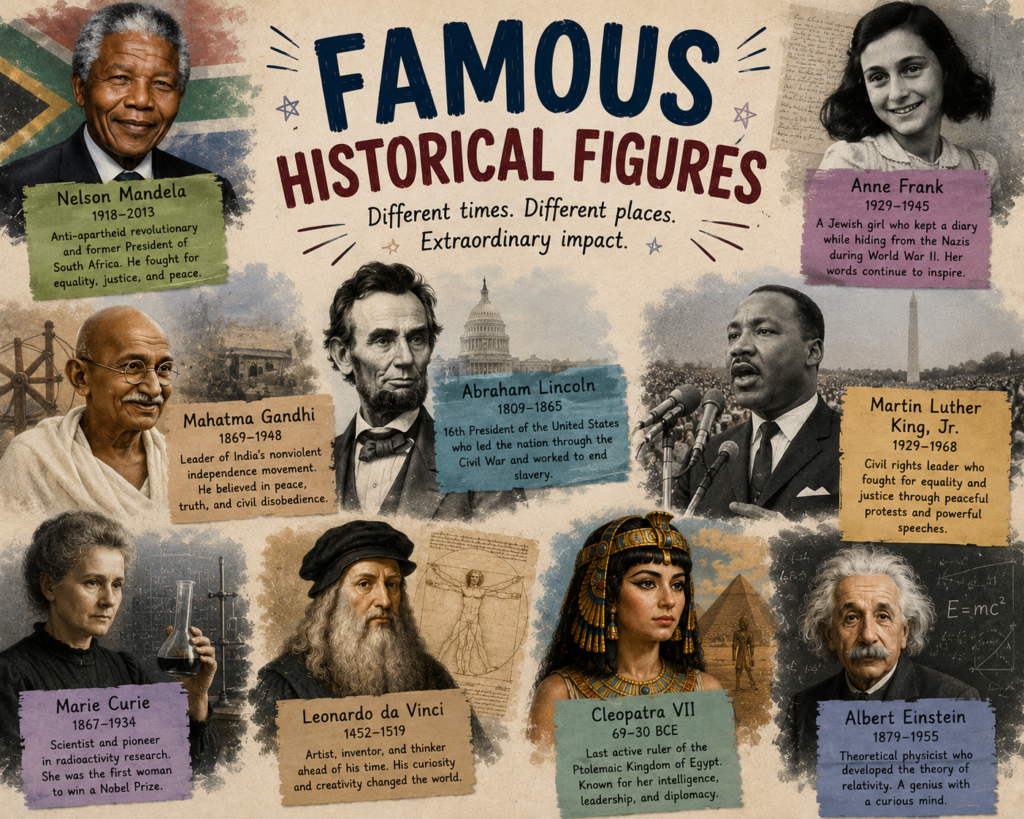
Anticipation (15 mins): “Who Am I?”
- Preparation: Stick a post-it note with the name of a famous historical figure on each student’s back (e.g., Manuela Sáenz, Albert Einstein, Cleopatra).
- Interaction: Students mingle and ask “Yes/No” questions to their classmates to guess their identity (e.g., “Was I a scientist?”, “Did I live in Ecuador?”).
- Discussion: Once everyone guesses, briefly discuss: Why do we remember these people today?
CONSTRUCTION
Part 2: Vocabulary Development (15 min)
The teacher explicitly introduces key vocabulary needed for the lesson, ensuring students clearly understand meaning and use. The words include:
| Vocabulary Word | Part of Speech | Definition |
| Historical figure | Noun | A famous person who lived in the past. |
| To achieve | Verb | To reach a goal or finish something important. |
| To influence | Verb | To have an effect on how someone thinks or acts. |
| Contribution | Noun | Something you give or do to help a project or cause. |
| Legacy | Noun | Something that continues to exist from the past. |
| Courageous | Adjective | Being very brave and not afraid. |
Part 3: Grammar Introduction: Simple Past Tense (20 mins)
Presentation Link: https://canva.link/26yvk302ouf60qi
Grammar: Past Simple “Be” & Regular Verbs (20 mins)
- Focus: Introduce was/were and -ed endings.
- Theory: Use a simple T-chart on the board.
- Affirmative: “She was a leader.” / “He helped people.”
- Negative: “They were not (weren’t) afraid.” / “He did not (didn’t) stop.”
4. Grammar Practice Activity (25 Minutes)
Activity:
Grammar Practice (25 mins): “Fact Files”
- Activity: Provide a worksheet with 5 short, unfinished sentences about historical figures using prompts.
- Task: Students must fill in the blanks using either the past tense of “to be” or a regular past tense verb.
- Example: “Marie Curie __________ (be) a scientist. She __________ (study) radioactivity.”
Worksheet Link: https://docs.google.com/document/d/1mdJ9Yzam8czF1danvOxriqzUYAouIFgt8Bf4oxmHZ_g/edit?usp=sharing
SESSION 2: CONSTRUCTION – REINFORCEMENT (40 min)
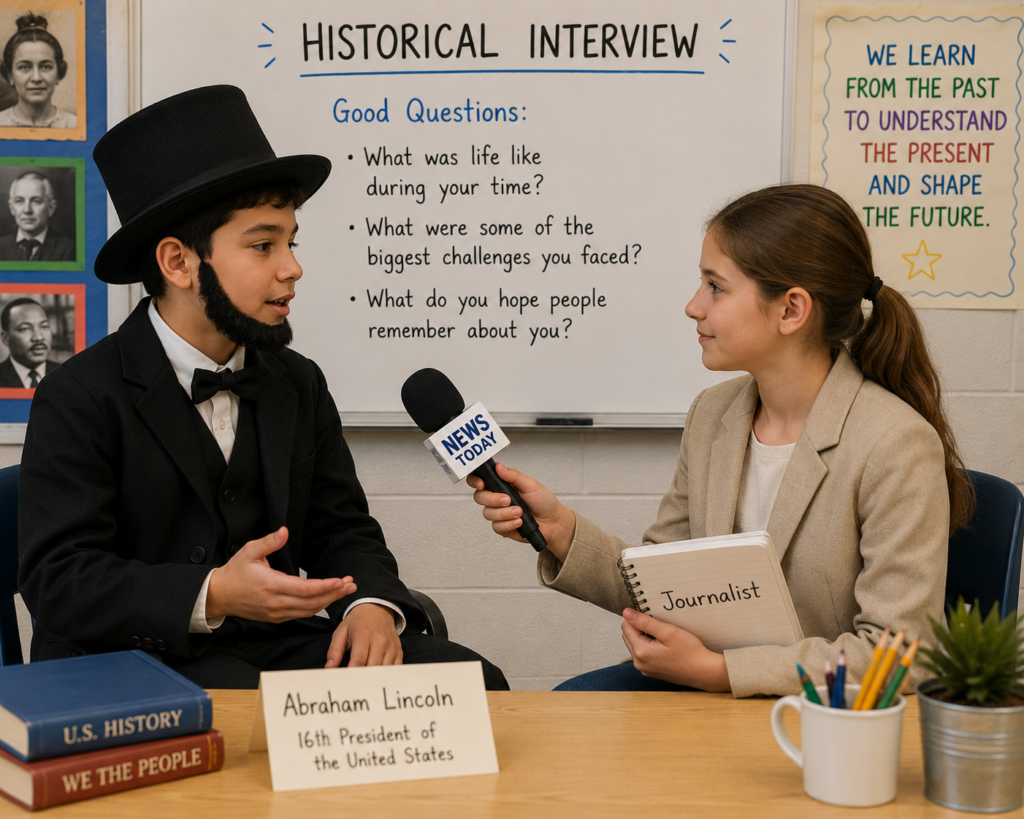
“Time Traveler’s Interview”
- Task: In pairs, one student acts as the historical figure, and the other is a journalist.
- Action: Students write 5 interview questions and answers (e.g., “What was your biggest challenge?”).
- Creative Element! Students present their “interview” to the class, wearing a simple prop or accessory to represent their character.
SESSION 3: CONSOLIDATION (80 min)
Part 1 – ( 2 x 40min)
Assessment Activity
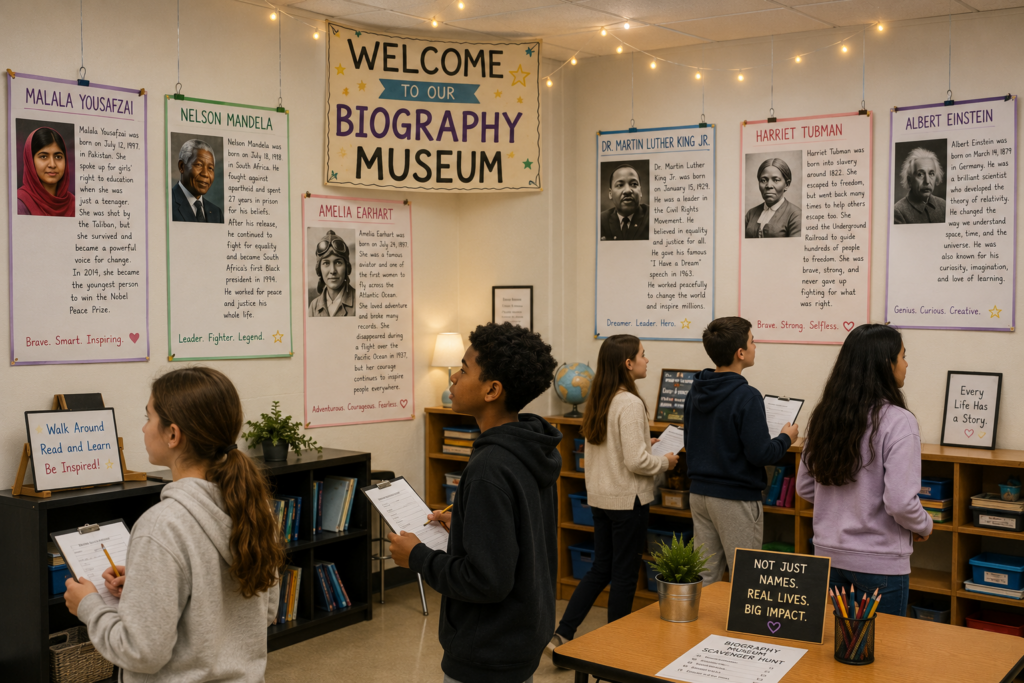
Period 1 (Writing): Students choose one historical figure and write a short biography (60–80 words). They must include at least 4 past tense verbs and 2 vocabulary words from the unit.
Period 2 (Speaking/Presentation): “Museum of History.” Students display their biographies on their desks. The class acts as visitors at a museum, rotating through the desks to read the bios and ask the “historical figures” one question. The teacher uses a rubric to assess grammar usage and pronunciation.
NEE – Agregar el tipo de adaptaciones curriculares
Principio II: Pautas 6.1 – 6.3 – 6.4
Principio III: Pautas 7.1 – 8.1 – 9.1
ALUMNO 1: Constante monitoreo. Dar tiempo adicional para el desarrollo de la actividad y se reduce el número de ejercicios o se modifican los ejercicios con un nivel de dificultad reducido, de acuerdo con sus necesidades académicas.
ALUMNO 2: Constante monitoreo, Dar tiempo adicional para el desarrollo de la actividad y se reduce el número de ejercicios o se modifican los ejercicios con un nivel de dificultad reducido, de acuerdo con sus necesidades académicas.
ALUMNO 3: Constante monitoreo. Corroborar que el contenido entregado en clase haya sido comprendido por la estudiante mediante retroalimentación.