
Routines and food
SKILLS
(EFL 4.1.2) Understand that some cultural artifacts (objects) are common across different countries.
(EFL 4.2.1)Use everyday objects to describe personal possessions in simple conversations.
REAL-LIFE APPLICATION
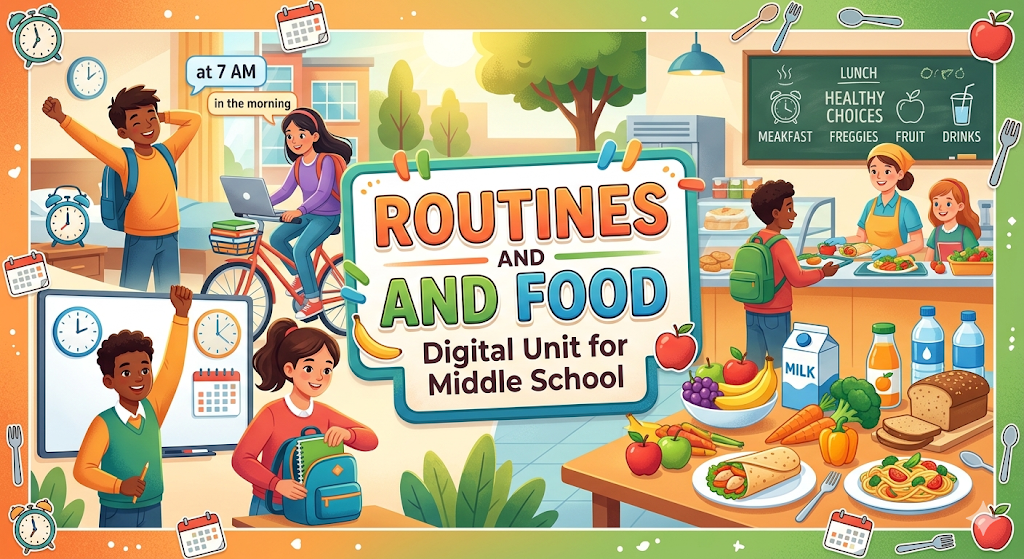
This unit bridges the digital classroom with the real world by giving students the language tools to talk about their actual lives. Instead of memorizing static word lists, middle schoolers learn to schedule their days, express time, and discuss food choices with friends. The final project transforms them from passive learners into content creators who can confidently share their personal cultures, healthy habits, and daily lives with a global audience.
LEARNING ACTIVITIES
TOPICS
- Daily routines,
- Time expressions
- Food and drinks
- K-Learning Project
NEE – Agregar el tipo de adaptaciones curriculares
Principio II: Pautas 6.1 – 6.3 – 6.4
Principio III: Pautas 7.1 – 8.1 – 9.1
ALUMNO 1: Constante monitoreo. Dar tiempo adicional para el desarrollo de la actividad y se reduce el número de ejercicios o se modifican los ejercicios con un nivel de dificultad reducido, de acuerdo con sus necesidades académicas.
ALUMNO 2: Constante monitoreo, Dar tiempo adicional para el desarrollo de la actividad y se reduce el número de ejercicios o se modifican los ejercicios con un nivel de dificultad reducido, de acuerdo con sus necesidades académicas.
ALUMNO 3: Constante monitoreo. Corroborar que el contenido entregado en clase haya sido comprendido por la estudiante mediante retroalimentación.