
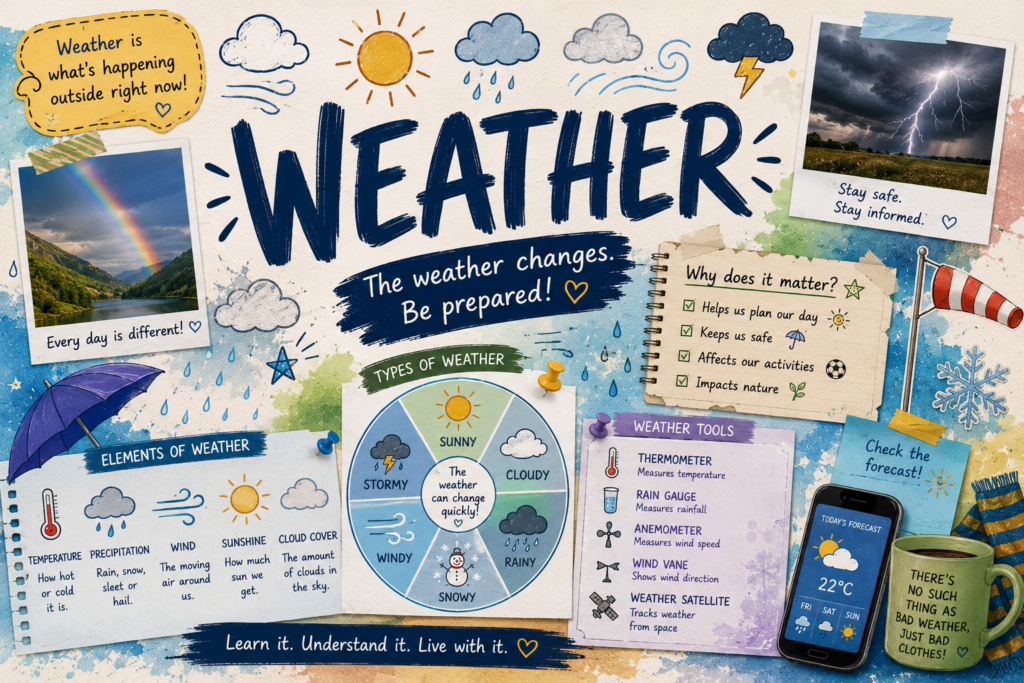
Weather
SKILLS
EFL 4.1.2: Understand main ideas and details in short texts.
EFL 4.2.14: Use strategies to maintain conversational exchanges.
EFL 4.3.1: Engage in meaningful conversations about familiar topics.
EFL 4.4.1: Write short, simple, and coherent texts.
REAL-LIFE APPLICATION
Weather impacts every daily decision, from what we wear to what activities we plan. By mastering weather-related English, students can interpret international forecasts, plan travel itineraries accurately, and engage in “small talk”—a vital social skill for building rapport with English speakers globally. This unit connects local climate awareness with a broader understanding of how weather shapes our daily routine.
LEARNING ACTIVITIES
SESSION 1 (80 min) ANTICIPATION
Part 1 – ( 10-15 minutes)
Anticipation Activity
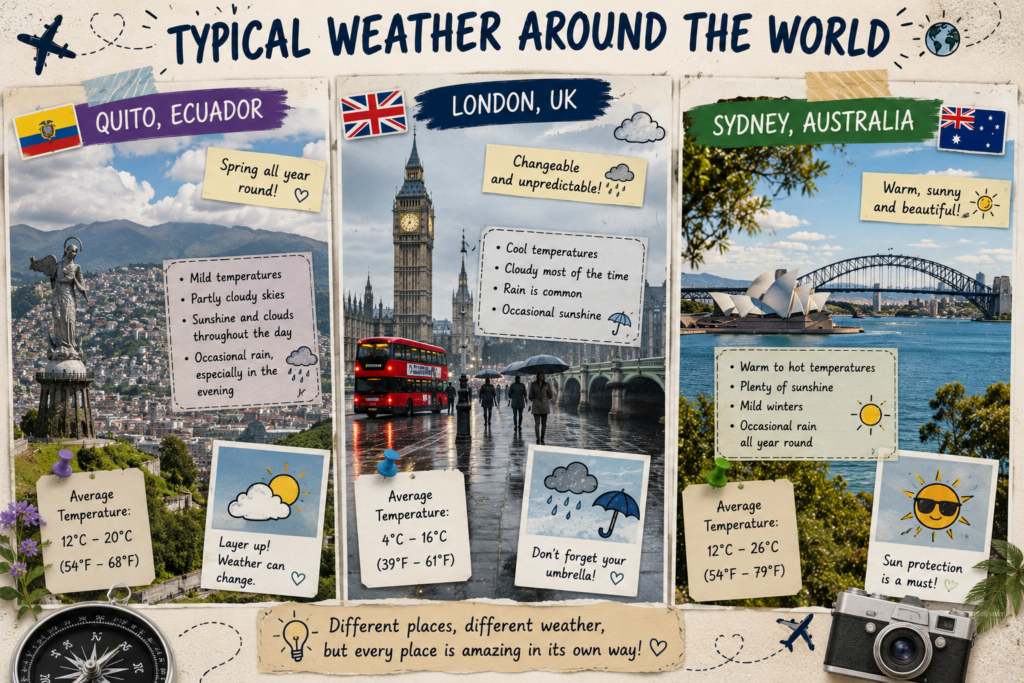
“The Global Weather Reporter”: Use a platform like Liveuamap or BBC Weather to show the current weather in three distinct locations: Quito (Ecuador), London (UK), and Sydney (Australia).
Instruction: Ask students to guess the weather in each city based on a photo of a person’s outfit.
Discussion: “If you were in London today, what would you need to pack?” This hooks them into the concept of clothes + weather.
CONSTRUCTION
Part 2: Vocabulary Development (15 min)
The teacher explicitly introduces key vocabulary needed for the lesson, ensuring students clearly understand meaning and use. The words include:
| Vocabulary | Definition | Example |
| Forecast | A prediction of future weather. | The forecast says it will rain today. |
| Conditions | The state of the atmosphere. | Today’s weather conditions are perfect for hiking. |
| Chilly | A bit cold. | It’s a bit chilly; bring a light jacket. |
| Heatwave | A period of very hot weather. | During the heatwave, stay inside with water. |
| Humid | Air with a lot of moisture. | It feels very humid before a storm. |
| Severe | Very intense or extreme. | Severe storms can cause big problems. |
Part 3: Grammar Introduction: Will VS Going To (20 mins)
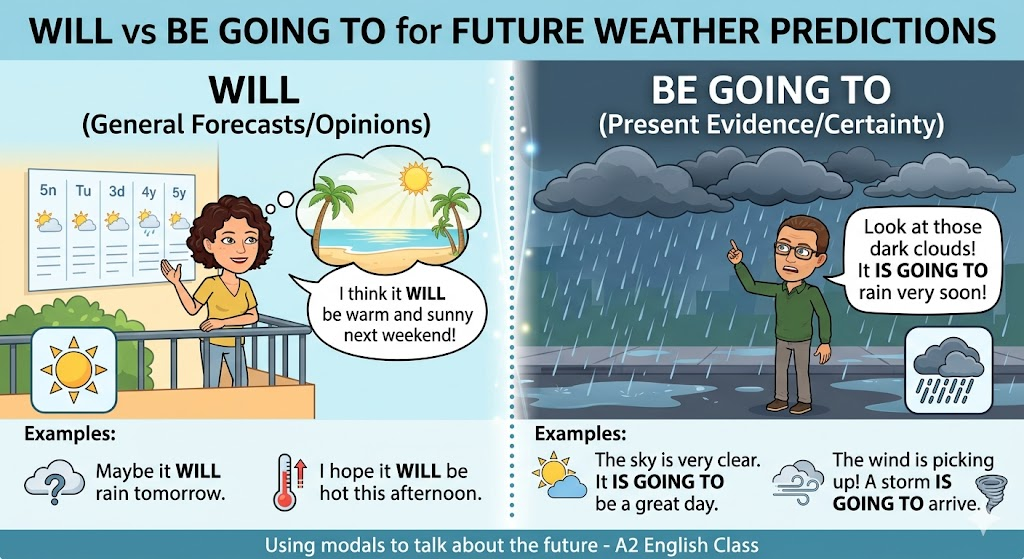
Focus: Will vs. Going to for Weather
- Will (Predictions): Use for general weather forecasts based on opinion/guess. “I think it will be sunny tomorrow.”
- Be Going To (Evidence): Use when you see clouds or signs of a change. “Look at those dark clouds! It is going to rain.”
- Teaching Tip: Use a “Grammar Detective” approach—show a weather map and ask students to point at specific icons to trigger the “Going to” structure.
4. Grammar Practice Activity (25 Minutes)
Activity:
“Weather Forecaster Duo”:
- Instruction: Divide students into pairs. One is the “Reporter,” the other is the “Viewer.”
- Task: The Reporter draws a quick map with symbols (sun, rain, snow). They present a 1-minute forecast: “In Quito, it is going to be cloudy. I think it will be cold in the afternoon.” The Viewer must respond with advice: “Then I should take my sweater!”
SESSION 2: CONSTRUCTION – REINFORCEMENT (40 min)
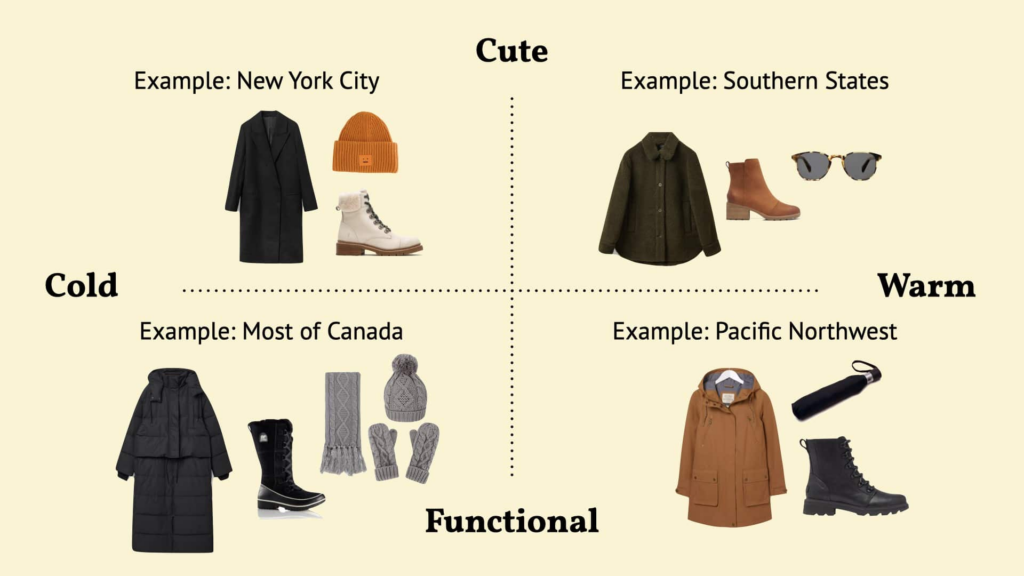
“Packing for the Trip”:
- Activity: Create a digital “Suitcase Designer” task.
- Instructions:
- Students pick a city for a “dream vacation.”
- They search the 5-day weather forecast for that city.
- They must create a digital collage or slide showing 5 items they will pack and explain why.
- Example: “I am going to Canada. The forecast says it will be snowy. I am going to pack my heavy coat and gloves.”
The next day they will ACTUALLY bring a bag or backpack and present it to the class as a warm up.
SESSION 3: CONSOLIDATION (80 min)
Part 1 – ( 2 x 40min)
Assessment Activity
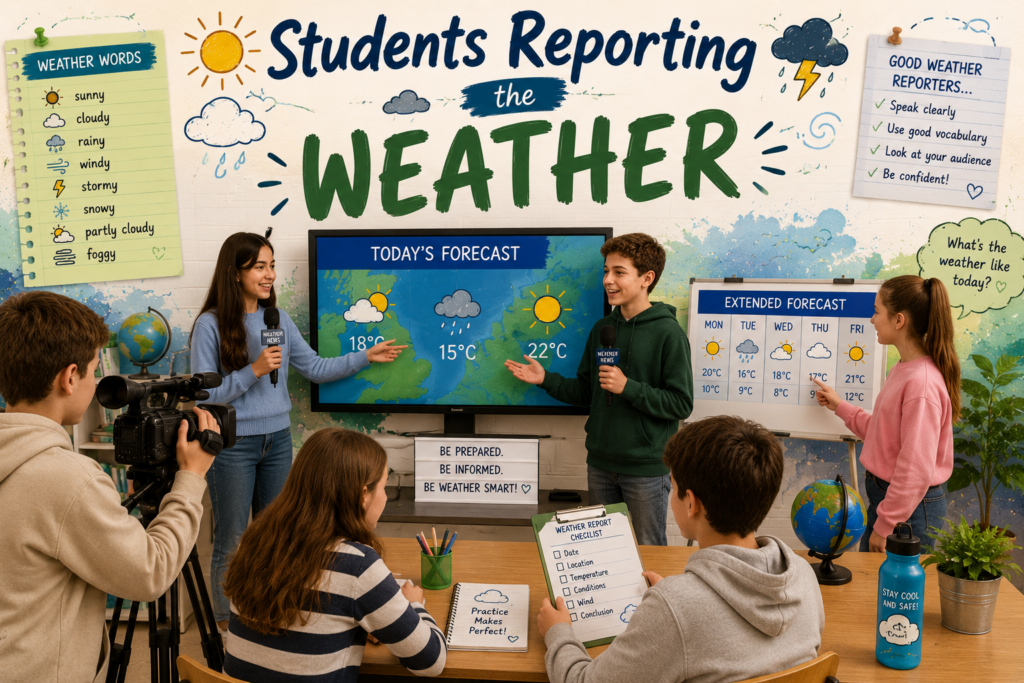
Period 1 (Written Assessment): “The Travel Brochure.” Students write a paragraph describing the weather in a chosen city during a specific month. They must use at least 4 vocabulary words and both will and going to correctly.
Period 2 (Performance Assessment): “The Live News Broadcast.” In groups of three, students record a 2-minute video presentation. One acts as the anchor, one as the reporter, and one as the “viewer” calling in with questions about the weather. They are graded on fluency, use of grammar, and accurate vocabulary application.
NEE – Agregar el tipo de adaptaciones curriculares
Principio II: Pautas 6.1 – 6.3 – 6.4
Principio III: Pautas 7.1 – 8.1 – 9.1
ALUMNO 1: Constante monitoreo. Dar tiempo adicional para el desarrollo de la actividad y se reduce el número de ejercicios o se modifican los ejercicios con un nivel de dificultad reducido, de acuerdo con sus necesidades académicas.
ALUMNO 2: Constante monitoreo, Dar tiempo adicional para el desarrollo de la actividad y se reduce el número de ejercicios o se modifican los ejercicios con un nivel de dificultad reducido, de acuerdo con sus necesidades académicas.
ALUMNO 3: Constante monitoreo. Corroborar que el contenido entregado en clase haya sido comprendido por la estudiante mediante retroalimentación.